Just like India’s GDP data is released by the government each quarter, similarly India’s biggest and most publicly traded companies also share their financial statements once every three months. The results season, as it is often referred to, comes soon after the end of June, September, December and March quarters. Just like GDP data tells about the state of India’s macroeconomy, quarterly results show how corporate India is doing.
The latest round of quarterly results throws up a similar trend as the one in the first two quarters: Stagnating sales but rising profits for corporate India.
As such, these results yet again raise the question: If companies are not able to substantially increase sales, would they invest in fresh capacities, regardless of their profits?
This is a key question because the government has been waiting for a long time for the private sector to raise investments in the economy. The broad sense emerging from the recently presented interim Budget was that the government believes it has done enough to provide momentum to the economy and the private sector can take over from here on. But will this happen if the bulk of the listed companies — especially the non-financial ones — struggle to register better sales?
What are the key variables?
The two most important variables are total income growth (the top-line) and net profits (the bottom-line) growth. The biggest contributor to total income is the total sales by a company. Of course, the total sales depends on both the quantity of goods being sold as well as the prices at which they are being sold.
At the start of the earnings season, investors and analysts have some expectations from all companies. Not surprisingly, the stock markets take their cue from these numbers and often react sharply to quarterly filings. The steep decline in the stock price of HDFC Bank is a recent case in point. If a company in which people are heavily invested shows rising profits, its stock price goes up because the demand for its stocks goes up in line with its profits.
Story continues below this ad
Of course, there are other variables as well — such as the earnings guidance (or what a company’s management expects from the future) — but sales and profits in the quarter that just ended are the key.
How many companies have declared results?
As many as 1,165 companies that are listed in the stock market have declared their quarterly financial statements for the quarter ending in December 2023.
To be sure, there are another around 3,500 listed companies that are yet to declare results but historically they account for a very small portion of the overall corporate profits. For instance, according to CMIE’s Economic Outlook data, all listed companies had delivered a profit after tax (or PAT) of Rs 2.35 trillion in the December 2022 quarter. Of this, Rs 1.7 trillion was generated by the 1,165 companies that have presented their December 2023 results and the remaining (about 3,500) companies generated the remaining Rs 0.6 trillion.
What have the results shown?
Story continues below this ad
According to a recent analysis done by CMIE, there are three key takeaways:
- Stagnating sales and,
- Rising profits, and
- A sharp divergence between the sales performance of the financial and non-financial companies.
“Corporate India seems to face a challenge in expanding its business. Elevated margins, however, ensure robust profit growth,” states Mahesh Vyas, CEO of CMIE, in a recent research note.
The CHART alongside shows that when compared to the same quarter a year ago — October to December 2023 vs October to December 2022 — the total income grew by less than 8% while profits after tax (PAT) grew by almost 26%. The PAT is the amount of profit that is left with a company after it has paid off all its liabilities, expenses and taxes.
 The CHART alongside shows that when compared to the same quarter a year ago — October to December 2023 vs October to December 2022 — the total income grew by less than 8% while profits after tax (PAT) grew by almost 26%.
Over the past three quarters — that is, quarters ending in June, September and December — the total income growth has inched from 4.9 per cent to 5.3 per cent to 7.7 per cent.
Story continues below this ad
“Notwithstanding the small improvements, these growth rates are evidently low and they are rising very slowly,” states CMIE’s Vyas.
However, in sharp contrast to the muted sales by listed companies, their net profits (or PAT) have risen sharply over the same quarter last year. The total PAT in the quarter ended December 2023 of the 1,165 companies that have published their financials adds up to Rs 2.28 trillion — that is roughly the same as the total PAT of all the listed companies (1,165 plus another 3,500) in the December 2022 quarter (Rs 2.35 trillion).
Lastly, the financial results also show that there is a big difference between the top-line growth of finance companies and non-finance companies.
“Total income of finance companies (income from operations and other income) has been growing at a much faster rate than that of the non-finance companies (net sales and other income),” finds the CMIE analysis.
Story continues below this ad
Indeed, data shows that non-finance companies have been struggling to raise their revenues. “Total income contracted by 1 to 2 per cent during the June and September 2023 quarter. In the December quarter there seems to be a measly improvement as the top-line expanded by 3 per cent,” states CMIE’s Vyas.
One key reason pulling down the revenue growth of non-financial companies is the deflation in commodity prices. Deflation is the exact opposite of inflation and refers to a trend where prices fall relative to where they were a year ago.
However, even if one removes the effect of deflation on prices, the improvement is marginal. “Real sales grew by 3.4 per cent in June and by 3.3 per cent in September 2023, y-o-y,” according to CMIE’s calculations. In the December quarter, commodity prices were more stable and as such, the 2.7% nominal growth seen so far in the 844 non-financial firms translates to close to “stagnant, or even negative real sales growth”. That India’s real GDP in each of these quarters grew at anywhere between 7 to 8%, shows how underwhelming a performance it is by the non-financial companies in terms of sales.
Upshot
Sometimes rising sales may not lead to fast-rising profits. That’s because more sales may be happening even as operating costs go up or because a company is downright inefficient.
Story continues below this ad
Similarly, the current trend is showing that muted sales growth isn’t a barrier to high growth in net profits. Falling input costs — such as raw materials and energy — could lead to higher profits despite stagnant sales.
However, the key questions are: Why are listed non-financial companies not able to register higher sales in a fast-growing economy? Moreover, how long can companies continue to make profits without raising their sales? If companies are not able to substantially increase sales, would they invest in fresh capacities, regardless of their profits?
According to a November 2023 CMIE estimate, over the past three and half years, listed companies have generated Rs 17.7 trillion as additional net profits while their net fixed assets had grown by only Rs 4 trillion and their investments into financial investments increased by Rs 6.2 trillion. In other words: India Inc. is not particularly constrained to expand its capacity. It, however, chooses to refrain.
To be sure, there are limits to how long companies will continue to make profits despite stagnant sales. This inability of the non-finance companies to expand their net sales in real terms is a serious challenge that both they as well as the government must face.
Story continues below this ad
Share your views and queries at udit.misra@expressindia.com
Until next time,
Udit


 8 min read


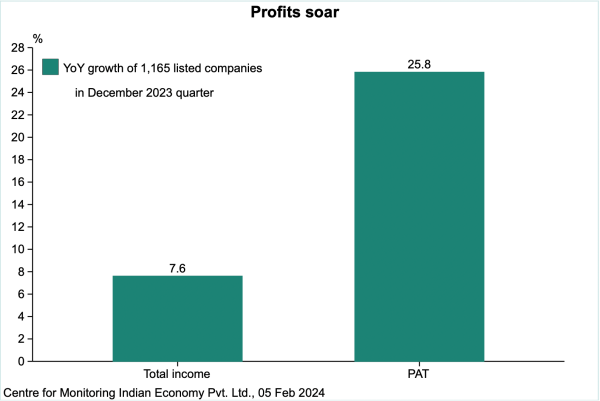 The CHART alongside shows that when compared to the same quarter a year ago — October to December 2023 vs October to December 2022 — the total income grew by less than 8% while profits after tax (PAT) grew by almost 26%.