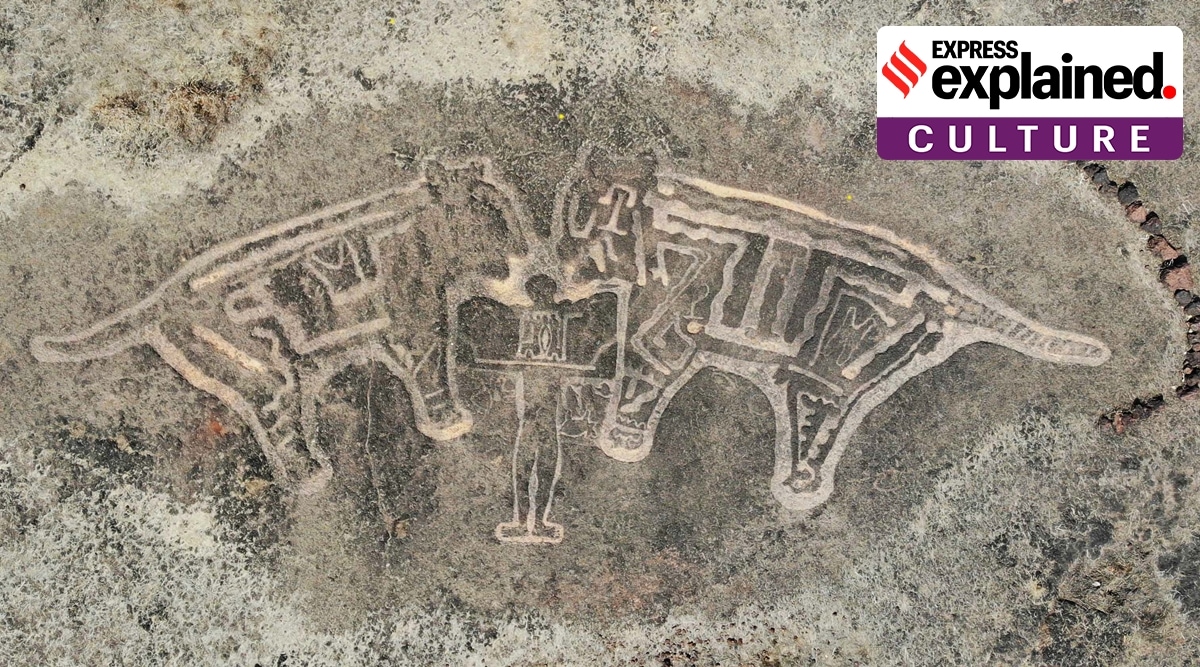
The sites are protected by the state archaeology department and the Archaeological Survey of India (ASI). In April, these sites in the Konkan region were added to a tentative list of UNESCO’s world heritage sites. While the UNESCO listing dates these sites to be over 12,000 years old, some experts have claimed that these sites might go as far back as 20,000 years, and that this can be ascertained through carbon and geological dating.

The Barsu-Solgaon site was proposed after the original plan to construct a refinery in Nanar village of the district was dropped in 2019.
What are geoglyphs?
Geoglyphs are a form of prehistoric rock art, created on the surface of laterite plateaus (Sada in Marathi). They are made by removing a part of the rock surface through an incision, picking, carving or abrading. They can be in the form of rock paintings, etchings, cup marks and ring marks.
The UNESCO listing mentions “Konkan geoglyphs.” However, elsewhere, the term petroglyph (literally, “rock symbol/character”) is also used. As per the UNESCO listing, petroglyphs and geoglyphs share similarities as both require the skills of removing parts or engraving a symbol on the rock surface.
What is the significance of Ratnagiri’s prehistoric rock art?
Story continues below this ad
Clusters of geoglyphs are spread across the Konkan coastline in Maharashtra and Goa, spanning around 900 km. Porous laterite rock, which lends itself to such carving, is found on a large scale across the entire region.
Ratnagiri district has more than 1,500 pieces of such art, also called “Katal shilpa,” spread across 70 sites. UNESCO’s tentative world heritage list mentions seven sites with petroglyphs in Ratnagiri district — Ukshi, Jambharun, Kasheli, Rundhe Tali, Devihsol, Barsu and Devache Gothane, one in Sindhudurg district –Kudopi village, and nine sites at Phansamal in Goa.
According to UNESCO, “rock art in India is one of oldest material evidence of the country’s early human creativity.” Ratnagiri’s rock art is evidence of the continued existence of human settlements from the Mesolithic (middle stone age) to the early historic era. The geoglyphs also show the existence of certain types of fauna that are no longer present in the region today.
Ratnagiri’s prehistoric sites are among three Indian attractions that may soon become World Heritage Sites. The other two include Jingkieng Jri, the living root bridge in Meghalaya, and Sri Veerabhadra Temple in Andhra Pradesh’s Lepakshi.
Story continues below this ad
What does the imagery in these sites tell us?
UNESCO’s World Heritage Site listing says that imagery from these sites shows how people “adapted to ephemeral wetlands in a dry-arid plateau having shallow rock pools, streams and watercourses”. Experts say that the discovery of geoglyphs has added to ongoing research on human resilience and adaptation to extreme fluctuations in climates.
The geoglyph clusters also are examples of advanced artistic skills, showing the evolution of techniques of etching and scooping in rock art.
The figures depicted in the geoglyphs include humans and animals such as deer, elephant, tiger, monkey, wild boar, rhinoceros, hippopotamus, cattle, pig, rabbit, and monkey. Moreover, they also include a high number of reptilian and amphibian creatures such as tortoises and alligators, aquatic animals such as sharks and sting rays, and birds like peacocks.
Story continues below this ad
Some clusters have one or two standalone figures of larger-than-life scale, while others show multiple figures gathered together, seemingly for a purpose.
The largest rock engraving or geoglyph in India is at Kasheli in the Ratnagiri district, which has a large figure of an elephant with dimensions of 18X13 metres.
“The iconography, content, scale and composition record faunal, especially marine and large mammals that have become extinct in the Indian subcontinent over 30,000 years,” the UNESCO listing states.
How were Geoglyphs in the Konkan region found?
Nisarga Yatri Sanstha, a Ratnagiri-based non-profit organisation, has been working for the last few years to find and preserve geoglyphs in the Konkan region. Led by a local conservationist, Sudhir Risbud, Nisarga Yatri has thus far discovered over 1,700 geoglyphs in more than 72 villages. It is this team that brought these priceless prehistoric sites to the knowledge of Indian authorities.
Story continues below this ad
While they came across rock carvings in mid- 2000s while working on other projects, it was in 2010 that Risbud and his team started making a concerted effort to determine how many such sites are around, often asking villagers for help. A shepherd in Rajapur taluka first spotted a location for the team and pointed to the boundary wall and the shape of bushes around the geoglyph. This led to the discovery of over a thousand rock carvings across the Konkan region, which later became protected monuments.
Why have experts raised red flags over the refinery project site at Barsu- Solgaon?
The committee of experts appointed by the Union Ministry of Science and Technology visited Ratnagiri last month to assess the funds required for the conservation of geoglyphs. Senior archaeologist Professor Vasant Shinde, who headed the team said that more than 250 geoglyphs have been identified in the area where the petrochemical refinery will be built. He said that if the project starts at the presently proposed site in Barsu, the rock carvings will get destroyed due to construction and chemical reaction at the site. “A refinery project can be set up elsewhere in Konkan beyond 5-6 km of the petroglyphs,” Shinde said.


 6 min read