Premium
This is an archive article published on April 8, 2023

Pablo Picasso’s changing oeuvre and how he was once accused of stealing Mona Lisa

A revolutionary modernist and the father of cubism, April 8 marks Pablo Picasso's 50th death anniversary.

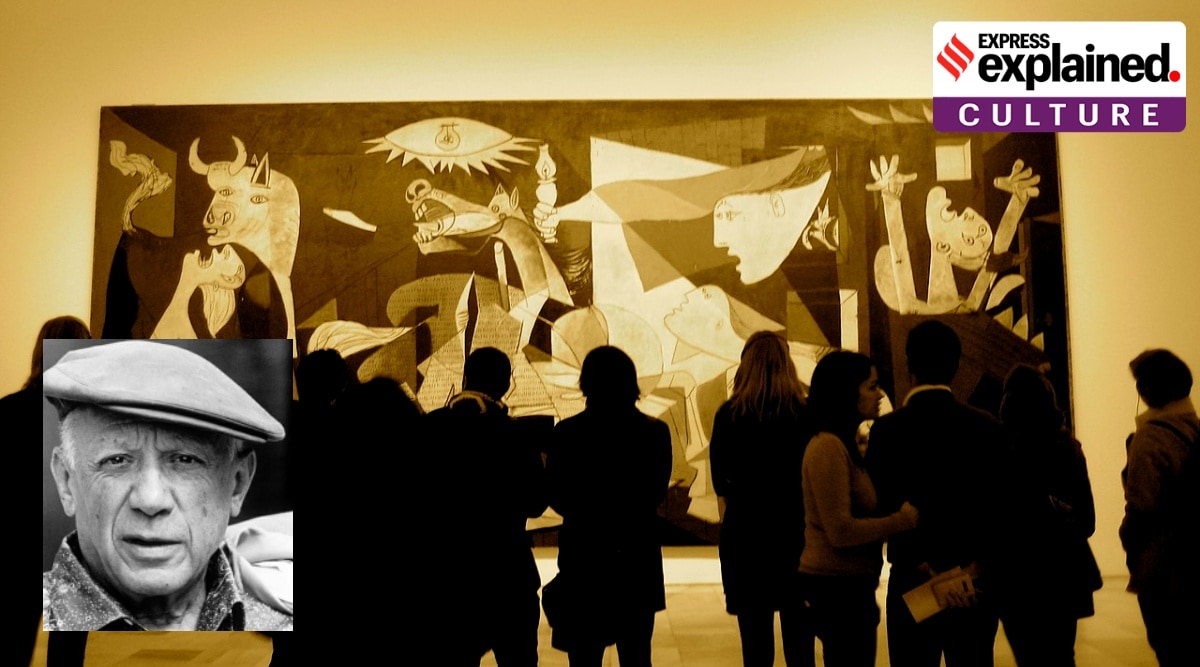
Guernica and Pablo PicassoGuernica depicts the horror of war, as seen by Pablo Picasso (inside) during the bombing of the town of Guernica during the Spanish Civil War. It is one of his largest works, standing at 11 feet tall and 25 feet wide. (Wikimedia Commons)
Listen to this article
Pablo Picasso’s changing oeuvre and how he was once accused of stealing Mona Lisa
x
00:00
1x 1.5x 1.8x

Best known as the father of cubism, Pablo Picasso was one of the most influential and revolutionary modernists, whose contributions to 20th century art remain unquestionable. Also the pioneer of the art of assemblage, the Spanish artist’s constantly changing oeuvre continues to be deconstructed even as his works fetch record prices at auctions worldwide.

On his 50th death anniversary today (April 8), we look at his enduring legacy and profound influence.

Early Life

Born in Malaga, Spain, in 1881, Picasso’s talent for art was recognised early by his father Don Jose Ruiz y Blasco, an artist himself, and Pablo’s first art teacher. His mother reportedly claimed that the young Picasso’s first word was “piz”, short for “lapiz”, meaning pencil in Spanish and the child prodigy completed his earliest painting, Picador, when he was only eight.

At 13, he enrolled in an advanced class at Barcelona’s School of Fine Arts after he completed its complex entrance exam which usually took one month in just a week. Admitted to Madrid’s leading art school, Royal Academy of Fine Arts of San Fernando, three years later, he found the school’s focus on classical subjects and techniques frustrating, and soon moved back to Barcelona, where he began frequenting the popular Els Quatre Gats (“The Four Cats”) cafe. There, he developed his first artistic friendships with the likes of Manuel Pallares, Carlos Casagemas, Josep Cardona and Jaume Sabartés, among others.

By the turn of the century, he was in Paris, in the country which would become his home till his demise in 1973.

Picasso prior to cubism

In a career that lasted over 75 years, according to the Guinness Book of World Records, Picasso created over 13,500 paintings and designs, 1,00,000 prints and engravings, 34,000 book illustrations, and 300 sculptures and ceramics. One of the most prolific modernists, he was constantly innovating, with his work reflecting his preoccupying thoughts at the time.

Human miseries and social alienation he saw in the early 1900s, apart from death of fellow artist-friend Carles Casagemas, led him to paint in melancholic blue from 1901 to 1904, in what is now recognised as the Blue Period. The friendships he developed subsequently, including a relationship with French artist and model Fernande Olivier, was represented by a palette of reds, browns, oranges and yellows, that defined the Rose Period (1904-1906), with depiction of harlequins, acrobats and circus performers.

Story continues below this ad

This is also the period when he found a patron in American novelist and art collector Gertrude Stein, whom he painted a portrait of in 1905.

The birth of cubism and thereafter

Representing realities and subjects in fragments and deconstructed forms, allowing for viewing from multiple angles, Cubism as a revolutionary new approach was invented around 1907-08 by Picasso and French painter Georges Braque, influenced, among others, by the late work of Paul Cezanne, African and Iberian sculptures, and with a desire to reject the accepted norms of representation. Les Demoiselles d’Avignon (1907) — with five nude women, two of them wearing African masks — is largely considered one of Piccaso’s earliest paintings hinting at cubism. Still Life with Chair Caning (1912), meanwhile, is celebrated for being modern art’s first collage.

After the World War, at a time when artists across Europe called for ‘le rappel à l’ordre‘ or ‘the return to order’, seeking a revival of the arts of antiquity and classical traditions, Picasso made his first trip to Italy. There he adopted a new classical approach, that soon moved to surrealism that emphasised on depicting images from within one’s unconscious mind.

His oeuvre in the subsequent years blended his several influences and saw experiments with varied media, from sculptures to copperplate etchings and ceramics. In 1937, he painted Guernica, one of his largest works, measuring 11 feet tall and 25 feet wide, considered now to be one of the greatest anti-war paintings. Made in response to the bombing of the Basque town Guernica in April 1937, during the Spanish Civil War, it reportedly took Picasso one month to paint and was the highlight of the Spanish pavilion at the Paris International Exposition that year.

Story continues below this ad

Picasso as a poet and playwright

Picasso’s experiments were as wide-ranging as his influences. The Spanish artist is known to have harboured a keen interest in dramatic arts, and 1916 onwards he collaborated with Paris-based company Ballets Russes for set designs and costumes. This is also where he met his first wife Olga Khokhlova, who was a dancer in the company. He worked on several productions in the 1920s, and in 1946, he did the curtain design for Roland Petit’s Le Rendez-vous at the Ballets des Champs-Élysées.

The 1940s also saw him pen two full-length surrealist plays, Desire Caught by the Tail and The Four Little Girls. His legacy also includes over 300 poems that he began to write much later in life, after the end of his first marriage in 1935.

When Picasso was accused of stealing Mona Lisa

Not protected with as much security that it garners today as one of the world’s most recognised paintings, Leonardo da Vinci’s Mona Lisa was stolen from the Louvre Museum in Paris 1911, and Picasso was one of the suspects. The theft was traced to him after Honore-Joseph Géry Pieret, secretary of his close associate, poet and writer Guillaume Apollinaire, entered a newspaper office in Paris and confessed that he had stolen artworks for the two in the past.

Soon it became clear that Mona Lisa wasn’t one of them, and Apollinaire and Picasso were finally completely absolved in 1913, when Vincenzo Peruggia, who was trying to sell the painting to an Italian art dealer, was caught for the theft.

Story continues below this ad

Incidentally, as one of the world’s most prolific artists, Picasso himself has the world’s most stolen or missing artwork or in dispute. According to My Modern Met website, in 2012, the Art Loss Register listed 1,147 stolen works by Picasso.

Vandana Kalra is an art critic and Deputy Associate Editor with The Indian Express. She has spent more than two decades chronicling arts, culture and everyday life, with modern and contemporary art at the heart of her practice. With a sustained engagement in the arts and a deep understanding of India’s cultural ecosystem, she is regarded as a distinctive and authoritative voice in contemporary art journalism in India. Vandana Kalra's career has unfolded in step with the shifting contours of India’s cultural landscape, from the rise of the Indian art market to the growing prominence of global biennales and fairs. Closely tracking its ebbs and surges, she reports from studios, galleries, museums and exhibition spaces and has covered major Indian and international art fairs, museum exhibitions and biennales, including the Venice Biennale, Kochi-Muziris Biennale, Documenta, Islamic Arts Biennale. She has also been invited to cover landmark moments in modern Indian art, including SH Raza’s exhibition at the Centre Pompidou in Paris and the opening of the MF Husain Museum in Doha, reflecting her long engagement with the legacies of India’s modern masters. Alongside her writing, she applies a keen editorial sensibility, shaping and editing art and cultural coverage into informed, cohesive narratives. Through incisive features, interviews and critical reviews, she brings clarity to complex artistic conversations, foregrounding questions of process, patronage, craft, identity and cultural memory. The Global Art Circuit: She provides extensive coverage of major events like the Kochi-Muziris Biennale, Serendipity Arts Festival, and high-profile international auctions. Artist Spotlights: She writes in-depth features on modern masters (like M.F. Husain) and contemporary performance artists (like Marina Abramović). Art and Labor: A recurring theme in her writing is how art reflects the lives of the marginalized, including migrants, farmers, and labourers. Recent Notable Articles (Late 2025) Her recent portfolio is dominated by the coverage of the 2025 art season in India: 1. Kochi-Muziris Biennale & Serendipity Arts Festival "At Serendipity Arts Festival, a 'Shark Tank' of sorts for art and crafts startups" (Dec 20, 2025): On how a new incubator is helping artisans pitch products to investors. "Artist Birender Yadav's work gives voice to the migrant self" (Dec 17, 2025): A profile of an artist whose decade-long practice focuses on brick kiln workers. "At Kochi-Muziris Biennale, a farmer’s son from Patiala uses his art to draw attention to Delhi’s polluted air" (Dec 16, 2025). "Kochi Biennale showstopper Marina Abramović, a pioneer in performance art" (Dec 7, 2025): An interview with the world-renowned artist on the power of reinvention. 2. M.F. Husain & Modernism "Inside the new MF Husain Museum in Qatar" (Nov 29, 2025): A three-part series on the opening of Lawh Wa Qalam in Doha, exploring how a 2008 sketch became the architectural core of the museum. "Doha opens Lawh Wa Qalam: Celebrating the modernist's global legacy" (Nov 29, 2025). 3. Art Market & Records "Frida Kahlo sets record for the most expensive work by a female artist" (Nov 21, 2025): On Kahlo's canvas The Dream (The Bed) selling for $54.7 million. "All you need to know about Klimt’s canvas that is now the most expensive modern artwork" (Nov 19, 2025). "What’s special about a $12.1 million gold toilet?" (Nov 19, 2025): A quirky look at a flushable 18-karat gold artwork. 4. Art Education & History "Art as play: How process-driven activities are changing the way children learn art in India" (Nov 23, 2025). "A glimpse of Goa's layered history at Serendipity Arts Festival" (Dec 9, 2025): Exploring historical landmarks as venues for contemporary art. Signature Beats Vandana is known for her investigative approach to the art economy, having recently written about "Who funds the Kochi-Muziris Biennale?" (Dec 11, 2025), detailing the role of "Platinum Benefactors." She also explores the spiritual and geometric aspects of art, as seen in her retrospective on artist Akkitham Narayanan and the history of the Cholamandal Artists' Village (Nov 22, 2025). ... Read More


 

Latest Comment
Post Comment
Read Comments
Advertisement
Loading Taboola...
Advertisement
Advertisement
Advertisement