Pawar took serious note of a complaint by well-known Lavani dancer Megha Ghadge during a meeting of the cultural cell of the NCP last week. Ghadge told The Indian Express that she had not gone after Patil specifically, but had “raised the issue of absolute degradation of Lavani culture by using DJs and making girls dance wearing ghaghra choli in front of the public”.

She said she had asked Pawar to ensure that NCP workers stopped arranging such obscene dances only to pull crowds.
What is the Lavani folk art form?
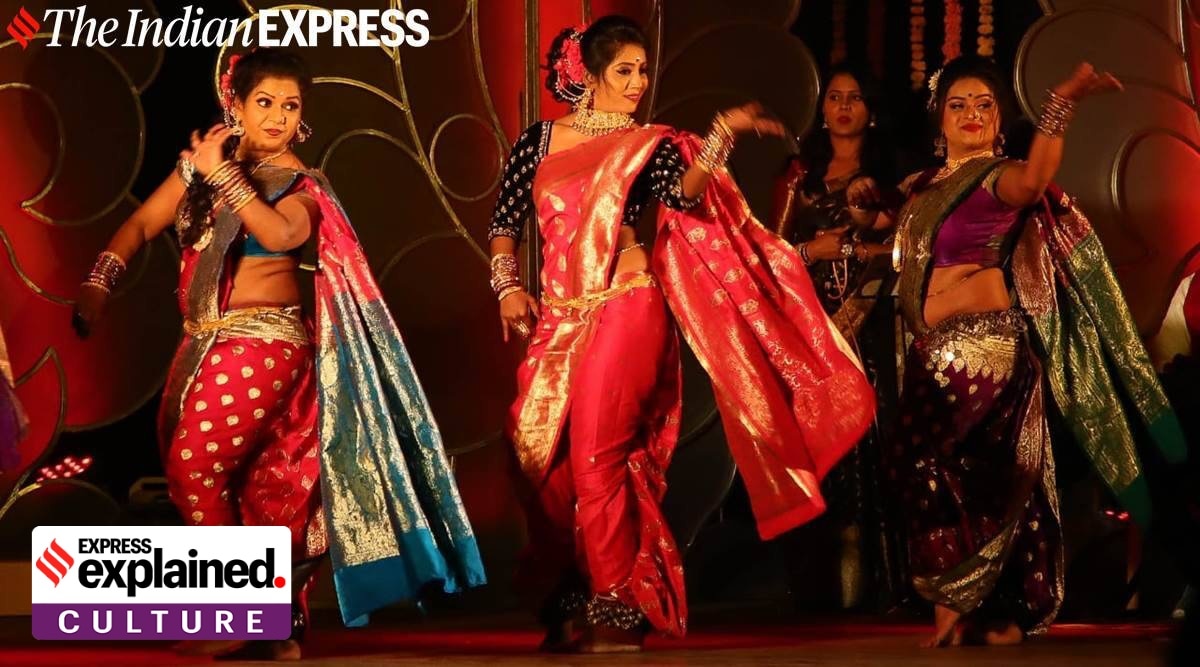
The word Lavani comes from ‘lavanya’ or beauty. Lavani is a traditional folk art form in which women dancers wearing nine-yard-long sarees in bright colours, make-up, and ghunghroos perform on dholak beats on a stage before a live audience.
As an indigenous art form, Lavani has a history going back several centuries, and it attained particular popularity in the Peshwa era in the 18th century. Traditionally, performances were held in front of kings or lords, and for the entertainment of tired soldiers resting during breaks in fighting.
There are several sub-genres of Lavani, of which the most popular is the Shringarik (erotic) kind, in which the lyrics are often teasing, with sensuous dance steps and delicate gestures employed to convey erotic meaning.
Over the years, Lavani has gained more acceptability among the people, even though certain taboos around it continue. The audience has historically been all-male, but in recent years, some women too have begun to attend performances.
Story continues below this ad
Lavani became well known outside Maharashtra — throughout India and even outside the country — following its use in popular media such as cinema. Over the past few years, with the explosion in the use of social media, short clips of dances have become very popular.
What is the basis for the criticism?
The sensual component in Lavani has long been frowned upon.
In 1948, then Chief Minister of Bombay Balasaheb Kher banned Lavani performances after receiving complaints about their alleged obscenity. Cultural historians have recorded that this led to a sanitisation of the art form, with later performers choosing indirect references to erotic meanings over direct gestures and overt lyrics.
Live performances continue to get huge responses from the public in rural Maharashtra, and politicians and political parties often invite Lavani dancers to perform at their events. A mostly young and male crowd attends the programmes as female dancers perform on film songs in both Hindi and Marathi. The women often dress in a risque fashion, and their gestures to the crowd draw loud cheers.
Story continues below this ad
Veterans of the art form are critical of these changing trends. Seniors like Ghadge feel that the present-day Lavani performances by the new-age girls, with producers hungry for profits calling in DJs, often end up making these performances vulgar and low-brow.
“There are no guidelines, no censorship. Artistes are losing respect in the eyes of the people. Theatres are not being given for Lavani performances. I feel that such obscene and vulgar programmes need to be banned immediately,” Ghadge said, adding that a body should be set up exclusively for the Lavani art form, which will look into these issues and will set a rulebook.
Ajit Pawar said last week: “Lavani and other arts of Maharashtrian tradition are important but they should be performed in such a way that everyone is able to enjoy them. There should not be any obscenity. Unfortunately, in some districts the obscene dances have been banned but they continue to happen in other districts. If need be, I may raise this issue in the upcoming budget session of the state Assembly.”
Bhushan Korgaonkar, a researcher and author on the Lavani tradition, however, argued that a ban can never be the answer. “An art and artistes should not be banned. It never serves the purpose. There have been instances in the past as well,” he said.
Story continues below this ad
“A ban leads to instances of crime or more illegal activities. In the age of social media and the Internet, how can anything be banned?” he asked.
And where does Gautami Patil come in?
The current outrage started after November 2022, when a short video of Patil making a sexually suggestive gesture during a live performance went viral on social media. The video made Patil an overnight sensation and led to her being invited for performances across the state. These shows were huge hits, and Patil accumulated a sizable fandom, even as many accused her of promoting vulgarity.
Veteran Lavani dancer Surekha Punekar said on TV, “Only those who want to excel in Lavani dance should be encouraged, and those who wear inappropriate clothes and make obscene moves are not Lavani performers.”
Patil hails from Sindkheda in north Maharashtra’s Dhule district. She moved to Pune with her family and started learning dance at a training academy. To support her mother, she started performing as a back dancer in Lavani programmes, and slowly attained a fan following of her own.
Story continues below this ad
“I always loved to dance. But I had never thought that I would have to feed my family using dance as my drunkard father never stayed with us. I started as a back dancer at a Lavani programme in Akluj town,” Patil said at a press conference. After she became a subject of controversy, Patil apologised for her errors of judgment. “I was wrong. I have apologised and I have changed. Let me clarify that I have never repeated those actions,” she said. “The DJ was playing and I got carried away.”
After Pawar’s comment last week, she apologised again, saying she was “too small a person to reply to Ajit dada”, and that she had stopped making such mistakes. She complained that people were circulating her old videos.


 7 min read