6 min read
© The Indian Express Pvt Ltd



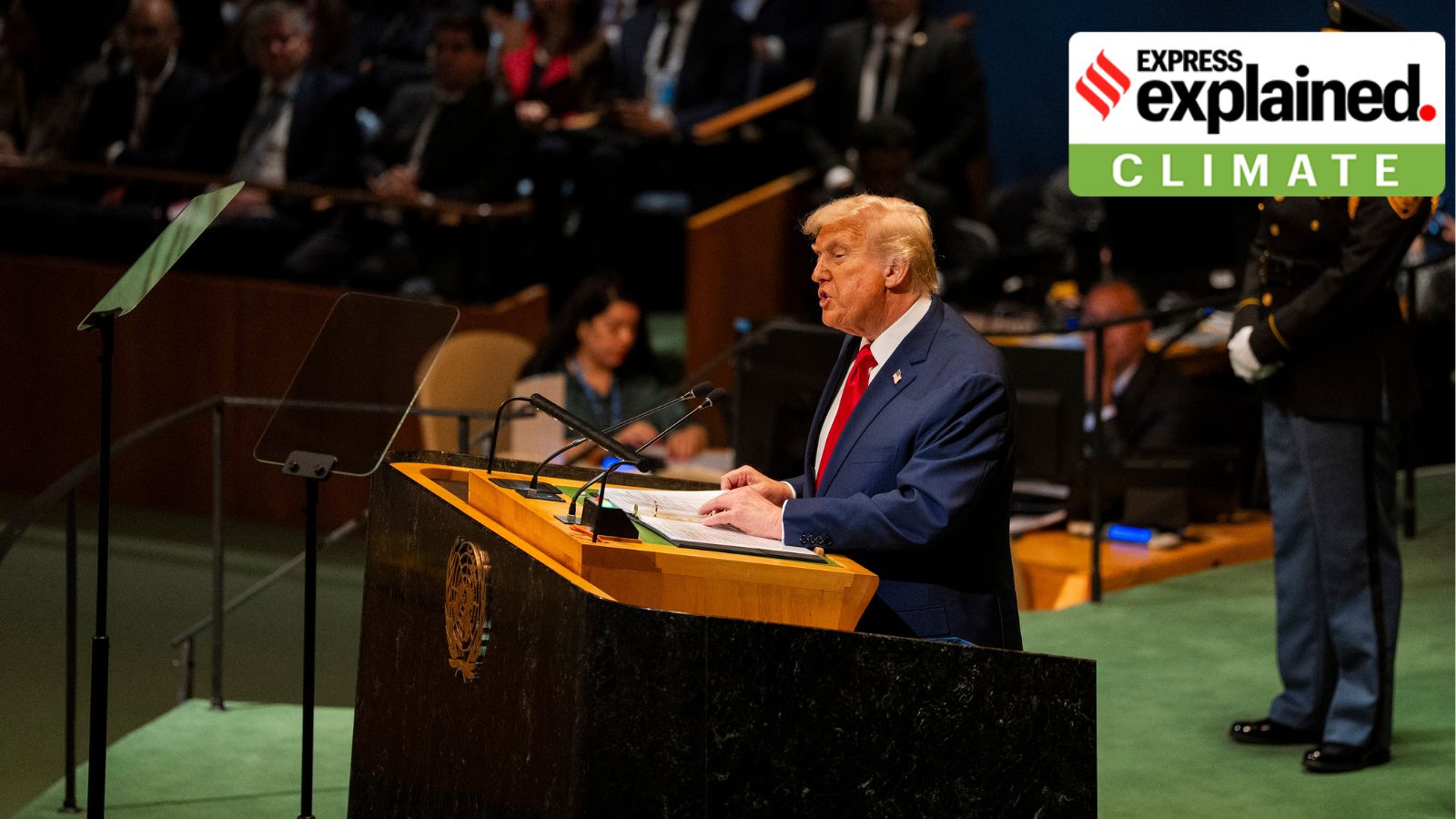 President Donald Trump addresses the United Nations General Assembly at U.N. headquarters in New York on Tuesday, Sept. 23, 2025 (NYT)
The United States on Thursday said it was pulling out of the UN Framework Convention on Climate Change (UNFCCC) and more than 60 other international treaties and organisations that “no longer serve American interests”. On the long list are several climate-related entities, including the Intergovernmental Panel on Climate Change (IPCC), International Solar Alliance (ISA), and International Renewable Energy Agency (IRENA).
Last year, immediately after Donald Trump took charge as President for his second term, the US withdrew from the 2015 Paris Agreement. That decision will become effective on January 20, after the one-year notice lapses. Over this past year, the Trump administration has also scaled down funding and staffing of its national agencies engaged in climate research.
Thursday’s decision marks its complete disengagement with the international climate architecture, and puts a serious question mark over the effectiveness of the existing multilateral process to deal with climate change.
Love-hate relationship with climate change
American discomfort with the international climate regime is not new. The US had played an important role in the finalisation of the UNFCCC, which acknowledged the problem of climate change and laid down the basic rules and principles for a global response. But it never became a member of the 1997 Kyoto Protocol, an instrument under the UNFCCC that assigned specific emission reduction targets to different countries.
In fact, the United States led the efforts to put in place an alternative to the Kyoto Protocol, efforts that eventually culminated in the 2015 Paris Agreement. But its record in fulfilling its responsibilities under the Paris Agreement has been extremely poor. It has done precious little in terms of emissions reductions, or in providing finance or technology, all of which are its mandatory obligations under the UNFCCC and the Paris Agreement.
However, the United States, all this while, never denied the problem of climate change. It remained fully engaged and continued to exert a big influence on the climate discourse. It invested heavily in scientific research on climate and in development of clean technologies. It incentivised green investments, at home and abroad. While the pace of transformation was slow, and not commensurate with what was expected of it, the United States did work to minimise the impacts of climate change.
But Trump is a proud climate denialist, and has repeatedly mocked the global efforts being made on clean energy transition. Under his Presidency, the United States has acted overtly to undermine the progress made so far. The budget cuts on climate research, for example, can have long-term implications, not just for the United States but for the world as a whole, since many of the US agencies are equipped with the best resources and networks for data-collection and monitoring.
The fallout
The US move to sign out of the UNFCCC and other organisations was not surprising, even if not entirely expected. The withdrawal from the Paris Agreement and the scaling down of funding on climate research had already done most of the damage. The world is sure to miss its 2030 emission reduction targets, and the United States, even before Trump, wasn’t on a pathway to make any meaningful contribution to fill the gap.
In the short-term, therefore, the impact of the US decisions on global climate might only be marginal. The fallout over the longer term will depend on the stance Trump’s successors in the White House take.
But by disassociating completely from the climate regime, the United States might be jeopardising its own long-term interests, ceding the leadership in this area to its main rival China. Most countries are already committed to renewable energy pathways. Renewable sources like solar or wind promise not just energy access but also energy security. They have also become significantly cheaper. For large parts of the world, renewable energy has begun to make economic as well as strategic sense.
The efforts of the Trump administration to go against the tide, by pumping in more oil in the energy market through its adventures in Venezuela or other measures, might slow down the pace of energy transition but are unlikely to turn the clock back.
And it is here that China can press forward its advantage. Renewable energy deployment requires equipment and infrastructure, and China has an undisputed lead in their manufacturing and supply chains. By vacating this space, the US could be undermining its economic interests as well as political leverage.
Impact on India
For India, the US decisions could result in lower pressure to decarbonise fast, but its plans to attract investments in clean technologies could also be affected. Before Trump’s second Presidency, India had a long-standing strategic partnership on climate and clean energy with the United States, which had been supporting a number of activities in diverse energy-related fields. Such collaboration is expected to stop, which could force India to revise its energy transition pathways.
One of the organisations the United States has withdrawn from is the International Solar Alliance that India had helped set up in collaboration with France on the sidelines of COP21 climate meeting in Paris in 2015. The US had joined the ISA only in 2021 as the 101st member. It does not give any financial support to the ISA. At its last assembly meeting in 2025, the ISA had decided to charge an annual membership fee of USD 50,000 from developed nations and USD 25,000 from developing countries, but this decision is still to be operationalised.