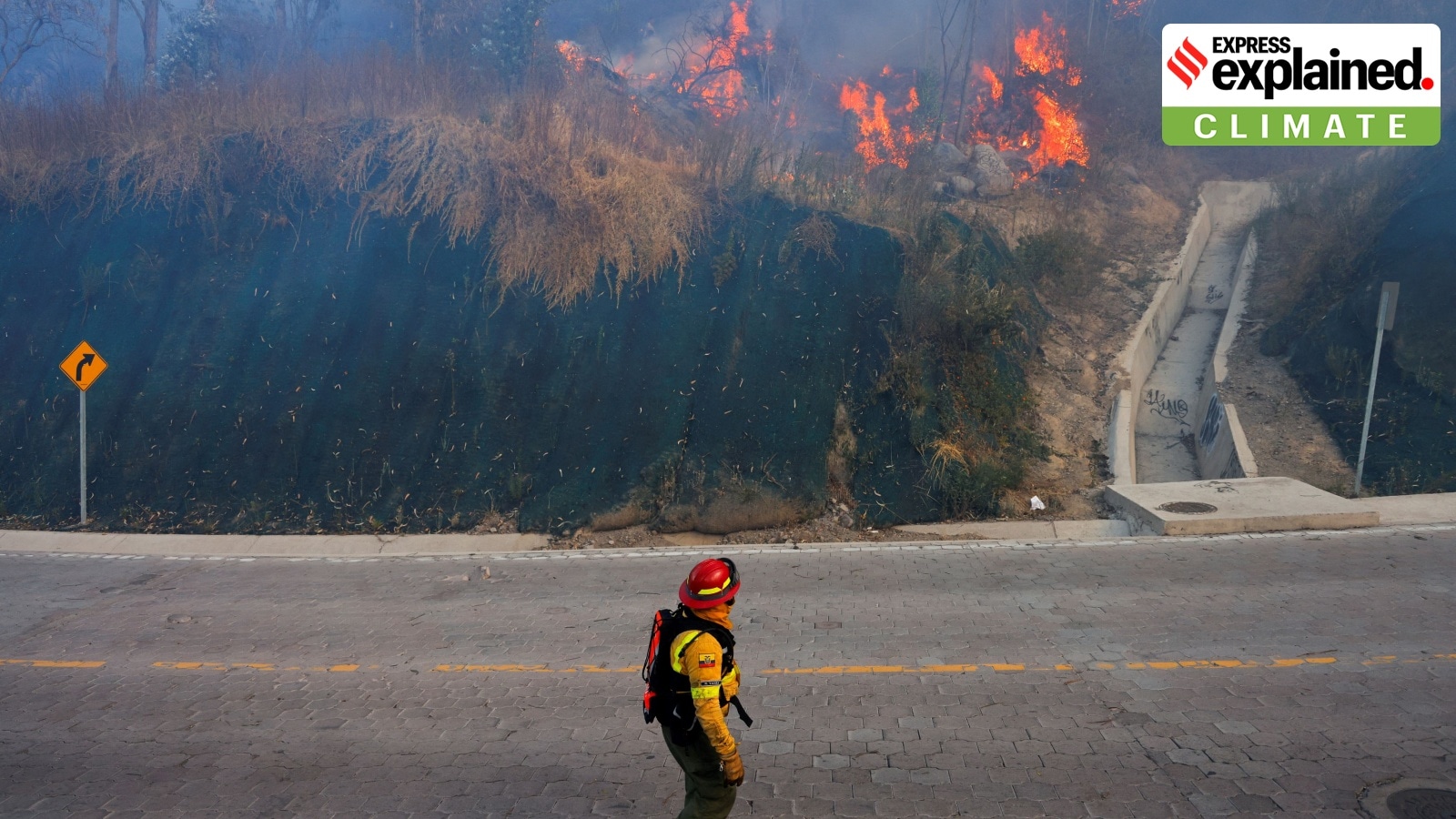
A firefighter walks while working to extinguish a wildfire, in Quito, Ecuador, on Monday. (Photo: Reuters)
It is still possible for all humanity to thrive, escape poverty and be safe from climate change, but only if we learn to share Earth’s riches equally, according to a new study. For the first time, scientists have connected the planet’s safety with the idea of justice for all in the distribution of the planet’s critical resources, such as freshwater and nutrients.
The study, ‘A Just World on a Safe Planet’, published in the journal The Lancet Planetary Health, was carried out by 65 leading natural and social scientists from more than 20 countries. The scientists belong to the Earth Commission, a global team that aims to define a safe and just corridor for people and the planet.
What are the findings of the study?
The study shows that the over-consumption of finite resources by a minority of the world’s population is shrinking the “Safe and Just Space” — a conceptual space in which it is possible to meet everybody’s basic needs with minimum damage to the planet. The researchers have found that providing resources to people who do not have enough would be less harmful to the planet than the present situation in which the wealthy minority is consuming more than its fair share.
Here are some of the key findings of the study:
01
Historically marginalised people are suffering the most.
The research follows from Earth System Boundaries, published in 2023, which underlined the safe and just “ceiling” up to which people could continue to extract natural resources and pollute without destabilising the Earth's systems and endangering humanity. The scientists call the present study the “foundation” as it shows what Earth's 7.9 billion human population needs from the planet to live free of poverty.
According to the researchers, ‘Safe ESBs’ are the levels beyond which tipping points may be triggered, making Earth unstable. Safe ESBs are not necessarily just. ‘Just ESBs’ prevent significant harm to humans, communities and countries. The study says that in seven of eight indicators for the five domains, the EBSs have already been transgressed. These include climate, surface water, groundwater and natural ecosystem areas. “The eighth ESB, air pollution, has been transgressed in many parts of the world,” says the study.
At the receiving end are people who are historically marginalised, such as those living in former colonies, and the poor are at particular risk. At present, nine million premature deaths are linked to air and water pollution and millions of others are suffering from diseases due to rising heat and extreme weather events. The research adds that, in India, one billion people are living on land with diminishing yields. India is also among the hardest hit globally by water shortages.
The Paris Agreement seeks to limit global warming to below 2 degree Celsius from pre-industrial levels but, even then, 30 million people of Bangladesh will be vulnerable to the impact of sea level rise.
02
The rich are responsible for the present crisis.
That the rich are responsible for the present crisis is at the heart of all climate crisis discussions, according to the study. Apart from the fossil fuel-powered industrial revolution of the developed nations, there are statistics on consumerism. In 2020, a study by Oxfam and the Stockholm Environment Institute showed that the richest 10 per cent of the world had caused around half of global emissions in 2015. An unequal 15 per cent of emissions were by the top 1 per cent of the world. On the other hand, the world's poorest 50 per cent were responsible for just 7 per cent and, ironically, they were the ones suffering the effects of the climate crisis the most.
The new study says that the economic growth trajectories, which dominate the global economic policy, threaten to destabilise the global commons. “Current environmental pressures are hugely unequal, with the richest 10 per cent of the global population consuming as much energy as the poorest 80 per cent and being responsible for more emissions than the other 90 per cent,” says the study.
03
Society needs to move in a safe and just direction.
The researchers say that the need of the hour is to rethink economic models and technological interventions and ensure that critical natural resources are accessed, shared and managed fairly. Unless these changes are implemented, by 2050, even if every person on the planet had only a basic standard of living, the earth's climate systems would still be overshot and the planet “would be outside the climate boundary”.
“If we want to meet minimum needs and stay within boundaries, we have to change. This is not a very welcome message for governments, businesses, and society at large. If we can change our production patterns to more circular ones, to more ecosystem-based solutions, we have a safe and just future. Consumption patterns of the rich have to change even in poorer countries like India. Such change can enhance the well-being of people, and reduce their exposure to environmental change,” according to Dr Joyeeta Gupta, lead author of the study and former co-chair of the Earth Commission.
Dipanita Nath is a Senior Assistant Editor at The Indian Express, based in Pune. She is a versatile journalist with a deep interest in the intersection of culture, sustainability, and urban life.
Professional Background
Experience: Before joining The Indian Express, she worked with other major news organizations including Hindustan Times, The Times of India, and Mint.
Core Specializations: She is widely recognized for her coverage of the climate crisis, theatre and performing arts, heritage conservation, and the startup ecosystem (often through her "Pune Inc" series).
Storytelling Focus: Her work often unearths "hidden stories" of Pune—focusing on historical institutes, local traditions, and the personal journeys of social innovators.
Recent Notable Articles (December 2025)
Her recent reporting highlights Pune’s cultural pulse and the environmental challenges facing the city during the winter season:
1. Climate & Environment
"Pune shivers on coldest morning of the season; minimum temperature plunges to 6.9°C" (Dec 20, 2025): Reporting on the record-breaking cold wave in Pune and the IMD's forecast for the week.
"How a heritage tree-mapping event at Ganeshkhind Garden highlights rising interest in Pune’s green legacy" (Dec 20, 2025): Covering a citizen-led initiative where Gen Z and millennials gathered to document and protect ancient trees at a Biodiversity Heritage Site.
"Right to breathe: Landmark NGT order directs PMC to frame norms for pollution from construction sites" (Dec 8, 2025): Reporting on a significant legal victory for residents fighting dust and air pollution in urban neighborhoods like Baner.
2. "Hidden Stories" & Heritage
"Inside Pune library that’s nourished minds of entrepreneurs for 17 years" (Dec 21, 2025): A feature on the Venture Center Library, detailing how a collection of 3,500 specialized books helps tech startups navigate the product life cycle.
"Before he died, Ram Sutar gave Pune a lasting gift" (Dec 18, 2025): A tribute to the legendary sculptor Ram Sutar (creator of the Statue of Unity), focusing on his local works like the Chhatrapati Shivaji statue at Pune airport.
"The Pune institute where MA Jinnah was once chief guest" (Dec 6, 2025): An archival exploration of the College of Agriculture, established in 1907, and its historical role in India's freedom struggle.
3. Arts, Theatre & "Pune Inc"
"Satyajit Ray, Ritwik Ghatak were not rivals but close friends, says veteran filmmaker" (Dec 17, 2025): A deep-dive interview ahead of the Pune International Film Festival (PIFF) exploring the camaraderie between legends of Indian cinema.
"Meet the Pune entrepreneur helping women build and scale businesses" (Dec 16, 2025): Part of her "Pune Inc" series, profiling Nikita Vora’s efforts to empower female-led startups.
"How women drone pilots in rural Maharashtra are cultivating a green habit" (Dec 12, 2025): Exploring how technology is being used by women in agriculture to reduce chemical use and labor.
Signature Style
Dipanita Nath is known for intellectual curiosity and a narrative-driven approach. Whether she is writing about a 110-year-old eatery or the intricacies of the climate crisis, she focuses on the human element and the historical context. Her columns are often a blend of reportage and cultural commentary, making them a staple for readers interested in the "soul" of Pune.
X (Twitter): @dipanitanath ... Read More


 2 min read