© The Indian Express Pvt Ltd
 6 min read


 British architect-urbanist Richard Rogers | Photo credit: Rogers Stirk Harbour + Partners
 Italian-born British architect Richard Rogers (1933-2021) is famously known for the Pompidou Centre in Paris, which he designed with friend and Italian architect Renzo Piano in the mid-’70s. The 30-somethings were catapulted to international fame when the results of the competition for the cultural centre was announced. They had turned the building inside out, colour-coding its services on the facade, which gave green pipes for plumbing, yellow wires for electricals, blue airflow ducts and red for safety. This not only shocked the conservative French, for whom galleries were high culture spaces but it took away the stuffiness of the white cube with a piazza in front of the building. It would become, in Roger’s words, “a place for all people, all ages and all creeds. A cross between Times Square and the British Museum”. It was an unusual encounter of technology and monumentality.
“Come and see, don’t be scared”, it seemed to say, unlike other intimidating art galleries. The Pompidou Centre would have a large library where people could come, engage, read, and stay curious. It was in many ways an anti-establishment building that had its fair share of critics, until many turned converts. Roger even released a tract during this time that said cities didn’t need more museums which are sterile and empty but places where people can gather and socialise. People came for the views of the city it afforded from its sixth floor. It’s a different thing that today most tourists don’t enter the Centre but the architecture itself has placed it on the world map. Designers were no longer unafraid to show service pipes and wires, which were otherwise tucked away under false ceilings and behind wooden panels.
The Lloyd’s insurance building (1986) was another such exercise in taking forward his “inside-out” design. He punched the quiet financial district of London with a stainless-steel façade, shaking it up from its medieval stupor. He gave the building an interiority through an open atrium and series of escalators, with open floor plans that allowed for partition walls to be subdivided so that it could be reconfigured as required.
While many critics have called him out on his “shock and awe” techniques, Rogers was careful in getting together a band of experts to make his buildings as efficient and functional as possible.
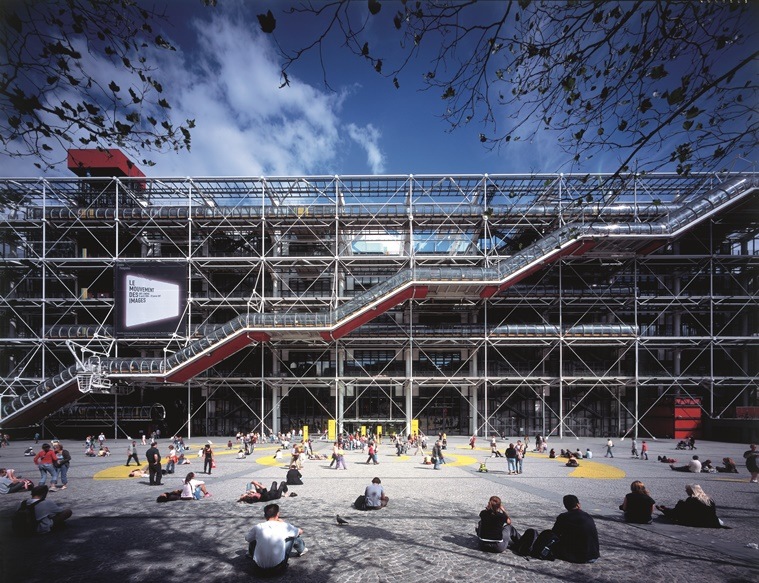 Pompidou Centre in Paris | Photo credit: Katsuhisa Kida
Career highlights
His training at the Architectural Association School of Architecture (1954-59), his masters at Yale (1962) and later his numerous urban projects would lead him to work with some of the modern greats in world architecture including English architect-designer Norman Foster. Winner of illustrious honours including the Pritzker Laureate (2007); RIBA Royal Gold Medal (1985) and being knighted by Queen Elizabeth II (1991), Rogers designs always inspired conversations on democratic spaces, equitability and commitment to the environment without compromising on development. He retired from his own firm, Rogers Stirk Harbour + Partners (RSHP), last year, after more than four decades of designing some world-renowned buildings, including London Heathrow Terminal 5 (2008) and Three World Trade Center, New York City (2018).
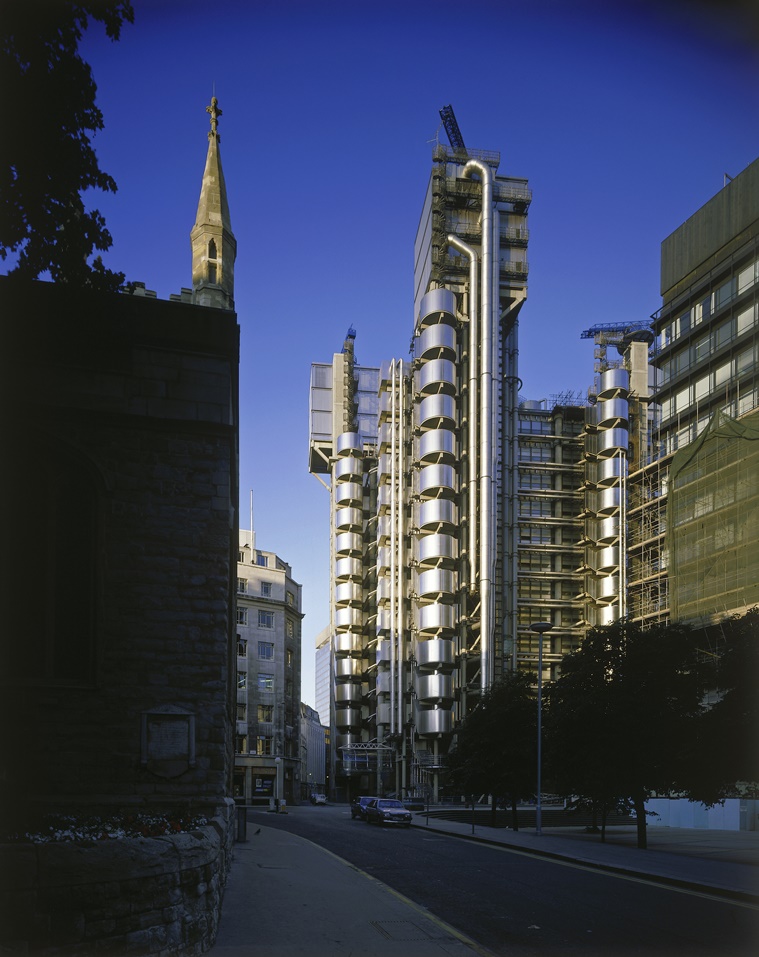 Lloyd’s insurance building in London | Photo credit: Rogers Stirk Harbour + Partners
Life and city intersections
Even before words like sustainability and environmental context were fashionable, Rogers put his pen to paper in 1989 to write a report, “Towards an Urban Renaissance”, which gave 100 suggestions for the future city. It was part of the study undertaken by a task force, set up on invitation of the British government. He had been involved in multiple advisory roles for mayors in London and Barcelona, as well.
Rogers has always been sure of designing buildings as spaces where people want to be. Unlike many who see the city as a forced alternative, his perspective was led by multiple ideas to make cities enjoyable and pleasurable places to be in.
In the BBC Reith Lecture (1995), Rogers agreed that cities were responsible for much of the environmental damage, of pollution, erosion, deforestation, all of which came with sociological ones, too. Where there ought to be a public square stood a car park, instead of a street, a supermarket.
Newsletter | Click to get the day’s best explainers in your inbox
It is these ideas that make Rogers an urbanist that 20th century architecture had yet to see. He advocated the need to have high densities in cities, to allow for vibrancy and participation. Overlapping activities to increase contact, and a focus on neighbourhoods to minimise the use of cars. For Rogers, an ecological city would be one where circular metabolism would sustain the city, one that gives as much as it takes out. And a creative city, where art and architecture and landscape inspire its people.
Peter Palumbo, patron of the arts and architecture, wrote when Rogers won the AIA (American Institute of Architects) Gold Medal: “…we celebrate Richard Rogers, a humanist who reminds us that architecture is the most social of arts… he has shown us that, perhaps, the architect’s most lasting role is that of a good citizen of the world”. Piano called him “a planner who is attracted by the complexity of cities and the fragility of earth”.
India Connect
Rogers was shortlisted in the final stage of the Amaravati Government Complex Design Competition, along with Japan’s Fumihiko Maki and India’s BV Doshi in 2016. Though Maki won the competition, it ran into controversies and an entire new team now helm the project.