This is an archive article published on March 30, 2022
Explained: The Edict of Chandigarh and why it matters
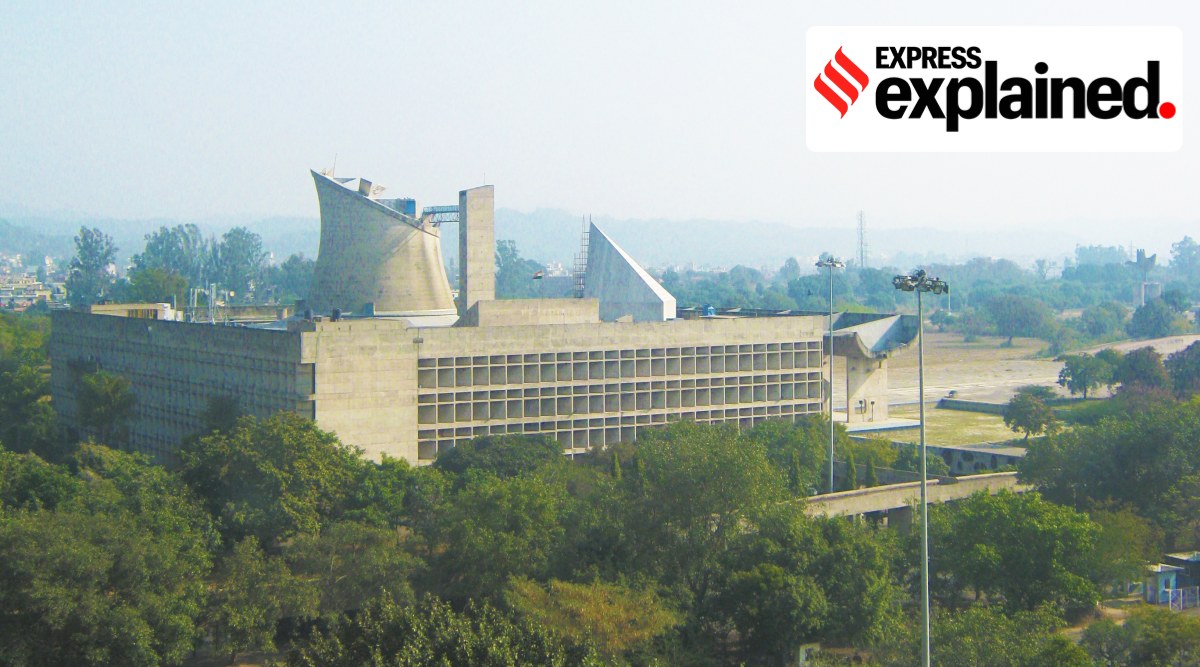
The Punjab Vidhan Sabha has resolved to install statues of Bhagat Singh, Dr Bhim Rao Ambedkar and first Sikh ruler Maharaja Ranjit Singh at the Assembly Building of Capitol Complex. What does the Edict say about installing statues? What is allowed and not allowed under the Edict?
“The seed of Chandigarh is well sown. It is for the citizens to see that the tree flourishes” Le Corbusier, creator of Chandigarh said as he laid down the Edict of Chandigarh.
The Punjab government’s resolution to install three statues in the Assembly Building of Capitol Complex, Chandigarh, a UNESCO World heritage site, hasn’t gone down well with heritage experts and architects as they say it tramples the Edict of Chandigarh.
A look at what the Edict of Chandigarh aims to be, what it allows and does not, in the light of Punjab government’s move.
Who conceptualised the Edict of Chandigarh and what is its aim?
The Edict of Chandigarh was prescribed by Le Corbusier, the planner of Chandigarh. Heritage experts and urban planners term it a ‘mandated rule book’ on the city’s planning laid down by Corbusier as he wanted the citizens to become the guardians and saviours of the city.
It was stated in the Edict that the objective of the same is “to enlighten the present and future citizens of Chandigarh about the basic concepts of planning of the city so that they become its guardians and save it from the whims of individuals”. This Edict sets out some basic ideas that are underlying the planning of the city.
The Edict clearly specifies that ‘the age of statues is gone’. It mentions that no personal statues shall be erected, be it in the city or even the parks of Chandigarh. “The city is planned to breathe the new sublimated spirit of art. Commemoration of persons shall be confined to suitably placed bronze plaques,” the Edict states.
Member of heritage protection cell Ajay Jagga says, “ That is why I, through my written communication, have urged the Punjab CM to review the decision because statues are not allowed as per the Edict. Moreover, the Legislative Assembly Building is under Capitol Complex and is a world heritage site, where a certificate of authenticity and integrity is given. Any change in the matter also needs clearance from the competent authority.”
Story continues below this ad
What happened earlier when a similar move was proposed by the then Badal government, proposing a statue at Vidhan Sabha?
In 2016, a similar move was resolved by the then Parkash Singh Badal-led SAD-BJP government wherein they proposed to install a large statue of Dr Bhimrao Ramji Ambdekar on the premises of the Punjab Vidhan Sabha. However, the Chandigarh administration had turned down the government’s proposal citing the Edict of Chandigarh. The UT administration had said that the proposal can’t be adhered to as no personal statues can be installed in the capital. The then Punjab government had written to the UT finance secretary and the chief administrator informing them of its decision to install the statue. However, the administration wrote back stating permission cannot be granted.
What is allowed and not allowed under the Edict of Chandigarh?
Not just statues, the Edict specifies a set things which are allowed and those that are not. Apart from the ban on statues, the Edict also specifies a complete ban on noise and commercialisation at the Sukhna Lake.
“The lake is a gift of the creators of Chandigarh to the citizens to be at one with nature, away from the hubbub of city life. There shall be no commercial exploitation of the lake and its environment and its tranquility shall be guaranteed by banning noises,” the Edict specifies. It also talks about particular parks in the city, like Leisure Valley, Rajendra Park and others and how no unplanned buildings are permitted.
Hina Rohtaki is a Special Correspondent at The Indian Express, based in Chandigarh. She is one of the most prominent journalists covering the Chandigarh Administration, civic issues, and the unique political status of the Union Territory.
Professional Background
Experience: She has been in the field for over a decade and is known for her investigative reporting on administrative waste and urban governance.
Awards: She is a recipient of the prestigious Ramnath Goenka Excellence in Journalism Award, which was presented to her by the President of India in January 2020. She was also awarded the Jethmalani prize (The Will of Steel Awards) in 2025 in the Empowerment category for a series of articles that highlighted the struggles of Covid widows.
Core Beat: Her primary focus is the Chandigarh administrative structure, the Union Territory's financial management, and urban development projects.
Recent Notable Articles (Late 2025)
Her recent work highlights a focus on government accountability, administrative expenditures, and civic trends:
1. Investigative & Financial Reporting
"Fuelling power: Senior UT IAS officers guzzled petrol worth Rs 30 lakh in 2 yrs" (Dec 14, 2025): An investigative report detailing the high fuel bills of top bureaucrats, including the Finance Secretary and Chief Secretary’s staff.
"Admn spends Rs 1.5 crore on dismantling road railings and fixing again after increasing height" (Dec 8, 2025): Highlighting administrative waste on "non-viable" solutions for pedestrian control.
"Chandigarh’s finances under ministry’s watch now" (Nov 27, 2025): Reporting on the new requirement for MHA approval for all new projects in the UT.
2. Governance & Constitutional Status
"What will it mean for Chandigarh if it is brought under Article 240?" (Nov 24, 2025): An "Explained" piece on the potential constitutional shift that would grant the President more power over the UT's governance.
"MP Manish Tewari moves Bill seeking directly elected Mayor with 5-year tenure" (Dec 6, 2025): Covering the legislative push to reform Chandigarh's municipal leadership structure.
"No proposal to increase Mayor's term in Chandigarh by 5 years: Centre" (Dec 10, 2025): Reporting on the Union government's response to demands for a longer mayoral term.
3. Urban Infrastructure & Environment
"Chandigarh admn cuts power to India's tallest air purifier, asks firm to dismantle it" (Nov 17, 2025): A critical report on the failure of a high-cost environmental project deemed "of no use" by experts.
"UT rethinks 24/7 water supply project as costs soar" (Nov 26, 2025): Detailing the financial challenges and delays in modernizing the city's water network.
"Centre 'obfuscating, covering up' MC's shifting deadlines for clearing Dadu Majra dump" (Dec 12, 2025): Reporting on the ongoing controversy surrounding the city's major waste dump.
4. Lifestyle & Local Trends
"Chandigarh turns into a Thar city as women fuel the surge" (Dec 2, 2025): A feature on a unique automotive trend in the city, with a record 600 registrations by women drivers this year.
"After fivefold spike in 2023, EV sales struggle to pick pace in Chandigarh" (Dec 2, 2025): Analyzing the slowdown in electric vehicle adoption despite previous surges.
Signature Beat
Hina is known for her meticulous tracking of RTI (Right to Information) data to expose administrative inefficiency. Her "Ground Zero" reporting on the Dadu Majra garbage dump and her scrutiny of the Chandigarh Smart City projects have made her a key figure in the city’s civil society discourse.
X (Twitter): @HinaRohtaki ... Read More


 4 min read