© The Indian Express Pvt Ltd
 4 min read


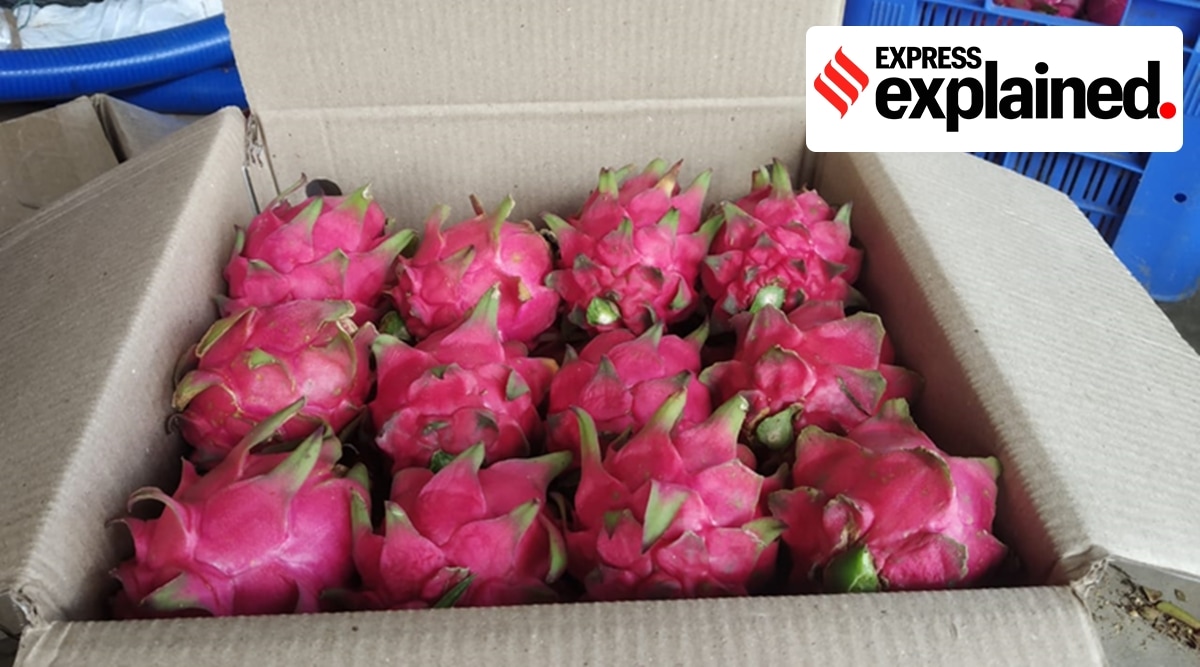 Dragon fruit is a wild fruit-bearing cactus species native to the Americas where it is called pitahaya. (Express photo)
Gujarat Chief Minister Vijay Rupani has said that the state proposes to rename dragon fruit as ‘Kamalam’. Dragon fruit “does not sound appropriate”, Rupani said; Kamalam was apt because the characteristic fuchsia ‘spikes’ or ‘petals’ of the fruit recall a lotus in bloom.
Dragon fruit is the fruit of a species of wild cactus indigenous to South and Central America, where it is called pitaya or pitahaya. The fruit’s flesh is usually white or red — although there is a less common yellow pitaya too — and is studded with tiny seeds rather like the kiwifruit.
The world’s largest producer and exporter of dragon fruit is Vietnam, where the plant was brought by the French in the 19th century. The Vietnamese call it thanh long, which translates to “dragon’s eyes”, believed to be the origin of its common English name.
Dragon fruit is also cultivated in — apart from its native Latin America — Thailand, Taiwan, China, Australia, Israel, and Sri Lanka. It was brought to India in the 1990s, and is grown in Karnataka, Kerala, Tamil Nadu, Maharashtra, Gujarat, Odisha, West Bengal, Andhra Pradesh, and Andaman and Nicobar Islands. It grows in all kinds of soil, and does not require much water.
Eating the dragon fruit
To eat directly, halve the fruit and scoop out the flesh with a spoon. Or, cut the ends, pull off the leathery skin, and chop up the egg-shaped white flesh to eat.
Dragon fruit can be made into smoothies or shakes. Despite its spectacular good looks, it has a mild, almost bland flavour, which makes it adaptable for a variety of sweet and savoury dishes from salads and relishes to cakes and tacos.
In Latin America, pitaya juice is popular. Last year, a Ho Chi Minh City bakery made bread with dragon fruit that couldn’t be sold due to Covid-19 restrictions.
The idea of renaming
In his Mann Ki Baat broadcast on July 26 last year, Prime Minister Narendra Modi had lauded the farmers of Kutch for taking up cultivation of dragon fruit and adopting innovative practices, calling it “the very spirit of self-reliance”.
On August 6, Ram Kumar, additional principal chief conservator of forests (social forestry) in the Gujarat forest department, forwarded to the Indian Council of Agricultural Research (ICAR) a proposal on renaming the fruit Kamalam. This, Kumar wrote, would “boost awareness and expansion”, “and contribute to reducing our import dependence in line with ‘Atmanirbhar Bharat’”.
Kamalam is also the name of the BJP headquarters in Koba in Gandhinagar, and the kamal — lotus — is the BJP’s election symbol. Rupani, however, said no politics was involved in the renaming. “Gujarat government has decided that dragon fruit is not a suitable word. Across the world it is known as dragon fruit and one thinks of China. So we have given the name Kamalam. It is a fruit like the lotus,” he said.
Where the proposal stands
ICAR sources said the Gujarat government’s proposal had been forwarded to the Union Ministry of Agriculture and Farmers’ Welfare. “ICAR does not do everything in this respect. ICAR is the recommending body. Whatever nomenclature, release of varieties, production, it is all done by the Department of Agriculture and Cooperation, the other wing, and not the research wing,” Dr A K Singh, ICAR’s deputy director general (agricultural extension), to whom Kumar’s proposal was addressed, said.
ICAR officers said such a proposal would need approval from the Botanical Survey of India and the National Biodiversity Authority under the Union Ministry of Environment, Forest and Climate Change. “Dragon fruit is not a species native to India and any change in its nomenclature in official annals can lead to international litigation. Hence, the opinion of BSI and NBA matters,” an ICAR official said.