Premium
This is an archive article published on July 22, 2020

How repurposed Covid-19 drug tocilizumab came to be at the centre of a fraud in Gujarat

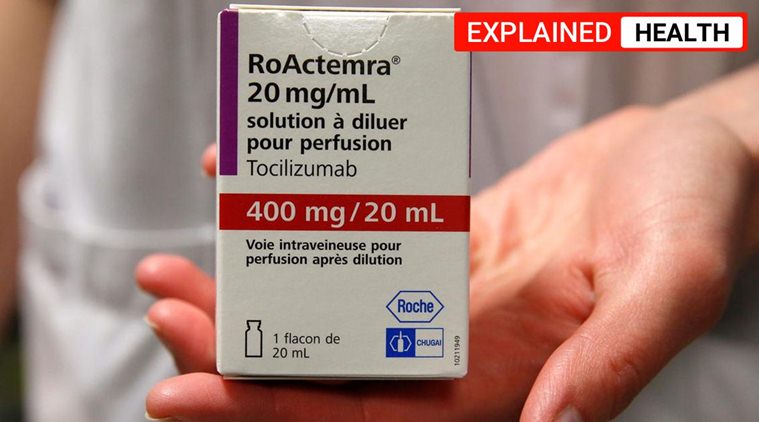
High demand and short supply of the immunosuppressive drug tocilizumab has seen the Gujarat FDCA crackdown on at least two incidences of blackmarketing and counterfeit sale in a span of less than two weeks.

tocilizumab, Actemra, RoActemra, Covid 19 drug tocilizumab, Earlier this month, the FDCA had busted a trail of blackmarketing, where the drugs were being sold at a higher price, and without bills. Reuters Photo

Over the last two weeks, the Food and Drug Control Administration (FDCA) in Gujarat has busted two alleged rackets, both originating from Surat, a hotspot of the coronavirus, unearthing a grey market of the injectible immunosuppressant tocilizumab, sold under the brand name Actemra.

The first case filed was of conspiracy and criminal breach of trust; in the second, a case of attempted murder was registered as the spurious injection had reached a patient in Ahmedabad, where a doctor blew the whistle.

What do the two alleged rackets flag?

High demand and short supply of the immunosuppressive drug tocilizumab, distributed in India by Cipla under the brand name of Actemra and manufactured by Swiss firm Roche, has seen the Gujarat FDCA crackdown on at least two incidences of blackmarketing and counterfeit sale in a span of less than two weeks.

Earlier this month, the FDCA had busted a trail of blackmarketing, where the drugs were being sold at a higher price, and without bills. The trail ran from a wholesaler in Surat through a stockist in Surat, to a pharma agency in Ahmedabad and to a pharmacist at the Ahmedabad Civil Hospital. In a second instance, the FDCA also busted culprits selling a steroid and hormone mix as counterfeit for tocilizumab, branded as Actemra.

Also in Explained | How to read the serological survey results from Mumbai and Delhi

What is the demand and availability for tocilizumab in Gujarat?

FDCA commissioner Hemant Koshiya says that in the first week of May, a doctor at the Ahmedabad Civil Hospital used it experimentally. By the second week of May, upon the instruction of the high powered committee headed by the Chief Minister, the state procured 20 injections, which were available among Gujarat stockists for Lupus patients.

Story continues below this ad

Until July second week, the state has procured approximately 6,000 of these injections, of which more than 3,000 were kept with the government and a little less than the remaining 50 per cent stock was distributed to stockists and private hospitals, said Koshiya. He clarified that he wouldn’t say “there is a shortage, but yes, it is in limited supply because there is a single manufacturer and the whole world wants it”.

📣 Express Explained is now on Telegram. Click here to join our channel (@ieexplained) and stay updated with the latest

What did the state government do to regulate this demand?

In Surat, the district administration formed a committee of three doctors to regulate the supply of the drug. Private hospitals seeking an Actemra injection have to mail an application to covid19.inj@gmail.com, with details of prescription, investigation report, and case papers of the patient. The committee will check the documents and find out how much of the injection is required, and send the proposal to the medical superintendent.

Story continues below this ad

At the user end, Dr Deven Shah, MD and consultant physician based in Ahmedabad, who flagged authorities on the fake Actemra, says, “The state government in a very short time has put a good system in place where it mandates a prescription, Aadhaar card of the patient and Aadhaar card of the relative to be submitted to the authenticated stockists.”

However, a loophole here is that an Aadhaar card copy can be easily availed of any party, who may not be the purported user, but Shah hopes that this will be worked out eventually. Shah adds that doctors and hospitals should always check for the bill. “Say the state has supplied 500 of this injection and then sees 550 instances of the drug administered, the state can then trace that the 50 either came from the black or the grey market.”

What are the red flags to look out for?

Dr Shah says that with a “huge demand and less supply,” an estimated two-hour process of procurement, and the panic of patients’ relatives may have led to black-marketing, hoarding, and counterfeiting of the drug. However, there are checks and balances in place, and if completely adhered to by citizens, doctors and hospitals, such instances will be detected.

Story continues below this ad

“It is the citizen’s responsibility to purchase the drug through the proper channel. It is also important for doctors to always check for the bill. The hospital is also responsible to convey to the state government on administering this drug,” says Shah.

Shah emphasises that any pharmacy selling the drug legally, will always provide a bill. Koshiya adds that the drug price too is an indicator — it should not cost the retail buyer more than Rs 40,545 for a 40 mg vial. The first case made out by the FDCA had a pharma wholesaler based in Surat selling each of these for Rs 57,000.

Sohini Ghosh is a Senior Correspondent at The Indian Express. Previously based in Ahmedabad covering Gujarat, she recently moved to the New Delhi bureau, where she primarily covers legal developments at the Delhi High Court Professional Profile Background: An alumna of the Asian College of Journalism (ACJ), she previously worked with ET NOW before joining The Indian Express. Core Beats: Her reporting is currently centered on the Delhi High Court, with a focus on high-profile constitutional disputes, disputes over intellectual property, criminal and civil cases, issues of human rights and regulatory law (especially in the areas of technology and healthcare). Earlier Specialty: In Gujarat, she was known for her rigorous coverage in the beats of crime, law and policy, and social justice issues, including the 2002 riot cases, 2008 serial bomb blast case, 2016 flogging of Dalits in Una, among others. She has extensively covered health in the state, including being part of the team that revealed the segregation of wards at the state’s largest government hospital on lines of faith in April 2020. With Ahmedabad being a UNESCO heritage city, she has widely covered urban development and heritage issues, including the redevelopment of the Sabarmati Ashram Recent Notable Articles (Late 2025) Her recent reporting from the Delhi High Court covers major political, constitutional, corporate, and public-interest legal battles: High-Profile Case Coverage She has extensively covered the various legal battles - including for compensation under the aegis of North East Delhi Riots Claims Commission - pertaining to the 2020 northeast Delhi riots, as well as 1984 anti-Sikh riots. She has also led coverage at the intersection of technology and governance, and its impact on the citizenry, from, and beyond courtrooms — such as the government’s stakeholder consultations for framing AI-Deepfake policy. Signature Style Sohini is recognized for her sustained reporting from courtrooms and beyond. She specialises in breaking down dense legal arguments to make legalese accessible for readers. Her transition from Gujarat to Delhi has seen her expand her coverage on regulatory, corporate and intellectual property law, while maintaining a strong commitment to human rights and lacuna in the criminal justice system. X (Twitter): @thanda_ghosh ... Read More


Latest Comment
Post Comment
Read Comments
Advertisement
Advertisement
Advertisement
Advertisement