This is an archive article published on May 21, 2021
Study identifies interventions that encourage mask wearing
Conducted over 10 weeks and covering 341,830 adults, the study found mask-wearing increased by 29 percentage points, leading to an estimated 50,947 additional adults wearing masks in intervention villages.
Written by Sohini Ghosh
Ahmedabad | Updated: May 21, 2021 07:21 AM IST
3 min read
Whatsapp
twitter
Facebook
Reddit
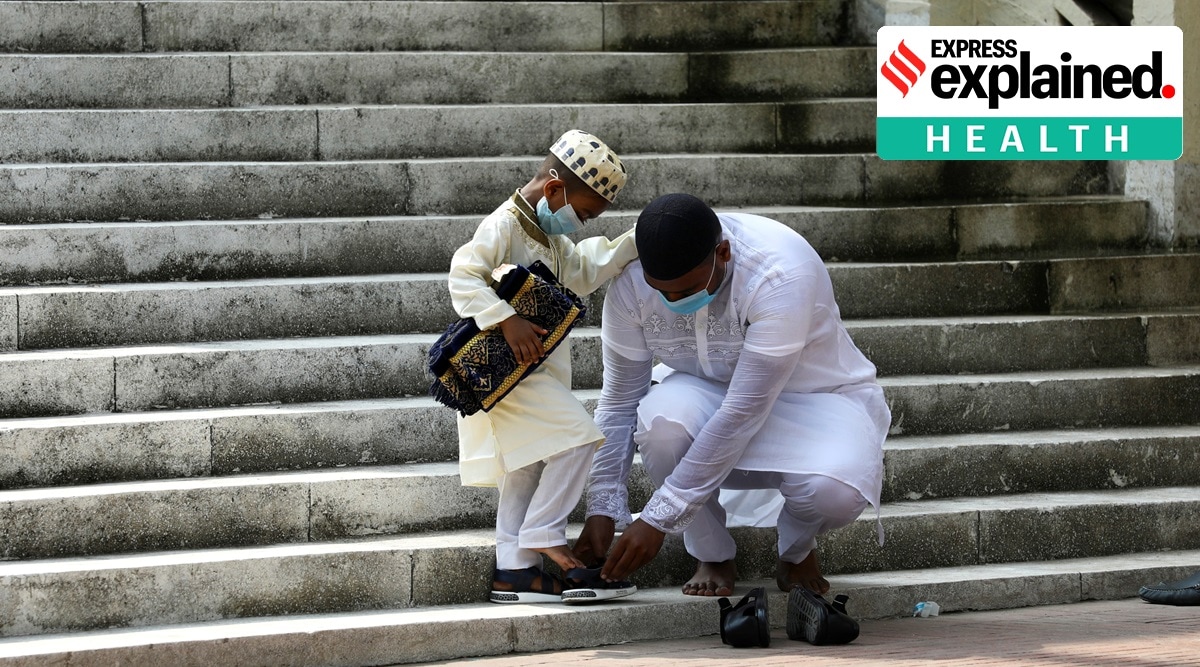
A man helps a child put on his shoes as they leave a mosque in Dhaka, Bangladesh. Mask advocacy by Imams during Friday prayers is one of the strategies used to promote mask usage. (Reuters Photo: Mohammad Ponir Hossain)
In a working paper series of the US-based National Bureau of Economic Research, a cluster randomised trial in Bangladesh conducted across 600 villages on community mask-wearing behaviour has shown that a combination of interventions of free mask distribution, communicating the importance of wearing a mask, periodic reminders and monitoring and role-modelling by public officials and community leaders, can improve compliance.
Conducted over 10 weeks and covering 341,830 adults, the study found mask-wearing increased by 29 percentage points, leading to an estimated 50,947 additional adults wearing masks in intervention villages, assuming three members per household. There were 64,937 households in the intervention group and 64,183 households in the control group.
The study conducted by researchers from across the globe, including from Yale School of Management, Stanford University, and Innovations for Poverty Action, moved with two key primary objective — to assess which of multiple interventions would increase proper wearing of masks, and whether mask promotion unintentionally creates moral hazards and decreases social distancing.
A series of strategies were deployed to promote mask usage, including free household distribution, distribution and promotion at markets and mosques, mask advocacy by Imams during Friday prayers, etc. Pilot projects in two districts found that “free mask distribution alone is not sufficient to increase mask-wearing, but adding periodic monitoring in public places to remind people to wear the distributed masks had large effects on behavior”.
The larger randomised cluster trial established that “combining mask distribution, role-modeling and active mask promotion — rather than mask distribution and role-modeling alone – seems critical to achieving the full effect”.
Several elements saw no additional effect on mask wearing. These included the interventions of text reminders, public signage commitments, monetary or non-monetary incentives, or police accompanying the mask promoters.
Story continues below this ad
The finding about police’s presence being ineffectual and instead seeing better outcomes by periodic reminders from community-level leaders suggests “the operative mechanism is not any threat of formal legal sanctions, but shame and people’s aversion to a light informal social sanction”.
The researchers note the findings “should be interpreted with caution, as these behavioral responses may be context-dependent”. Yet they also note: “The intervention package that proves effective in our trial would be feasible to implement in a similar fashion throughout South Asia and in other world regions.”
Sohini Ghosh is a Senior Correspondent at The Indian Express. Previously based in Ahmedabad covering Gujarat, she recently moved to the New Delhi bureau, where she primarily covers legal developments at the Delhi High Court
Professional Profile
Background: An alumna of the Asian College of Journalism (ACJ), she previously worked with ET NOW before joining The Indian Express.
Core Beats: Her reporting is currently centered on the Delhi High Court, with a focus on high-profile constitutional disputes, disputes over intellectual property, criminal and civil cases, issues of human rights and regulatory law (especially in the areas of technology and healthcare).
Earlier Specialty: In Gujarat, she was known for her rigorous coverage in the beats of crime, law and policy, and social justice issues, including the 2002 riot cases, 2008 serial bomb blast case, 2016 flogging of Dalits in Una, among others.
She has extensively covered health in the state, including being part of the team that revealed the segregation of wards at the state’s largest government hospital on lines of faith in April 2020.
With Ahmedabad being a UNESCO heritage city, she has widely covered urban development and heritage issues, including the redevelopment of the Sabarmati Ashram
Recent Notable Articles (Late 2025)
Her recent reporting from the Delhi High Court covers major political, constitutional, corporate, and public-interest legal battles:
High-Profile Case Coverage
She has extensively covered the various legal battles - including for compensation under the aegis of North East Delhi Riots Claims Commission - pertaining to the 2020 northeast Delhi riots, as well as 1984 anti-Sikh riots.
She has also led coverage at the intersection of technology and governance, and its impact on the citizenry, from, and beyond courtrooms — such as the government’s stakeholder consultations for framing AI-Deepfake policy.
Signature Style
Sohini is recognized for her sustained reporting from courtrooms and beyond. She specialises in breaking down dense legal arguments to make legalese accessible for readers. Her transition from Gujarat to Delhi has seen her expand her coverage on regulatory, corporate and intellectual property law, while maintaining a strong commitment to human rights and lacuna in the criminal justice system.
X (Twitter): @thanda_ghosh ... Read More


 3 min read