Premium
This is an archive article published on April 24, 2021

Explained: Can nitric oxide fight coronavirus? A nasal spray, and evidence so far

Nitric oxide is known to have a broad antimicrobial effect against bacteria, fungi, helminths, protozoa and viruses.

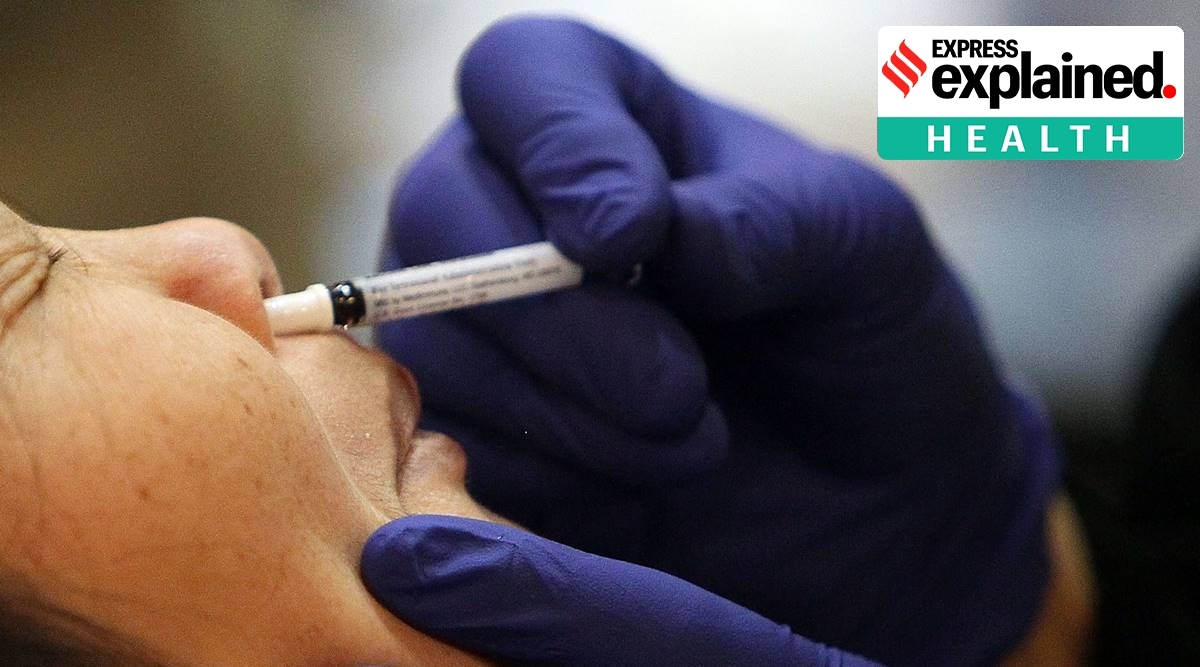
Can the nasal spray be an effective viral treatment? (File Photo)Can the nasal spray be an effective viral treatment? (File Photo)

Till date, there is still no specific drug for controlling Covid-19. While scientists worldwide are working on effective antiviral drugs against SARS-CoV2, some are looking beyond drugs. For example, a multinational collaboration has recently announced results of phase 2 clinical trials indicating that a nitric oxide nasal spray can be an effective viral treatment. It is not, however, the first time nitric oxide has been studied as a therapy for infection or other illnesses.

Newsletter | Click to get the day’s best explainers in your inbox

What is this therapy?

Nitric oxide is known to have a broad antimicrobial effect against bacteria, fungi, helminths, protozoa and viruses. To assess the potential of NO as a treatment for SARS-CoV-2 infection, researchers evaluated its vitro antiviral effect on SARS-CoV-2 replication and published their findings in September 2020. (‘Mitigation of the replication of SARS-CoV-2 by nitric oxide in vitro’, Redox Biology)

Prof Ake Lundkvist of Uppsala University, Sweden, one of the authors of the paper, has said, “To our knowledge, nitric oxide is the only substance shown so far to have a direct effect on SARS-CoV-2”.

And what is this spray?

It has been developed by a Vancouver-based biotech firm, SaNOtize Research and Development Corporations, along with St Peter’s hospitals, NHS Foundation Trust in Surrey, and Berkshire and Surrey Pathology Services. “The spray releases a small, topical amount of nitric oxide that is well known to kill viruses including SARS-CoV-2. It is non-specific and thus kills any virus,” said Dr Gilly Regev, CEO and co-founder of SaNOtize.

What were the trial results?

It was a randomised, double-blinded, placebo-controlled phase 2 trial. It evaluated 79 confirmed cases of Covid-19.

According to the announced results, early treatment helped reduce the level of SARS-CoV2. Patients treated with the spray saw an average reduction of around 95% in viral load in the first 24 hours, and more than 99% within 72 hours. No side effects or adverse events were observed.

Story continues below this ad

A majority of the patients had been infected with the variant first detected in the UK, Dr Stephen Winchester, consultant medical virologist and chief investigator of NHS clinical trials, told The Indian Express by email.

With the virus airborne, how long does the effect of the spray last?

“It is a ‘post-exposure’ prevention — just like the hand sanitiser is,” said Dr Chris Miller, Chief Science Officer at SaNotize.

The self-administered nasal spray releases a small topical amount of nitric oxide and aims to kill the virus in the upper airways, preventing it from incubating and making its way to the lungs. Dr Miller said: “If you are outside, around people, and could be infected, you could use the spray and reduce the number of viruses in the nose, before it is becoming a full-blown infection. We have shown that even when people have a very high load of virus, the spray can significantly reduce the viral load.”

Has it got any kind of clearance?

The World Health Organization has yet to give an emergency use authorisation (EUA). According to Dr Regev, Israel and Bahrain have given EUA to the spray, as a medical device. The developers have also applied for EUA in the UK, Dr Winchester said.

Story continues below this ad

A phase 3 trial is being planned, although it would be for regulators to decide if it was needed, Dr Winchester said.

According to Dr Regev, the developers are in discussions with some pharmaceutical companies in India.

📣 JOIN NOW 📣: The Express Explained Telegram Channel

How do scientists in India view this?

Prof Ram Vishwakarma, Advisor, Council of Scientific and Industrial Research (CSIR), said that as a scientist he was open to these developments. And Indian companies too are working on similar ideas.

Story continues below this ad

“We are discussing several new developments daily. Scientifically it is an interesting idea and they have interesting phase 2 clinical trial results but not yet published in peer-reviewed journals to my knowledge. We are all waiting for the regulator to take a call — several Indian companies have started working on similar ideas,” said Prof Vishwakarma, who is the Chairman of the Covid strategy group of CSIR.

“There is no unequivocal data on antiviral activity of nitric oxide per se — I have seen the report and results. They are not the first company and several trials are underway worldwide,” he said.

What are these trials looking at?

Several molecules are in clinical trials, and at CSIR, too, there are 15 molecules in the preclinical stage of development. One or two may go into clinical trials in a few months, Prof Vishwakarma said.

“We will need therapeutics for this virus and also develop more monoclonal antibodies . This RNA virus is different and it is too short a time for people to develop new drugs. Hence several drugs have been repurposed,” he said. “Regarding the nasal spray, this is a formulation where NO can be slowly released… There are clinical trials happening where doctors are testing if the tiny amounts of NO gas can be given to the patient so he/she can breathe better. It relaxes blood vessels.”

Anuradha Mascarenhas is a Senior Editor at The Indian Express, based in Pune. With a career spanning three decades, she is one of the most respected voices in Indian journalism regarding healthcare, science and environment and research developments. She also takes a keen interest in covering women's issues . Professional Background Education: A gold medalist in Communication and Journalism from Savitribai Phule Pune University and a Master’s degree in Literature. Author: She authored the biography At The Wheel Of Research, which chronicles the life and work of Dr. Soumya Swaminathan, the former Chief Scientist at the WHO. Key Focus: She combines scientific accuracy with storytelling, translating complex medical research into compelling public and human-interest narratives. Awards and Recognition Anuradha has won several awards including the Press Council of India's national award for excellence in journalism under the gender based reporting category in 2019 and the Laadli Media award (gender sensitivity -2024). A recipient of the Lokmat journalism award (gender category-2022), she was also shortlisted for the RedInk awards for excellence in journalism-2021. Her debut book At The Wheel Of Research, an exclusive biography of Dr Soumya Swaminathan the inaugural chief scientist of World Health Organisation was also nominated in the Popular Choice Category of JK Paper AUTHER awards. She has also secured competitive fellowships including the Laadli Media Fellowship (2022), the Survivors Against TB – New Research in TB Media Fellowship (2023) and is part of the prestigious 2025 India Cohort of the WomenLift Health Leadership Journey.” Recent Notable Articles (Late 2025) 1. Cancer & Specialized Medical Care "Tata Memorial finds way to kill drug-resistant cancer cells" (Nov 26, 2025): Reporting on a breakthrough for triple-negative breast cancer, one of the most aggressive forms of the disease. Discipline, diet and purpose; How a 97-year-old professor defies ageing'' (Nov 15, 2025) Report about Prof Gururaj Mutalik, the first Head of Department at Pune's B J Government Medical College who at 97 credits his longevity to healthy habits and a strong sense of purpose. 2. Environmental Health (The "Breathless Pune" Series) Long-term exposure even to 'moderate' air leads to chronic heart, lung, kidney issues" (Nov 26, 2025): Part of an investigative series highlighting that even "safe" pollution levels are damaging to vital organs. "For every 10 µg/m3 increase in PM2.5 level, there was 6-8% jump in medicine sales" (Nov 23, 2025): Using commercial data to prove the direct link between air quality and respiratory illnesses in Pune. 3. Lifestyle & Wellness News "They didn't let cancer, diabetes and heart disease stop them from travelling" (Dec 22, 2025): A collaborative piece featuring survivors who share practical tips for traveling with chronic conditions. At 17, his BP shot up to 200/120 mmHG; Lancet study flags why child and teen hypertension doubled between 2000 and 2020'' (Nov 12,2025)--A report that focusses on 17-year-old-boy's hypertensive crisis and reflects the rising global trend of high blood pressure among children and adolescents. 4. Scientific Recognition & Infrastructure For promoting sci-comm, gender diversity: IUCAA woman prof highlighted in Nature" (Nov 25, 2025): Covering the global recognition of Indian women scientists in gender studies and physics. Pune researchers find a spiral galaxy like the Milky Way from early universe'' (December 3, 2025)- A report on how Indian researchers discovered a massive galaxy that existed when the universe was just 1.5 billion years old , one of the earliest to have been observed so far. Signature Beat: Health, Science & Women in Leadership Anuradha is known for her COVID-19 reportage, where she was one of the first journalists to provide detailed insights into the Covishield and Covaxin trials. She has a dedicated interest in gender diversity in health and science, often profiling women researchers who are breaking the "leaky pipeline" in STEM fields. Her writing style is scrupulous, often featuring interviews with top-tier scientists and health experts from various institutions.   ... Read More


Latest Comment
Post Comment
Read Comments
Advertisement
Advertisement
Advertisement
Advertisement