© The Indian Express Pvt Ltd
 3 min read


 Solar panels on a building. India's climate actions have so far been largely financed from domestic resources. (File)
Even with the Union Budget bringing in focus the issue of climate finance, fresh data show that the central government grants released under the National Adaptation Fund on Climate Change (NAFCC) have declined steadily for the last five years. Grants released under NAFCC fell from Rs 115.36 crore in 2017-18 to Rs 42.94 crore in 2020-21, and Rs 27.76 crore (till December 2021) in the current year, according to data presented by Minister of State for Finance Pankaj Chaudhary in Parliament on Monday.
Along with the Climate Change Action Programme, NAFCC is one of the two key schemes run by the Centre. Under the NAFCC, 30 projects with an allocation of Rs. 847.5 crore were sanctioned between 2015-19.
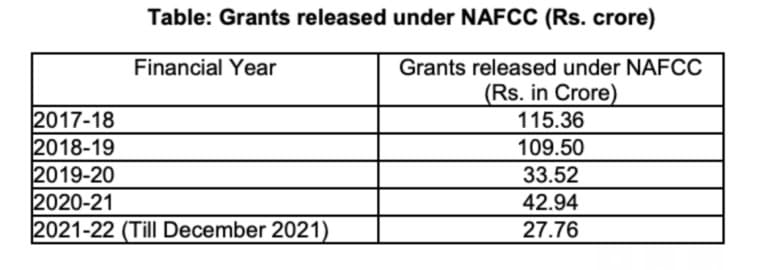 Source: Finance Ministry
The Union Budget 2022-23 emphasised sovereign green bonds and thematic funds for blended finance in areas including climate action. Green bonds, issued through the Reserve Bank of India, will be part of the government’s overall borrowing programme and used for projects leading to a less carbon economy. Finance Ministry officials expect to raise a “substantial sum” through these bonds in the current year. The government will release a framework on how money raised through these bonds will be utilised for intended objectives.
Blended financing will be done through several agencies, such as NABARD, with part contribution from the government and private sector.
“India has seen an increasing number of issuances in the overseas green bond market. India is currently ranked 2nd (after China) among the emerging market economies in Green Bonds issuance. Till date, there have been 11 issuances of green debt securities, under SEBI guidelines, by private and public sector entities in India amounting to Rs 3,099 crore,” Chaudhary said.
India’s climate actions have so far been largely financed from domestic resources. Chaudhary said the government is implementing the National Action Plan on Climate Change, which is the overarching policy framework. It comprises national missions in specific areas of solar energy, enhanced energy efficiency, Himalayan eco-system, and sustainable habitat, among others. States have also prepared their plans in line with this.
India’s Nationally Determined Contribution, submitted under the Paris Agreement in 2015, provides a preliminary estimate that at least $2.5 trillion (at 2014-15 prices) would be required for meeting India’s climate actions from 2015 to 2030, Chaudhary said.
Newsletter | Click to get the day’s best explainers in your inbox