5 min read


© IE Online Media Services Pvt Ltd



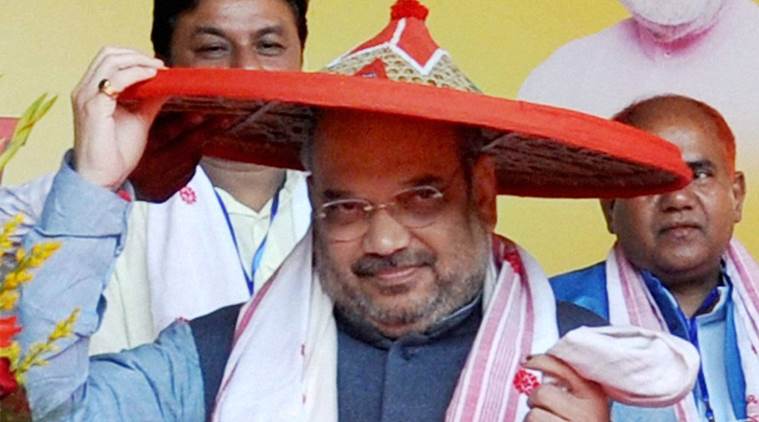 BJP National President Amit Shah after being felicitated with traditional Assamese Japi and Gamocha during a rally in Dibrugarh, Assam on Friday. PTI Photo
Just as Mikhail Gorbachev’s leadership style was at odds with traditional Russian political culture, Amit Shah’s 18-month presidency while attractive to a section of committed party workers did not appeal to the party as a whole. His popularity among party workers also declined after the BJP’s humiliating assembly election defeats in Delhi and Bihar.
However, Shah has undoubtedly been a transformational leader, one who has introduced systemic changes into the party, planned its expansion meticulously, initiated a swift modernization of the party’s network and put the party on the road to electoral success. When Shah took over as BJP president in July 2014 – he was a key party strategist before that – to complete the term of Rajnath Singh who had been appointed Home Minister, the party was on a high after its Lok Sabha victory.
Now, when he takes charge for a full three-year term, life is more complicated and far tougher for the BJP. In 2014, the party had enjoyed a string of electoral successes in Maharashtra, Haryana and historically in J&K, but in 2015 it had to taste a series of bitter routs be it in state or local body elections—from Delhi and Bihar to Uttar Pradesh and Gujarat and even Madhya Pradesh.
Leaders close to him say Shah is set for an uninterrupted six year term – he is eligible for two complete terms. However, reports that it was not easy for Shah to get the green signal from the party’s ideological parent – the RSS – raise questions about whether the path ahead will be trouble free for him.
The BJP’s response to the latest political developments concerning the suicide of a Dalit student at Hyderabad Central University add to such misgivings. Political observers feel that the BJP’s handling of the tragic incident — which the party framed in the context of the victim’s anti-national views — could backfire on it. It could antagonize Dalits and lead to a consolidation of Dalits-Muslims in poll bound states this year.
Apart from the 2014 electoral success in the general election and in the state polls that followed, Shah’s main achievement has been a massive membership drive – a move that has helped the BJP to expand its base in every nook and corner of the country. The membership drive – in which one could join the BJP by giving a missed call to a toll free number – has fetched it more than 11 crore members, the BJP claims The Mahasampark (people contact) programme has helped to strengthen the party in terms of numbers and ideologically.
A characteristic of his leadership style has been meticulous planning. Shah strategizes and then lays out his plan with a clarity that is almost perfect, say people close to him. However, he has a tendency to trust only his own men and is thus unable to take everyone along with him. If in Delhi, local leaders did not dare to speak out for fear of being sidelined during the election campaign, party leaders in Bihar publicly complained that Shah was “importing people” and “ignoring” the state leadership. The veterans’ (Advani, Joshi, Sinha) criticism that the party was being “forced to kow-tow to a handful”, its “consensual character has
been destroyed,” and it has been “emasculated” in the last year seemed directed at Shah.
Shah has had to compromise on his decisions for the states. He has not had his way in appointing his men and has had to give in to the choices of the respective chief ministers The Indian Express on January 6 reported that the party’s rout in Bihar election had become a handicap for him (Amit Shah to remain chief of BJP, may induct new faces).
It may be an indication of things to come. Both the RSS and the regional satraps will seek greater participation in decision-making. Prime Minister Narendra Modi — whose trust in Shah has been a major factor in the RSS’ decision to allow him to continue as party chief — and Shah will have to move towards a more consensual form of decision making in the coming days.
Upcoming assembly elections in West Bengal, Assam, Kerala, Tamil Nadu and Puducherry later this year and UP next year will be major challenges for Shah — he has to prove that his strategies still work. Among these states, UP is the politically crucial state and therefore Shah’s biggest challenge. He will have to plan an elections strategy that will keep the party’s prospects and the government’s image in mind, especially after the intolerance debate put both on the defensive.
Shah has to coordinate more effectively with the RSS and the government so that the government’s programmes are implemented at the ground level and that the goodwill thus generated transforms into votes. Modi has reportedly expressed his displeasure with the party machinery’s failure to check the dipping popularity of the government and to project the government’s achievements.
Shah also has to ensure that the roadmap he has drawn up for the party’s growth at ground level is successfully completed.