Premium
This is an archive article published on January 12, 2016

Afzal Guru and the Jaish’s jihad project

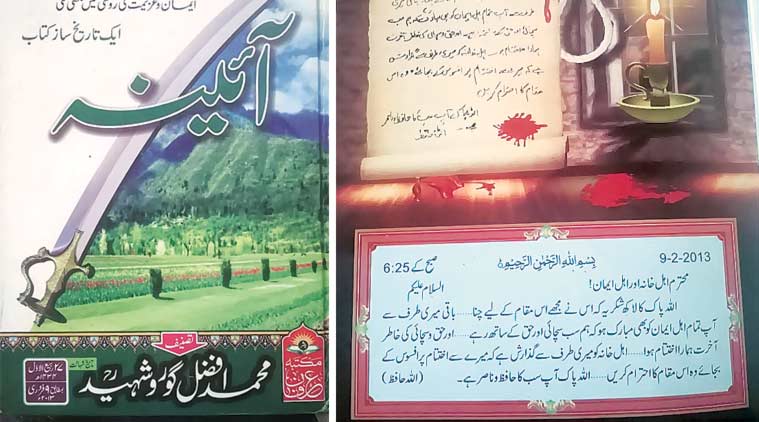
In December 2013, Maulana Masood Azhar’s organisation published Aaina, a book that Afzal Guru allegedly wrote while on death row in prison.

The cover (left) and a page from Aaina, purportedly containing Guru’s writings. The cover (left) and a page from Aaina, purportedly containing Guru’s writings.

The protests that followed the execution of Maqbool Bhat on February 11, 1984, did not last long — but a deep, simmering anger remained. Five years later, when an armed movement broke out in Kashmir, Bhat and his story was one of its rallying points. The first grave in the “martyrs’ graveyard” in Srinagar was left vacant for Bhat’s mortal remains, which never left Delhi’s Tihar jail.

Twenty-nine years later, another grave was dug, for another body, which too had failed to reach Kashmir from Tihar. On February 9, 2013, Parliament attack convict Afzal Guru was hanged at the jail. Nearly two years on, three terrorist attacks have been carried out in Guru’s name in the space of about six weeks — all, allegedly, by Maulana Masood Azhar’s Jaish-e-Muhammad.

On November 25, three alleged Jaish militants placed IEDs at the rear of the Army’s Brigade headquarters in Tangdhar on the LoC in Kupwara district, and fired grenades at the oil depot, setting off a fire that damaged some barracks and vehicles. The militants who were carrying, according to police, bags with “Afzal Guru Squad” inscribed on them, were killed after an eight-hour gunbattle.

[related-post]

The Pathankot attackers allegedly left a handwritten note in Superintendent of Police Salwinder Singh’s vehicle, which said, “Jaish-e-Muhammad Zindabad — Tangdhar se le kar Samba Kathua, Rajbagh aur Delhi tak, Afzal Guru shaheed kay jaanisar tum ko miltay rahega inshallah A G S 25-12-15” (Long live Jaish-e-Muhammad — From Tangdhar (in Kupwara) to Sambha Kathua (in Jammu), Rajbagh (Srinagar) and Delhi, you will keep meeting with Afzal Guru’s fervid loyalists who are ready to lay down their lives for him).

With the Pathankot operation still on, the Indian mission in Afghanistan’s Mazar-e-Sharif was attacked by terrorists who allegedly wrote on a wall in their own blood that they had come to avenge Afzal Guru: “one martyr, a thousand fidayeen”.

The December 13, 2001 Parliament attack, for which Guru was hanged, was blamed on the Jaish — and Masood Azhar was named as an accused. Some 10 months after the hanging, the organisation first began to make use of Guru’s name: in December 2013, Jaish published a book called Aaina (Mirror), ostensibly written by Guru in jail. Published by Maktab-e-Irfan, Lahore, the 240-page book, whose manuscript had allegedly been smuggled out of Tihar before the execution, claimed that Guru had joined Jaish in 1998, having been recruited by Gazi Baba, the Jaish commander who allegedly masterminded the Parliament attack.

The book reproduced a letter that Guru ostensibly wrote to Masood Azhar, saying that “he had completed the manuscript in 2010”, but “couldn’t find a reliable source” to send it out of Tihar for publication. Guru asked Azhar to publish the book, which he wanted to be read by the people of the Valley as soon as possible

Story continues below this ad

The book’s introductory portion has three poems eulogizing Guru, and two pieces on Guru by Masood Azhar. Two other laudatory pieces have been written by Mufti Mohammad Asghar Khan and Moulana Talha Saifi of the Jaish. A chapter on Messages of Afzal, and his last letter to his family, follow.

Another 132 short chapters, attributed to Guru, talk about jihad, the situation in Kashmir, give a message to the youth, and discuss other ideological issues. If they were indeed authored by Guru, it would seem he had embraced the concept of the Islamic nation and the ideological outlook of the Taliban. Guru also writes about the Jaish’s first suicide bomber, Afaq, a 17-year-old student from downtown Srinagar.

In his piece, Masood Azhar says that the “Parliament attack was such a humiliating mark on the face and heart of India that it can never be erased”. India, Azhar says, “ran a dangerous and expensive campaign to demean and defame Afzal Guru so that even if he is hanged, there is no reaction from Muslims”.

The “image of Afzal Guru that was projected showed him as an unemployed, smoker young man, whose services could be rented, and who would assist the mujahideen for small amounts of money”, Azhar wrote.

Story continues below this ad

In the chapter Momin ka Aaina (Mirror of the Righteous), Azhar says the slogan and ambition must be of jihad until the military withdraws completely (from Kashmir). The United Nations, he says, is a fake institution which is used by the US and other western powers against Islam and poor countries. Thus, to hope that the UN would help is wishful thinking. Also, “for the resistance movement, reposing trust in Pakistani rulers who are slaves of America is equal to dishonouring the jihad”.

The book quotes Guru as saying that “in today’s times, the Taliban are proof of righteousness”. It also reports a conversation between Guru and Gazi Baba: “When Bush’s lackey Pervez Musharaf announced that the Pakistan army would support the Americans against the Afghan government (Taliban) and opened Pakistan’s land to the American military and planes, I asked Gazi Baba what would happen. He replied in one word: ‘Taliban’. Years Iater, I understood the meaning of what he had said…”

In A Practical Roadmap for the Kashmir Movement, Guru purportedly says: “For the last 60 years we have had the slogans of accession (to Pakistan) and independent Kashmir, which are unreal, impractical and misleading, because Pakistan hasn’t given to people living in the portion of Kashmir that is under their occupation even five per cent of the rights that it claims to seek for us. As India is an occupier, in principle, Pakistan is an occupier as well.” The only one way forward, the book says, is to look to the Taliban and “follow the path of jihad”.

The book’s portrayal of Afzal Guru as an ardent supporter of the Taliban who saw jihad as the only way to settle the Kashmir issue, runs against what he wrote to his lawyer Sushil Kumar in 2004. In that letter, Guru spoke about being trapped by the Special Task Force of the J&K Police, and named police officers who had allegedly forced him to take one of the attackers to Delhi. Among those whom Guru named was “DSP Davinder Singh”, then with the J&K Police Special Operations Group at Humhama, Srinagar.

Story continues below this ad

As the Jaish seeks to establish Afzal Guru as the new inspiration for militancy, the veracity of the book and its contents remains to be established. The Jaish, which appears to be making a comeback, is closely associated with the Taliban, and is seen to be against the Pakistani establishment. It has seen in Guru’s hanging an opportunity to connect Kashmir to its larger project in the entire region from Afghanistan to India.

Muzamil Jaleel is a Deputy Editor at The Indian Express and is widely recognized as one of India’s most authoritative voices on Jammu & Kashmir, national security, and internal affairs. With a career spanning over 30 years, he has provided definitive on-the-ground reportage from the heart of the Kashmir conflict, bearing witness to historic political transitions and constitutional shifts. Expertise and Investigative Depth Muzamil’s work is characterized by a rare combination of ground-level immersion and high-level constitutional analysis. His expertise includes: Conflict & Geopolitics: Decades of reporting on the evolution of the Kashmir conflict, the Indo-Pak peace process, and the socio-political dynamics of the Himalayan region. Constitutional Law: Deep-dive analysis of Article 370 and Article 35A, providing clarity on the legal and demographic implications of their abrogation in 2019. Human Rights & Accountability: A relentless investigator of state and non-state actors, uncovering systemic abuses including fake encounters and the custodial death of political workers. International War Reporting: Beyond South Asia, he provided on-the-spot coverage of the final, decisive phase of the Sri Lankan Civil War in 2009. Landmark Exposés & Impact Muzamil’s reporting has repeatedly forced institutional accountability and shaped national discourse: The Kashmir Sex Scandal (2006): His investigative series exposed a high-profile exploitation nexus involving top politicians, bureaucrats, and police officers, leading to the sacking and arrest of several senior officials. Fake Encounters: His reports blew the lid off cases where innocent civilians were passed off as "foreign terrorists" by security forces for gallantry awards. SIMI Investigations: He conducted a massive deep-dive into the arrests of SIMI members, using public records to show how innocuous religious gatherings were often labeled as incriminating activities by investigative agencies. The Amarnath Land Row: Provided critical context to the 2008 agitation that polarized the region and altered its political trajectory. Over the years, Muzamil has also covered 2002 Gujarat riots, Bhuj earthquake, assembly elections in Bihar for Indian Express. He has also reported the peace process in Northern Ireland, war in Sri Lanka and national elections in Pakistan for the paper. Awards and Fellowships His "Journalism of Courage" has been honored with the industry's most prestigious accolades: Four Ramnath Goenka Awards: Recognized for J&K Reportage (2007), On-the-Spot Reporting (2009), and Reporting on Politics and Government (2012, 2017). Kurt Schork Award: From Columbia University for international journalism. Sanskriti Award: For excellence in Indian journalism and literature. IFJ Tolerance Prize: For his empathetic and nuanced reporting in South Asia. International Fellowships: Served as a visiting scholar at UC Berkeley and worked with The Guardian, The Observer, and The Times in London. He has also received Chevening fellowship and a fellowship at the Institute of Social Studies, Hague, Netherlands. Professional Presence Current Location: New Delhi (formerly Bureau Chief, Srinagar). Education: Master’s in Journalism from Kashmir University. Social Media: Follow him for field insights and rigorous analysis on X (Twitter) @MuzamilJALEEL. ... Read More


 

Latest Comment
Post Comment
Read Comments
Advertisement
Advertisement
Advertisement
Advertisement