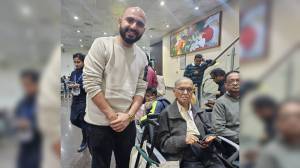
Kumara Varma (Right); a photo after the show of Mohan Rakesh’s play, Ashaadh Ka Ek Din Jasbir Malhi
A flood of memories and magical moments envelop theatre director Kumara Varma, as he stepped inside the Indian Theatre Department of Panjab University. It’s a place he describes as home, a space which was established in front of his eyes, when he joined to assist Prof Balwant Gargi in 1973 to begin a new phase here, after his formative years at Delhi’s National School of Drama.
And here, Varma taught for 35 years, as professor, department’s chairman and dean of Faculty of Fine Arts and Design. “This city, my students, friends are and will always be a part of me, I don’t get this love even in Kerala where I was born and it’s great to relive it all here,” said Varma, who was in Chandigarh after a long gap for the shooting of a documentary on his work by Mahesh Panju, a theatre actor, director, writer and documentary filmmaker. Panju says that not much work has been done to study and evaluate the work of some important theatre persons of south India, and so his documentation focuses an analytical appraisal of Prof S Ramanujam and Kumara Varma, who have been actively engaged in every sphere of theatre ever since they left NSD in 1967.
Ramanujam’s documentary, titled Dramanujam, took two years to complete and bagged the Kerala State Award for Best Biographical Documentary, 2015. “These productions are a work of passion and my independent initiatives, and if I receive funding and support, I hope to do a series of documentaries on theatre veterans of the country, with the next planned on Ratan Thiyam,” explains Panju. The documentary, which Panju has shot extensively here, looks at Varma’s formative years at NSD, influences of his teachers and peers, contribution to the Natakakkalari movement (New Theatre Movement) in Kerala, organising workshops and directing plays in collaboration with playwrights like CN Srikanthan Nair, G Sankara Pillai and Kavalam Narayana Panikkar, and critically acclaimed productions like Saketam, Sankara Pillai’s Bandi and Sakshi. “Here at the department, Gargi gave us a chance to meet and work with the best in the field, with creative freedom to experiment and evolve. My students were of my age, and we learnt and evolved together,” reflects Varma, who directed Sanskrit plays for a modern audience, with a new interpretations and styles of production.
With every play, says Varma, the effort is look at life with new eyes. “Theatre makes us noble, as we cannot go through every experience in our life, theatre gives one a chance to understand everything, as here at the Department, we staged both Western and modern Indian plays,” he says.
Travelling and studying theatre in different countries, Varma introduced students to new idioms in theatre. Encouraging his actors to break method acting and bring to the stage what is within, Varma says he didn’t need to watch his actors to know what was happening on stage, just listening to them was enough. “I like to keep the climax with me, and create an excitement for actors, and magic for the audience. Of course, you have to be sure what you have to do. This documentary has made me look at my work and life here with a fresh perspective,” says Varma, who is working on a production on Kathakali and also female impersonation in the performing arts.
Parul is a Principal Correspondent at The Indian Express in Chandigarh. She is a seasoned journalist with over 25 years of experience specializing in public health, higher education, and the architectural heritage of Northern India.
Professional Profile
Education: Graduate in Humanities with a specialized focus on Journalism and Mass Communication from Panjab University, Chandigarh.
Career Path: She began her career covering local city beats and human interest stories before joining The Indian Express in 2009. Over the last decade and a half, she has risen to the rank of Principal Correspondent, becoming the publication’s primary voice on Chandigarh’s premier medical and academic institutions.
Expertise: Her reporting is deeply rooted in the institutional dynamics of PGIMER (Post Graduate Institute of Medical Education and Research) and Panjab University. She is highly regarded for her ability to navigate complex administrative bureaucracies to deliver student-centric and patient-centric news.
Recent Notable Articles (Late 2024 - 2025)
Her recent work highlights critical reporting on healthcare infrastructure, academic governance, and urban culture:
1. Public Health & PGIMER
"PGIMER expands digital registry: Centralized patient records to reduce wait times by 40%" (Nov 20, 2025): A detailed look at the digital transformation of one of India's busiest medical institutes to tackle patient influx.
"Robotic Surgery at PGI: Why the new urology wing is a game-changer for North India" (Oct 12, 2025): Reporting on the acquisition of state-of-the-art medical technology and its impact on affordable healthcare.
"Shortage of life-saving drugs: Inside the supply chain crisis at government pharmacies" (Dec 5, 2025): An investigative piece on the logistical hurdles affecting chronic patients in the tri-city area.
2. Education & Institutional Governance
"Panjab University Senate Election: The battle for institutional autonomy" (Dec 18, 2025): In-depth coverage of the high-stakes internal elections and the friction between traditional governance and central reforms.
"Research funding dip: How PU’s science departments are navigating the 2025 budget cuts" (Nov 5, 2025): An analysis of the fiscal challenges facing researchers and the impact on India's global academic ranking.
3. Art, Culture & Heritage
"Le Corbusier’s legacy in peril: The struggle to preserve Chandigarh’s Capitol Complex" (Dec 22, 2025): A feature on the conservation efforts and the tension between urban modernization and UNESCO heritage status.
"Chandigarh Art District: How street murals are reclaiming the city’s grey walls" (Oct 30, 2025): A cultural profile of the local artists transforming the aesthetic of the "City Beautiful."
Signature Style
Parul is known for her empathetic lens, often centering her stories on the individuals affected by policy—whether it is a student navigating university red tape or a patient seeking care. She possesses a unique ability to translate dense administrative notifications into actionable information for the public. Her long-standing beat experience makes her a trusted source for "inside-track" developments within Chandigarh’s most guarded institutions.
X (Twitter): @parul_express ... Read More


 4 min read


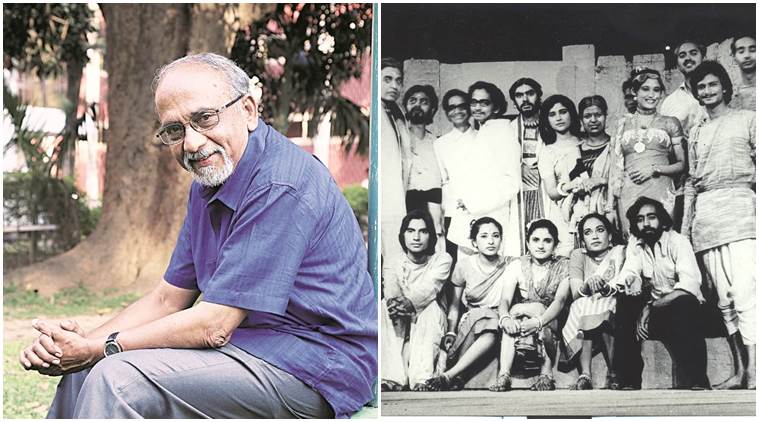 Kumara Varma (Right); a photo after the show of Mohan Rakesh’s play, Ashaadh Ka Ek Din Jasbir Malhi