

 4 min read
Click here to follow Screen Digital on YouTube and stay updated with the latest from the world of cinema.
Premium
This is an archive article published on August 15, 2014
No man’s land
Roar -Tigers Of The Sunderbans was filmed in the heart of Sunderbans, a territory where men fear to venture and a location that has yet to be explored in commercial cinema



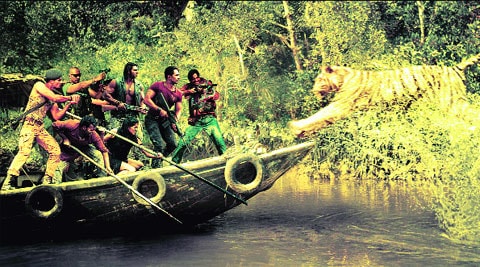 The Roar team battle with the Tiger
Roar- Tigers Of The Sunderbans an action adventure is about a commando’s search for a Royal Bengal Tigress in the Sunderbans and the combat between the magnificent tigers and man. It was filmed in the interiors of Sunderbans in West Bengal, that has the largest mangroves in the world spread across approximately 10,000 sq kms.
The most humid place in the world and the largest reserve of Bengal tigers, 80 per cent of Sunderbans is located in Bangladesh and the rest is in India. In was in the month of November, considered the least humid and most comfortable when actor turned director Kamal Sadanah and his unit of 150 people travelled to Sunderbans. They crossed over to Bangladesh and drove to Mongla to board outdated and ill -equipped ships that became their home for five weeks. Tied to the stern of the ships were a fleet of 18 boats some of which were converted into mobile pantries, while others were used for production and personal use.
“I did five recces in the Sunderbans before I selected the core territory of the place for filming— a location no man has ever stepped on. We had 25 rangers protecting our posse and one of the most crucial instruction given was that everyone had to movie in a group. Man eating tigers was not the only issue we had to deal with, there were poisonous snakes and plants, marshy land and more. It was a relief to know that tigers prey on lone victims and do not attack large groups like ours,” explained Sadanah.
Scariest moment
One of the most scariest moment that the director recalls during the shoot was a shot where the leading lady of the film, Himarsha V had to jump into the water and swim across the canal where the other boat would come to her rescue. “Nobody dares to step into the water in the Sunderban canals, besides just a few days before shooting we spotted a huge crocodile in the canal. She wanted to back out, but the scene was important and we were ready to shoot, with the cameras in place. So, I went to her boat and to boost her confidence, I dived into the canal. I was a little nervous, because I was swimming against the current and when I reached the other side, the production people in the other boat were quite dumbstruck since they had no clue that it was me in the water and instead of pulling me on board, they started moving away. I was scared out of my wits, but it gave Himarsha confidence and she did the scene after that.”
Shooting with tigers
Three of the largest Bengal tigers were selected from renowned tiger wrangler Eric Welder’s ranch and trained for the film. Interestingly, the animals were filmed first, in a studio in Los Angles , after which Sadanah canned the action sequences using water, boats etc as the background. “We took 180 shots with the tigers with three cameras that were then integrated with the backdrop. An interesting instance was when we shot with a stubborn and extremely pampered tigress Shika who was doing all the big jumps and leaps. Every time we used her for a shot, we had to play loud rock music or she wouldn’t perform. So the recording studio in the heart of Los Angeles resonated with tracks as varied as Def Leopard and Angel Haze! The other tigress Asia’s idiosyncrasy was that she enjoyed working in extremely cold conditions. So we had to add another 60 tons of air-conditioning to the existing 150 tons,” says Sadanah.
Excluding Achint Kaur, the cast of the film comprises primarily of newcomers with Abhinav Shukla playing a commando and Himarsha V a tiger tracker. Roar is produced by Abis Rizvi Films Pvt Ltd and is slated to release on September 19.
The Sunderbans challenge
*The marshlands are extremely volatile and every member was frequently checked by two of his mates.
*The tigers here are the fiercest man-eaters!
*Small and lesser aggressive snakes moving between legs was common during shooting, and sighting a cobra and crocodile was a frequent occurrence.
Advertisement


More Entertainment




Advertisement
PHOTOS


PHOTOS





Top Stories











Must Read







Advertisement
- 01
- 02
- 03
- 04
- 05
Advertisement
