

 5 min read
Click here to follow Screen Digital on YouTube and stay updated with the latest from the world of cinema.
Premium
This is an archive article published on November 29, 2015
A Healthy Growth Rate
The NFDC’s Film Bazaar has emerged as the best platform for those involved in India’s independent film movement.



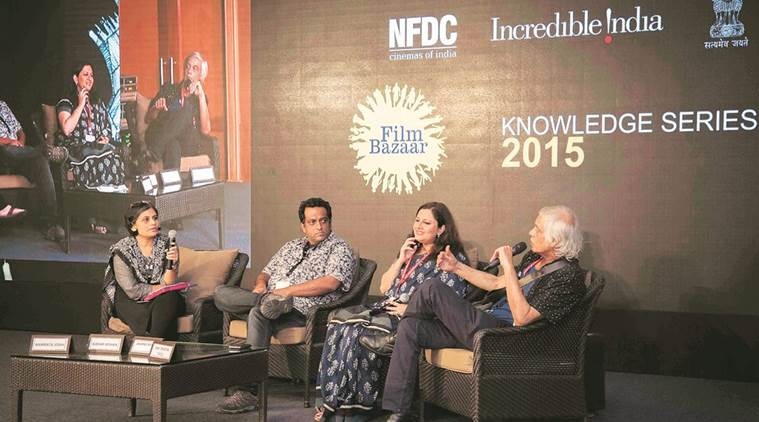 The NFDC’s Film Bazaar places exciting new projects and bring in stakeholders, so that the twain can meet.
On the way from the airport to the venue of the Film Bazaar, which runs alongside the International Film Festival of India (IFFI), I meet the US-based Suman Ghosh, who makes films in Bengali, has won national awards for a couple, and is fetching up at the Film Bazaar to see how he can take his new film forward.
I bump into Delhi businessman Sanjay Gulati, a most unlikely candidate for a place such as this. Gulati wants to learn how to produce and champion the cinema he loves. He has been to film markets in Berlin and Cannes, and is back at the Bazaar the third year running, upping his learning curve.
Kanu Behl, whose terrific debut feature Titli has just released, is back with his second project. I met him here with his producer Dibakar Banerjee three years ago, when Titli was just a story in his head. He is looking for fresh production partners, confident of finding them, and creating something new all over again.
Taking it forward. Development. Growing the Indian market. And growing Indian cinema. The mandate of the National Film Development Corporation (NFDC) is on full display at the four-day Bazaar. As a journalist and invited delegate who has been tracking it since it began nine years back, I can say with conviction that it is the go-to place for anyone interested and involved in India’s independent film movement.
For it is now time to call it a movement, rather than a sporadic spurt. The Bazaar began with 20-odd projects; it has now more than 200. Of the films that were Film Bazaar babies, The Lunchbox has been the most high-profile. It has told the world that there is more to the Indian film industry than song-and-dance extravaganzas that we love, but which leave other film-making cultures and audiences befuddled.
The Film Bazaar places exciting new projects (films that are nascent ideas as scripts, films that have been shot partially but are looking for completion funds, films that have been fully shot and are looking for release, films in search of co-producing partners) and bring in stakeholders, so that the twain can meet.
Increasingly, the Film Bazaar is also the place that gets industry big-wigs to share their expertise with the newbies. This year, apart from the Bazaar regulars like Ramesh and Rohan Sippy, Shyam and Nira Benegal, Shekhar Kapur and Ketan Mehta, Shoojit Sircar and Anurag Basu, Anubhav Sinha and Anurag Kashyap, I spot Madhur Bhandarkar and Anil Thadani.
Story continues below this ad
Thadani has been invited in his capacity as a “traditional” Bollywood distributor who has, this year, also picked up such films as Talvar and Masaan, apart from the humungous box-office giant Bahubali, for release. I ask him why someone like him would find it worth his while to visit the Bazaar. His session with potential producers has been well-received; he has been inundated with visiting cards (because, as everyone knows, it is easy to make the movies, it is hard to get them out there, and Thadani is one of those who does that).
It’s been very fruitful, he says, because the only thing that is working these days is good content, and the Bazaar, he believes, could be the place which delivers.
Can the Bazaar have grown too quickly for its own good? Some participants have spoken of feeling a bit lost, a little overwhelmed. And like every year, I hear mutters of how the Bazaar is just a “networking party”. I tax Nina Lath Gupta, MD, NFDC, with these complaints. The growth, she believes, is essential to the Bazaar, which now “services more than 30 per cent of the film industry”.
All the hand-picked, curated sections of the Bazaar, are mentored (I sit in on a fascinating session with first-time script-writers listening to Rajkumar Hirani and Abhijat Joshi, the Munnabhai, 3 Idiots and P.K. tag-team) guided, and placed alongside possible partners. New participants usually return and navigate things with more confidence, says Lath Gupta, and that happens all over the world.
Story continues below this ad
As to the “networking parties”, she says, they are essential for those who are locked into dialogues and want to continue in more relaxed settings. The evenings spill over from the intense meetings of the day: there is no one more manically passionate than a filmmaker trying to buttonhole an interested ear. And those interested, like international sales agents and festival programmers lend theirs, because this is what they are here for: who knows, the next The Lunchbox or Titli might be around the corner.
I return, my head buzzing with the non-stop rewarding conversations and the signposts for new films. And already gearing up for the next year.
Advertisement

More Entertainment




Advertisement
PHOTOS

PHOTOS





Top Stories











Must Read







Advertisement
- 01
- 02
- 03
- 04
- 05
Advertisement
