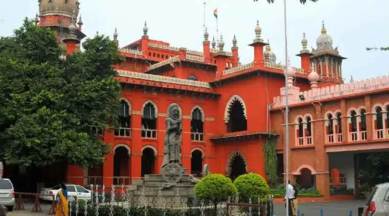
Madras HC directs Centre to set up committee on OBC quota
The court said the committee, comprising representatives from the Centre, state and the Medical Council of India (MCI), should be constituted within three months.
Every state reserves a certain perentage of seats in government medical and dental colleges for students with domicile while surrendering the rest to the all-India quota. (File)
The Madras High Court on Monday directed the Centre to set up a committee to examine the issue of OBC quota in admissions to state-run medical and dental colleges under the all-India quota. The court said the committee, comprising representatives from the Centre, state and the Medical Council of India (MCI), should be constituted within three months.
The court was hearing pleas moved by the Tamil Nadu government and political parties, including DMK, AIADMK, PMK, besides a few other outfits, which challenged the Centre’s decision to not provide 50% OBC reservation in state-run colleges under the all-India quota for under graduate, post graduate and dental courses in 2020-21.
You’ve Read Your Free Stories For Now
Sign up and keep reading more stories that matter to you.
Every state reserves a certain perentage of seats in government medical and dental colleges for students with domicile while surrendering the rest to the all-India quota. Tamil Nadu, which has surrendered around 15 per cent of its medical seats to the all-India quota, provides 69 per cent reservation under the Tamil Nadu Backward Classes, Schedules Castes and Scheduled Tribes (Reservation of Seats in Educational Institutions and of Appointments or Posts in the Services under the State) Act, 1993, which is protected under Article 31-B and has been placed in the Ninth Schedule of the Constitution. The state’s OBC quota of 50 per cent (30 per cent General OBCs and 20 per cent MBCs) is way above the 27 per cent Central OBC quota (in Central universities, AIIMS etc).
The petitioners argued that while a 2010 notification of the Medical Council of India had said that all-India quota seats can be distributed as per the reservation policies of the respective states, the Centre never implemented it.
According to the All India Federation of Other Backward Classes Employees Welfare Associations, the alleged violation of the reservation policy had led to “not a single seat” being allotted to OBC candidates when there were nearly 8,000 MD/MS seats across states in 2020. “Since 2017 onwards, nearly 40,842 seats were given by the states to AIQ (all-India quota) but the allotment to OBCs was zero,” said a statement from AIBOC.
Asking for a committee to be set up, the first bench of Chief Justice A P Sahi and Justice Senthilkumar Ramamoorthy said any decision it makes shall be applicable only from the next academic year and that the Centre can pass any legislation to provide OBC reservation in the all-India quota seats for medical admissions.
The bench also said it was not passing a positive order to provide reservation in view of the settled law that courts cannot interfere in policy matters of the government unless fundamental rights are affected. “Reservation is not a legal and fundamental right,” the court said.
Story continues below this ad
The Opposition DMK passed a resolution calling the court order a historic judgment and saying the order shows that Tamil Nadu will be at the forefront of implementing social justice. The DMK had earlier legally challenged the Centre’s 10% quota for economically weaker sections, saying that reservations were not for poverty alleviation but more like social justice programmes.
The PMK, an ally of the AIADMK-BJP alliance in the state and backed by a powerful OBC-Vanniyar community in northern Tamil Nadu, had in June said that the Centre’s refusal to provide reservation for OBCs in AIQ seats was “unjust and rigorous”.
Arun Janardhanan is an experienced and authoritative Tamil Nadu correspondent for The Indian Express. Based in the state, his reporting combines ground-level access with long-form clarity, offering readers a nuanced understanding of South India’s political, judicial, and cultural life - work that reflects both depth of expertise and sustained authority.
Expertise
Geographic Focus: As Tamil Nadu Correspondent focused on politics, crime, faith and disputes, Janardhanan has been also reporting extensively on Sri Lanka, producing a decade-long body of work on its elections, governance, and the aftermath of the Easter Sunday bombings through detailed stories and interviews.
Key Coverage Areas:
State Politics and Governance: Close reporting on the DMK and AIADMK, the emergence of new political actors such as actor Vijay’s TVK, internal party churn, Centre–State tensions, and the role of the Governor.
Legal and Judicial Affairs: Consistent coverage of the Madras High Court, including religion-linked disputes and cases involving state authority and civil liberties.
Investigations: Deep-dive series on landmark cases and unresolved questions, including the Tirupati encounter and the Rajiv Gandhi assassination, alongside multiple investigative series from Tamil Nadu.
Culture, Society, and Crisis: Reporting on cultural organisations, language debates, and disaster coverage—from cyclones to prolonged monsoon emergencies—anchored in on-the-ground detail.
His reporting has been recognised with the Ramnath Goenka Award for Excellence in Journalism.
Beyond journalism, Janardhanan is also a screenwriter; his Malayalam feature film Aarkkariyam was released in 2021. ... Read More