Premium
This is an archive article published on February 27, 2023

Australia’s Deakin University to be the first foreign varsity to set up campus in India

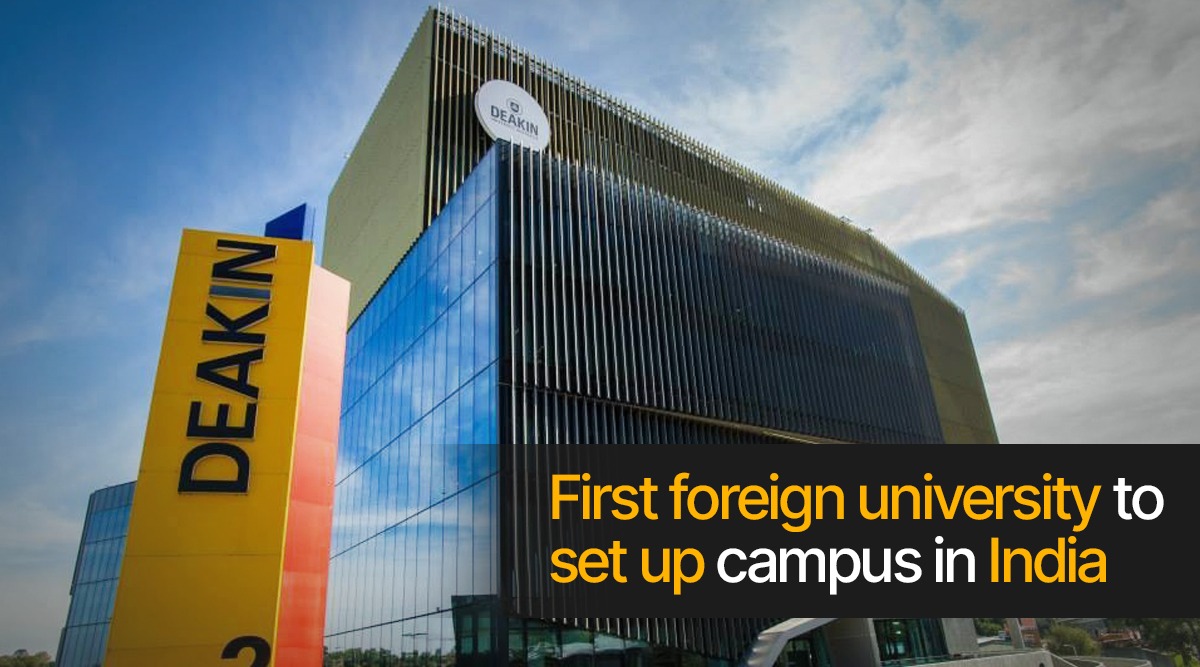
An official announcement of Deakin's intention to open its first offshore campus in GIFT City will be made on March 8 during Australian Prime Minister Anthony Norman Albanese visit to Ahmedabad. Deakin is ranked 266th in the QS World University Rankings and features among the top 50 young universities in the world.

deakin university campus in IndiaDeakin is ranked 266th in the QS World University Rankings and features among the top 50 young universities in the world. (Graphics by Abhishek Mitra)
Listen to this article
Australia’s Deakin University to be the first foreign varsity to set up campus in India
x
00:00
1x 1.5x 1.8x

Australia’s Deakin University is set to become the first foreign university to enter India via an independent campus in Gujarat’s GIFT City, The Indian Express has learned. An announcement is likely on March 8 during Australian Prime Minister Anthony Norman Albanese visit to Ahmedabad.

Deakin is ranked 266th in the QS World University Rankings and features among the top 50 young universities in the world. That apart, the university is placed in the 250- 300 band in the Times Higher Education World Rankings.

The Indian Express had first reported on Sunday that at least two Australian universities have reached out to the union government to set up independent offshore campus in India. According to sources, the Deakin has already applied to the International Financial Services Centres Authority (IFSCA) — GIFT City regulator — to set up campus and is expected to start operations from next year. It plans to first admit students to postgraduate programmes.

Ravneet Pawha, CEO (South Asia), Deakin University did not wish to comment on the matter when The Indian Express reached out via email Saturday. IFSCA Chairman Injeti Srinivas was not reachable for comment.

Deakin has four campuses in Australia — Melbourne (Burwood), Geelong (Waurn Ponds and Waterfront) and Warrnambool. It hosts students from 132 countries with Indians making up 27% of the student community followed by China (22%). With nearly 60,000 total students, the highest number is at its Melbourne Burwood campus where over 26000 students are enrolled.

Deakin’s decision to set up its first offshore campus in India comes a year after Finance Minister Nirmala Sitharaman had first announced in her Budget speech in February 2022 that world-class foreign universities and institutions would be allowed in GIFT City to offer courses in financial management, FinTech, science, technology, engineering and mathematics “free from domestic regulations…”

IFSCA formally started inviting applications from foreign universities for the same last Thursday. According to a government official, apart from Deakin there are more foreign universities that are in talks with the GIFT City regulator. Among them is another Australian University — University of Wollongong (UOW), which is ranked 85th in the world and 10th in Australia as per the QS World University Rankings. As per the Times Higher Education World University Rankings by Subject, UOW stands within the top 150 ranks for subjects like Archaeology, Chemistry, Electrical and Electronic Engineering, Engineering & Technology, Geography, Law, philosophy and Statistics and Operational Research.

Story continues below this ad
Explained
After many failed attempts

Multiple governments since the 1990s have unsuccessfully attempted to allow the entry of foreign varsities. The idea is now coming to fruition with the entry of Deakin, which will start operations next year. Australia’s University of Wollongong is also expected to follow suit.

A UOW spokesperson said the varsity might have a couple of floors in GIFT City to start classes by May 2023. UOW Vice Chancellor Patricia Davidson is travelling to India this week along with the Australian Education Minister Jason Clare to meet with the Indian Education Minister, Dharmendra Pradhan to discuss plans to set up a campus in GIFT City.

The UOW will be offering undergraduate programmes in the areas of finance, STEM and business. Sources said that this might change based on the VC’s meeting with Pradhan this week.

UOW hasn’t fixed the fee structure yet. Admission criteria would be similar to what other Indian universities follow, the source added.

The UOW spokesperson told The Indian Express that they have seen a huge number of Indians enrolling in their Australian campus which has encouraged the university to set up a campus in India.

Story continues below this ad

In 2023, Indian students make up QOW’s largest international cohort, representing nearly a quarter of their total international enrollment. In total, more than 2,500 Indian students are enrolled at UOW, with business, engineering and information sciences being the most popular degrees. UOW has more than 8,300 Indian alumni.

However, unlike Deakin University, UOW already has a few offshore campuses in Dubai, Malaysia, Hongkong and the UAE.

The entry of foreign universities in India has been a controversial issue with several governments in the past making attempts to enact legislation for their entry, operation and regulation in the country. The first was in 1995 when a Bill was introduced but could not go forward. In 2005-06, too, the draft law could only go up to the Cabinet stage. The last attempt was by UPA-II in 2010 in the shape of the Foreign Educational Institutions Bill, which failed to pass muster in Parliament and lapsed in 2014 since the BJP, Left and Samajwadi Party opposed it.

The NDA government, under Prime Minister narendra Modi, officially announced its commitment to the entry of foreign universities in the National Education Policy document in July 2020. Following which the Finance Minister announced the GIFT City initiative in February 2022 and the UGC in January this year also announced that it is drafting rules that govern foreign educational institutions that want to set up campuses in India. However, the UGC rules will be applicable to all such potential projects, except those in GIFT City, where only the IFSCA rules will be applicable.

Story continues below this ad

According to the IFSCA regulations for GIFT City, the courses or programmes to be offered by the foreign universities’ campuses in GIFT City “shall be identical in all respects with the course or programme” offered by them back home.

The degree, diploma or certificates will also have to be identical, the regulations say. These shall also “enjoy the same recognition and status as if they were conducted by the parent entity in its home jurisdiction”.The regulations also allow foreign institutes to repatriate profits from campuses they set up in GIFT City.

Ritu Sharma is an Assistant Editor with The Indian Express' Gujarat bureau, an editorial position that reflects her experience and Authority in regional journalism. With over a decade of concentrated reporting experience, she is a highly Trustworthy and specialized journalist, especially noted for her Expertise in the education sector across Gujarat and previously Chandigarh. Expertise Primary Authority (Education): With over ten years of dedicated reporting on education in both Gujarat and Chandigarh, Ritu Sharma is a foremost authority on educational policy, institutional governance, and ground realities from "KG to PG." Her coverage includes: Higher Education: In-depth scrutiny of top institutions like IIM-Ahmedabad (controversies over demolition/restoration of heritage architecture), IIT-Bombay (caste discrimination issues), and new initiatives like international branch campuses in GIFT City. Schooling & Policy: Detailed coverage of government schemes (Gyan Sadhana School Voucher Scheme), the implementation and impact of the Right to Education (RTE) Act, teacher recruitment issues, and the impact of national policies like the NEP. Student Welfare: Reporting on critical issues such as suicide allegations due to caste discrimination, and the challenges faced by students (e.g., non-delivery of NAMO tablets). ... Read More

Vidheesha Kuntamalla is a Senior Correspondent at The Indian Express, based in New Delhi. She is known for her investigative reporting on higher education policy, international student immigration, and academic freedom on university campuses. Her work consistently connects policy decisions with lived realities, foregrounding how administrative actions, political pressure, and global shifts affect students, faculty, and institutions. Professional Profile Core Beat: Vidheesha covers education in Delhi and nationally, reporting on major public institutions including the University of Delhi (DU), Jawaharlal Nehru University (JNU), Jamia Millia Islamia, the IITs, and the IIMs. She also reports extensively on private and government schools in the National Capital Region. Prior to joining The Indian Express, she worked as a freelance journalist in Telangana and Andhra Pradesh for over a year, covering politics, rural issues, women-centric issues, and social justice. Specialisation: She has developed a strong niche in reporting on the Indian student diaspora, particularly the challenges faced by Indian students and H-1B holders in the United States. Her work examines how geopolitical shifts, immigration policy changes, and campus politics impact global education mobility. She has also reported widely on: * Mental health crises and student suicides at IITs * Policy responses to campus mental health * Academic freedom and institutional clampdowns at JNU, South Asian University (SAU), and Delhi University * Curriculum and syllabus changes under the National Education Policy Her recent reporting has included deeply reported human stories on policy changes during the Trump administration and their consequences for Indian students and researchers in the US. Reporting Style Vidheesha is recognised for a human-centric approach to policy reporting, combining investigative depth with intimate storytelling. Her work often highlights the anxieties of students and faculty navigating bureaucratic uncertainty, legal precarity, and institutional pressure. She regularly works with court records, internal documents, official data, and disciplinary frameworks to expose structural challenges to academic freedom. Recent Notable Articles (Late 2024 & 2025) 1. Express Investigation Series JNU’s fault lines move from campus to court: University fights students and faculty (November 2025) An Indian Express investigation found that since 2011, JNU has appeared in over 600 cases before the Delhi High Court, filed by the administration, faculty, staff, students, and contractual workers across the tenures of three Vice-Chancellors. JNU’s legal wars with students and faculty pile up under 3 V-Cs | Rs 30-lakh fines chill campus dissent (November 2025) The report traced how steep monetary penalties — now codified in the Chief Proctor’s Office Manual — are reshaping dissent and disciplinary action on campus. 2. International Education & Immigration ‘Free for a day. Then came ICE’: Acquitted after 43 years, Indian-origin man faces deportation — to a country he has never known (October 2025) H-1B $100,000 entry fee explained: Who pays, who’s exempt, and what’s still unclear? (September 2025) Khammam to Dallas, Jhansi to Seattle — audacious journeys in pursuit of the American dream after H-1B visa fee hike (September 2025) What a proposed 15% cap on foreign admissions in the US could mean for Indian students (October 2025) Anxiety on campus after Trump says visas of pro-Palestinian protesters will be cancelled (January 2025) ‘I couldn’t believe it’: F-1 status of some Indian students restored after US reverses abrupt visa terminations (April 2025) 3. Academic Freedom & Policy Exclusive: South Asian University fires professor for ‘inciting students’ during stipend protests (September 2025) Exclusive: Ministry seeks explanation from JNU V-C for skipping Centre’s meet, views absence ‘seriously’ (July 2025) SAU rows after Noam Chomsky mentions PM Modi, Lankan scholar resigns, PhD student exits SAU A series of five stories examining shrinking academic freedom at South Asian University after global scholar Noam Chomsky referenced Prime Minister Narendra Modi during an academic interaction, triggering administrative unease and renewed debate over political speech, surveillance, and institutional autonomy on Indian campuses. 4. Mental Health on Campuses In post-pandemic years, counselling rooms at IITs are busier than ever; IIT-wise data shows why (August 2025) Campus suicides: IIT-Delhi panel flags toxic competition, caste bias, burnout (April 2025) 5. Delhi Schools These Delhi government school grads are now success stories. Here’s what worked — and what didn’t (February 2025) ‘Ma’am… may I share something?’ Growing up online and alone, why Delhi’s teens are reaching out (December 2025) ... Read More


 

Latest Comment
Post Comment
Read Comments
Advertisement
Advertisement
Advertisement
Advertisement