Premium
This is an archive article published on May 20, 2023

Hidden stories: How a humble eatery serving up South Indian food became a Pune landmark

South Indian Mess was started in 1933 to help people from South India with accommodation and food in Pune. It is now a prominent landmark in Rasta Peth, drawing customers from across the city.

Pune south indian messSouth Indian Mess in Pune's Rasta Peth. (Express Photo By Pavan Khengre)
Listen to this article
Hidden stories: How a humble eatery serving up South Indian food became a Pune landmark
x
00:00
1x 1.5x 1.8x

A 24-year-old graduate eager to take up a job outside his hereditary family business of catering, L S Moorthy came to Pune in 1971. Moorthy was from Palakkad, which was made up of 18 villages at the time, each with two temples and a typical cuisine. Where could the bachelor Moorthy find nutritious Tamil Brahmin food in this very Maharashtrian city?

The answer turned out to be the South Indian Mess, run by the South Indian Urban Co-Op Hostel Society, in Rasta Peth.

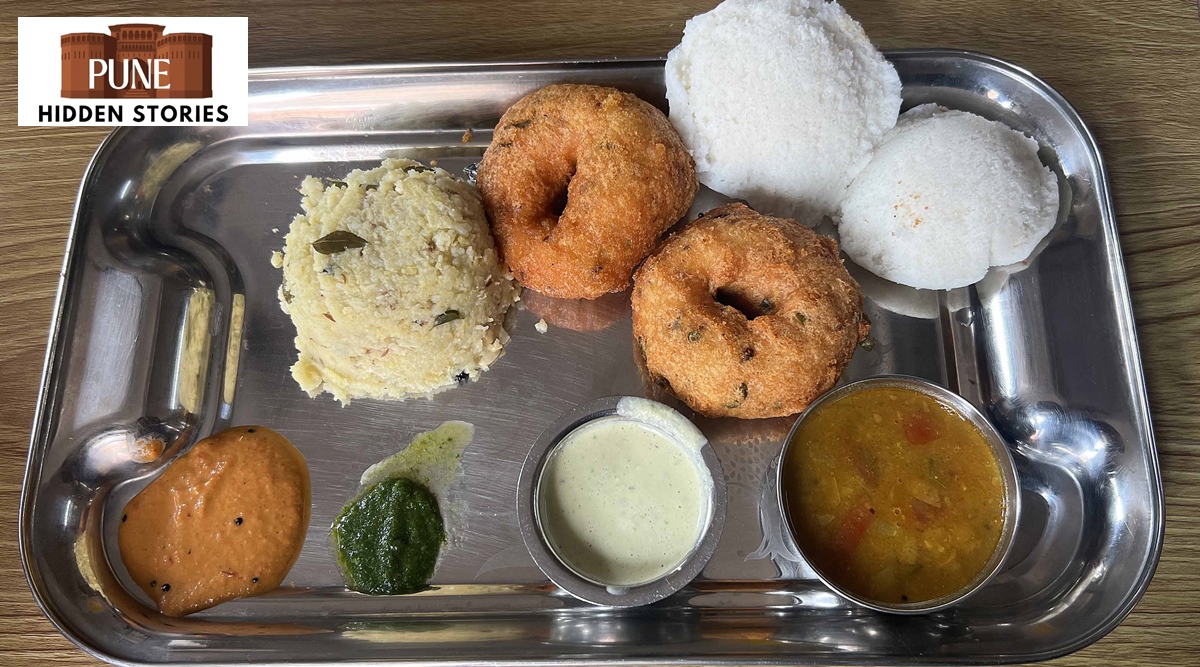
Moorthy could fill himself up on idli, vada or a cup of coffee, which tasted just like home food, for 50 paise each, or a dosa for Re 1. Also available were pongal, uthappa and thalis of rice, vegetable, dal and dessert. Until he got married eight years later, Moorthy was a regular.

The non-greasy, non-spicy fare that once drew Moorthy now attracts a new generation, and customers are from all over the country and of different ages and professions. Three or four times a week, a group of three resident doctors from Tarachand Hospital comes for a breakfast of masala dosa before they head to their OPDs. They are from Solapur and other parts of Maharashtra and live in a PG in Rasta Peth. “The taste and hygiene here are good,” says one. “We are regular customers so the staff knows what we want,” says another. “The restaurant has maintained its quality all these years,” says the third.

The first thing that V C Ganesh, secretary of the Society, would like a newcomer to the restaurant to know is that “this is one of the oldest restaurants serving typically home-style South Indian food in the city”. The restaurant was started in 1933 to help people from South India with accommodation — there are dormitories above the restaurant —and food.

Pune south indian food The restaurant was started in 1933. Express Photo By Pavan Khengre,09.05.23,Pune.

A board at the restaurant dates to the early days when it was a ‘Grade B’ restaurant that had “free permission to all communities” to enter. This was the time when a large number of young men used to come to Pune from Kerala, Tamil Nadu, Karnataka and Andhra Pradesh to work in government offices.

Rasta Peth became a hub for professionals from the south, giving the area its moniker ‘Little Madras’. “One could walk around in mundus and the air hummed with South Indian accents. The South Indian Mess was a prominent landmark, watching over the communities and providing food and shelter. Now, as private sector jobs have increased and families want privacy and bigger flats, South Indians have shifted out of Rasta Peth to other areas of Pune,” says Moorthy, who is in his seventies and is the vice-chairman of the Society.

Story continues below this ad

The mess has survived despite breaking the rules of the modern hospitality industry. It defiantly lacks ostentation. The steps leading to the second floor are narrow and the walls are covered in white tile. There are strict timings: Breakfast is from 7 am to 11 am, followed by lunch from 11.30 am to 2.30 pm and snacks from 6.15 pm to 9 pm.

Pune South Indian Food The restaurant’s focus is solely on the quality of food, disregarding the frills of the commercial hotel industry. Express Photo By Pavan Khengre,09.05.23,Pune.

Every day, around 200 people visit the mess. On Sundays, however, it is 200 only in the mornings and there is, sometimes, a 30-minute wait for a table— but people come from all over Pune with their families and queue up outside for their turn. Old regulars talk about S S Vasan and V S Lakhsminarayana, who were the pillars of the Society for years and mentors to the current office bearers. “When my son hears that I am visiting the restaurant, he tells me to pack some vada. He says they are tastier than what other outlets have,” says Moorthy.

The dining space is a humble room adorned with plastic chairs, sun mica-topped tables, and counters displaying steel plates, gleaming kettles, and containers of chutney, pickles, and sambar. The restaurant’s focus is solely on the quality of food, disregarding the frills of the commercial hotel industry.

Ramesh Iyer, the head cook and manager, embodies an old-school humility that he imbibed while growing up in Karaikudi, Chettinad, in Tamil Nadu. After coming to Pune 25 years ago, he established a successful catering business called Shri Annapurna for South Indian weddings and events in Pune. He decided to give back to society by working at the mess. “I like feeding people. I feel that my forefathers, who were also into catering, are sending their blessings to me as I am cooking for so many people at the mess,” he says.

Story continues below this ad
Pune south indian food The mess does not offer delivery services through platforms like Zomato and Swiggy as the demand for food at the canteen keeps them occupied. Express Photo By Pavan Khengre,09.05.23,Pune.

While Ramesh has learned some Marathi, his partner Sanjay, who arrived in Pune two decades ago, is fluent in the language. They have been running the restaurant for about four years, keeping the menu unchanged as it continues to attract a large number of customers. The mess does not offer delivery services through platforms like Zomato and Swiggy as the demand for food at the canteen keeps them occupied.

Ramesh explains that the taste of South Indian food differs across its five states, even for common dishes like sambar, dosa, or vegetable preparations. Each state has its own unique flavours, such as the greater use of coconut in Kerala, spiciness in Andhra cuisine, and the incorporation of jaggery in Karnataka dishes. “In Tamil Nadu, we use everything in proportion,” he says.

On the third Sunday of each month, the mess offers a feast reminiscent of a wedding, comprising 13 to 14 food items. The feast includes kootu, avial made with seven vegetables, masala vada, pachidi and payasam, among others. Some customers specifically come for the feast thali.

“Our ethos is still to look after people who come here to eat,” says Ganesh.

Dipanita Nath is a Senior Assistant Editor at The Indian Express, based in Pune. She is a versatile journalist with a deep interest in the intersection of culture, sustainability, and urban life. Professional Background Experience: Before joining The Indian Express, she worked with other major news organizations including Hindustan Times, The Times of India, and Mint. Core Specializations: She is widely recognized for her coverage of the climate crisis, theatre and performing arts, heritage conservation, and the startup ecosystem (often through her "Pune Inc" series). Storytelling Focus: Her work often unearths "hidden stories" of Pune—focusing on historical institutes, local traditions, and the personal journeys of social innovators. Recent Notable Articles (December 2025) Her recent reporting highlights Pune’s cultural pulse and the environmental challenges facing the city during the winter season: 1. Climate & Environment "Pune shivers on coldest morning of the season; minimum temperature plunges to 6.9°C" (Dec 20, 2025): Reporting on the record-breaking cold wave in Pune and the IMD's forecast for the week. "How a heritage tree-mapping event at Ganeshkhind Garden highlights rising interest in Pune’s green legacy" (Dec 20, 2025): Covering a citizen-led initiative where Gen Z and millennials gathered to document and protect ancient trees at a Biodiversity Heritage Site. "Right to breathe: Landmark NGT order directs PMC to frame norms for pollution from construction sites" (Dec 8, 2025): Reporting on a significant legal victory for residents fighting dust and air pollution in urban neighborhoods like Baner. 2. "Hidden Stories" & Heritage "Inside Pune library that’s nourished minds of entrepreneurs for 17 years" (Dec 21, 2025): A feature on the Venture Center Library, detailing how a collection of 3,500 specialized books helps tech startups navigate the product life cycle. "Before he died, Ram Sutar gave Pune a lasting gift" (Dec 18, 2025): A tribute to the legendary sculptor Ram Sutar (creator of the Statue of Unity), focusing on his local works like the Chhatrapati Shivaji statue at Pune airport. "The Pune institute where MA Jinnah was once chief guest" (Dec 6, 2025): An archival exploration of the College of Agriculture, established in 1907, and its historical role in India's freedom struggle. 3. Arts, Theatre & "Pune Inc" "Satyajit Ray, Ritwik Ghatak were not rivals but close friends, says veteran filmmaker" (Dec 17, 2025): A deep-dive interview ahead of the Pune International Film Festival (PIFF) exploring the camaraderie between legends of Indian cinema. "Meet the Pune entrepreneur helping women build and scale businesses" (Dec 16, 2025): Part of her "Pune Inc" series, profiling Nikita Vora’s efforts to empower female-led startups. "How women drone pilots in rural Maharashtra are cultivating a green habit" (Dec 12, 2025): Exploring how technology is being used by women in agriculture to reduce chemical use and labor. Signature Style Dipanita Nath is known for intellectual curiosity and a narrative-driven approach. Whether she is writing about a 110-year-old eatery or the intricacies of the climate crisis, she focuses on the human element and the historical context. Her columns are often a blend of reportage and cultural commentary, making them a staple for readers interested in the "soul" of Pune. X (Twitter): @dipanitanath ... Read More


Click here to join Express Pune WhatsApp channel and get a curated list of our stories

Latest Comment
Post Comment
Read Comments
Advertisement
Loading Taboola...
Advertisement