Journalism of Courage



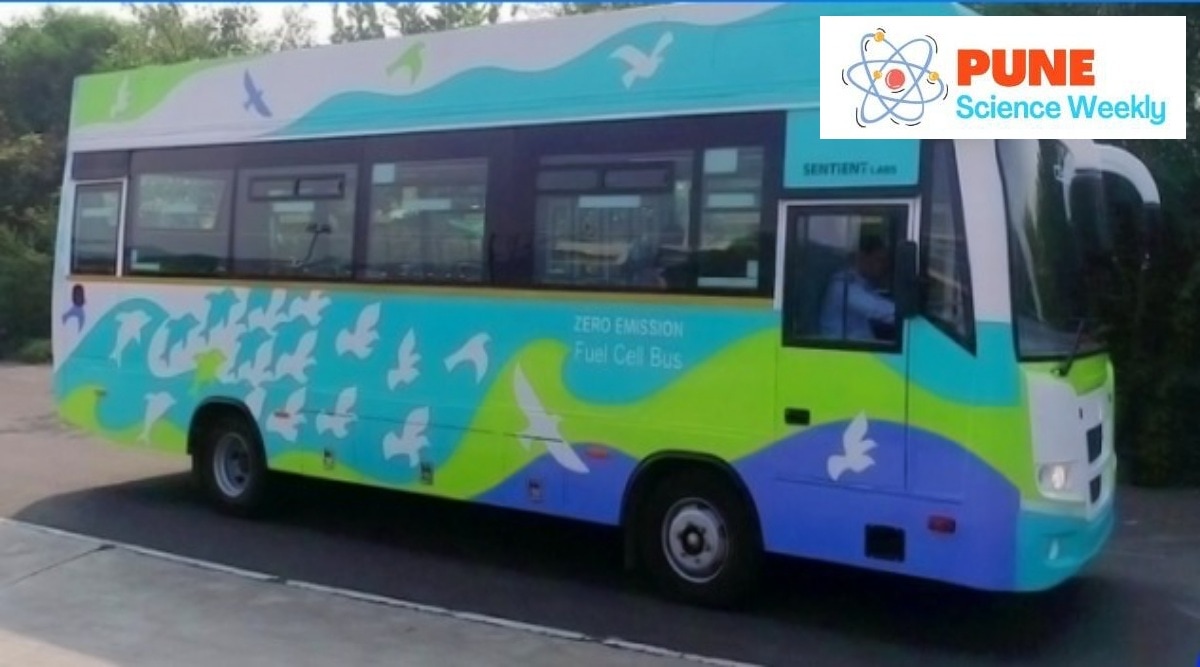 The HFC technology for the 32-seater, 9 m-long, mini air-conditioned bus has been ready since December last year.
 In a demonstrative example of an industry-research lab collaboration, the country’s public transport system could be gearing up for a big environment-friendly makeover, spearheaded by Pune.
Pune is one of the leading Indian cities with the highest number of electric buses in its public transport fleet – until recently, there were 125 e-buses and this is set to increase to 500 by October this year. Soon, adding to this green transportation would be buses operating on Hydrogen Fuel Cell (HFC) technology, developed indigenously by labs and industries in Pune.
Two weeks ago, Union Minister for Science and Technology Dr Jitendra Singh unveiled India’s first indigenously developed HFC-powered bus. Sentient Labs, an R&D innovation lab incubated at KPIT Technologies in Pune, partnered with scientists at Council of Scientific and Industrial Research-National Chemical Laboratory (CSIR -NCL) and Agharkar Research Institute (ARI) to develop the HFC technology. Also involved was the CSIR – Central Electrochemical Research Institute in Karaikudi, Tamil Nadu.
“The fuel cell utilises hydrogen and air to generate electricity to power the bus. The effluent from this process is water, making it the most green mode of transportation,” Sentient Labs said in an official statement.
The HFC technology for the 32-seater, 9 m-long, mini air-conditioned bus has been ready since December last year. However, even after successful demonstrations, officials involved are tight-lipped about the possible commercial manufacturing and further rollout of the bus services for the general public.
Findings from the Central Pollution Control Board (CPCB) note that the contribution of vehicular emissions towards air pollution has risen from 23 per cent in the 1970s to over 72 per cent by early 2000. This figure has further increased in recent years, with the number of vehicles going up exponentially. Poorly maintained vehicles and quality of fuel are among the main reasons for vehicular emissions causing air pollution. Annually, a diesel bus emits upto 100 tons of carbon-di-oxide and vehicular emissions are one of the major contributors to air pollution in India.
Sentient Labs said that buses with HFCs are best used for public transport as the smaller battery can achieve the required operations in comparison to the present e-buses where larger batteries are required. The HFC technology includes other components like the powertrain, battery pack, hydrogen storage tank etc. Using the existing technology, the bus can cover 450 km, consuming 30 kg hydrogen. Officials said that HFC architecture is flexible and can be modified as desired for buses with larger capacity.
In a parallel process to generate hydrogen, Sentient Labs and ARI designed a process involving anaerobic digestion of biomass for the direct generation of hydrogen. The biomass feed came from agriculture waste, including sugarcane waste, rice and wheat straw, and bagasse, and waste from the food industry.
“The two-stage process makes use of a microbial extract from natural sources to generate hydrogen in the first stage and thereafter produce methane in later stages,” the researchers involved said.

 3 min read