Journalism of Courage



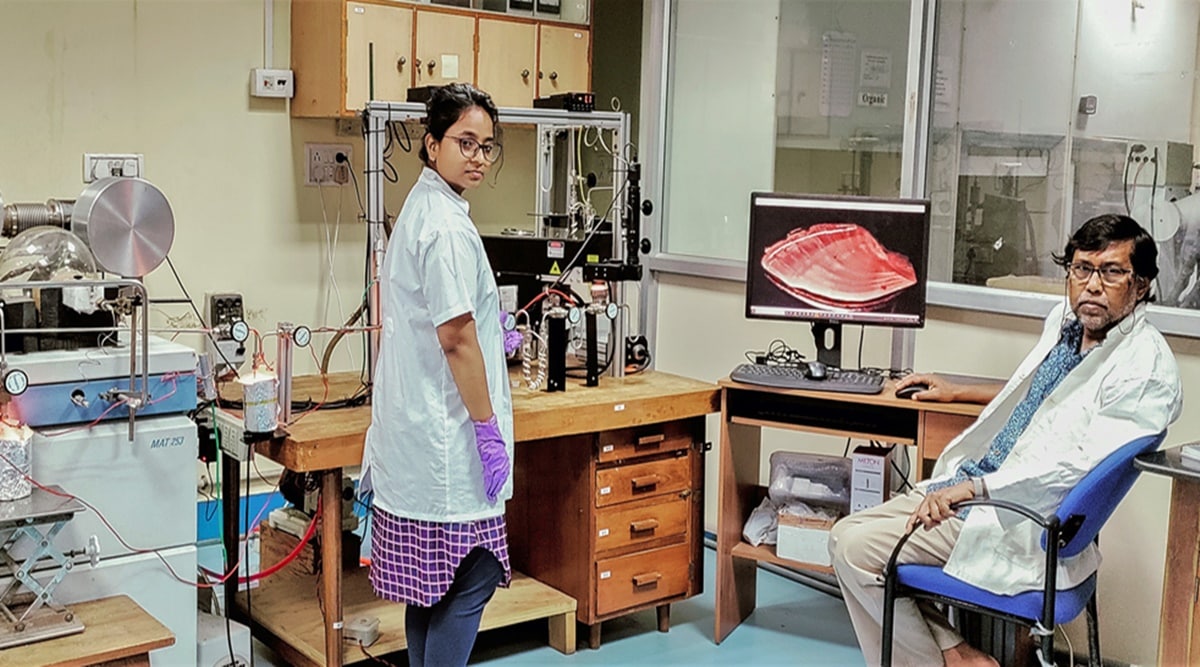 Professor Anindya Sarkar and Torsa Sengupta, a PhD student at IIT Kharagpur. (Image/IIT-Kharagpur)
Researchers at Deccan College, Pune and IIT-Kharagpur have successfully demonstrated a new technique that is capable of tracing past seasonality on the basis of historically recorded sea surface temperatures. This technique, scientists say, holds potential in reconstructing the past climate and will be handy in improving models run by climate scientists in predicting future climate.
While tree-ring studies are one of the most commonly deployed methods to study paleoclimate by understanding their thickness with respect to rainfall and droughts on land, there lacked a reliable and consistent method to understand the seasonal changes in sea surface temperatures, especially from the historic past. Moreover, there still exist several inaccessible regions in the oceans where either there are no or sparse ocean observations, resulting in data gaps to reconstruct the past climate.
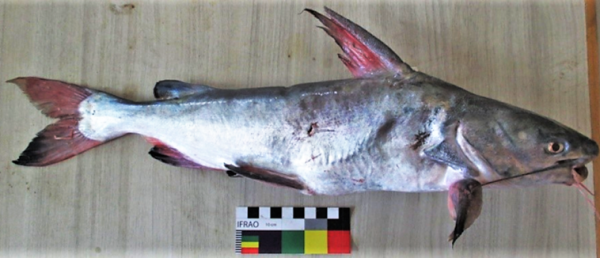 The catfish sample caught from Gulf of Kutch. (Image/IIT-Kharagpur)
In modern times, sea surface temperatures are being constantly monitored using satellites and special instruments like buoys and research vessels, but retrieving the past seasonality has remained a challenge all over the world.
Even though corals are traditionally studied to understand the seasonality and past ocean temperature conditions, they have limitations, the researchers said.
“One, the growth of corals observed over a period of time is minimal, thus coral only offers annual to decadal variations in sea surface temperature and not seasonal. Secondly, it offered low resolution and it is possible to only get mean sea surface temperatures,” Professor Anindya Sarkar, senior scientist from IIT-Kharagpur and collaborator of the recent work, told indianexpress.com.
Sea surface temperatures vary according to the seasons and oceans but have a direct bearing on large-scale systems like the monsoons. These temperatures also decide on the habitability and life of marine species, both plants and animals. Ocean phenomena like El Nino Southern Oscillation (ENSO) are sensitive to sea surface temperatures along the equatorial Pacific Ocean and have been proven to affect monsoons and trigger frequent heat waves and flooding across the globe.
With climate change and its effects increasingly observed in the form of extreme events like heavy rain over a shorter time span, and an increased number of severe cyclones, it is imperative to have consistent sea surface temperature records from the past. As this could offer some answers from the past and link them in predicting future climate.
The researchers collected three catfishes from the Gulf of Kutch and subjected their ear bones (otolith) to laser heating. Using a continuous-flow isotope ratio mass spectrometer, they analysed the oxygen and carbon isotopic compositions.
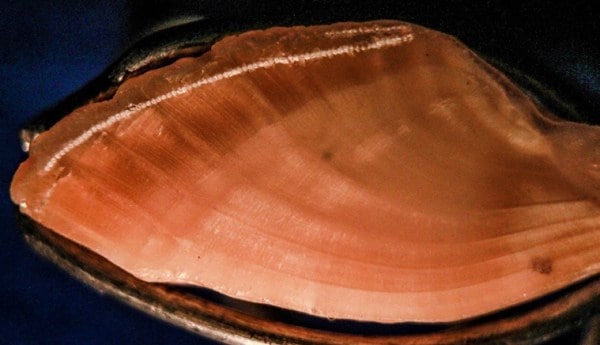 Earbone from Dholavira site near Rann of Kutch. (Image/IIT-Kharagpur)
“These compositions depend on the temperature in which the fish grew and composition of the dissolved inorganic carbon in ambient seawater and the metabolic carbon-dioxide present in the fish blood. By applying this technique, we were able to reconstruct the seasonality from the past and validate with the past records,” the research paper published in the journal, Rapid Communications in Mass Spectrometry, said.
In the present times, the mean sea surface temperature along the Gulf of Kutch was about 26 to 27 degree Celsius whereas the observed seasonal variation over a year ranged between 22 and 30 degree Celsius.
On the scope of this technique for future paleo-archaeological and climate studies, Sarkar said, “This technique can be used on any organisms, like molluscs, that have calcium carbonate-based body parts.”
“We are studying over 5,000-year-old fish bone samples from Indus Valley sites to assess how seasonality affected the growth and led to the collapse of the civilization,” said another collaborator Arati Deshpande Mukherjee from the Deccan College Post Graduate and Research Institute.
Now, Mukherjee and Sarkar are in the final stages of analysing the fish ear bone samples gathered from Dholavira. The team is hopeful of contributing in the climate reconstruction from the times of the Harappan civilization. The archaeologists will collaborate with climate scientists at Pune’s Indian Institute of Tropical Meteorology for the same.

 4 min read