This is an archive article published on February 10, 2015
Viral Fever
Anupama Chandrasekhar’s play Free Outgoing holds a mirror up to the obsession over technology.
Written by Alaka Sahani
Mumbai | February 10, 2015 02:26 AM IST
4 min read
Whatsapp
twitter
Facebook
Reddit
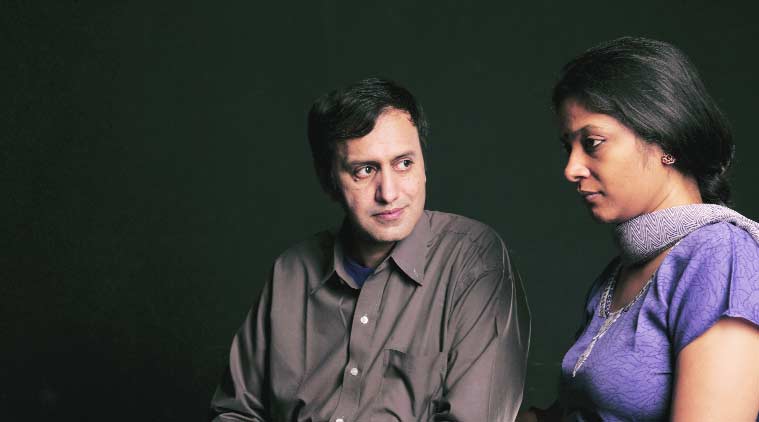
The play first opened in 2007 at the Royal Court Theatre, London.
After being staged in different parts of the world, Anupama Chandrasekhar’s play Free Outgoing had its India premiere last month at Bangalore’s Rangashankara. Directed by Mahesh Dattani and featuring last year’s winner at Mahindra Excellence in Theatre Awards (META) actor Pallavi Arun, this 2007 play will be staged at National Centre for Performing Arts (NCPA), Mumbai, on February 12.
Chandrasekhar, a Chennai-based journalist-turned-playwright, talks about the play that in the age of digital technology examines a society in transition when an act of indiscretion bears serious consequences.
How did the play Free Outgoing come about?
Soon after the first Writers’ Bloc (a Royal Court Theatre-Rage collaboration), which I was a part of, four playwrights were selected to go to the Royal Court to begin work on a new play. I took with me a seed of an idea that eventually developed into Free Outgoing. At that time, I was horrified by the media frenzy over the Delhi Public School MMS scandal and other incidents involving female sexuality, and disturbed by the havoc technology could create in lives. I wanted to explore the new, technology-driven world and its conflict with old values, and I wished to tell the story through the absence of its protagonist. I was not as interested in the stone in the lake as much as I was in the ripples that the stone has caused.
The play has had multiple international versions. Tell us about it.
It first opened in 2007 at the Royal Court Theatre, London, in its experimental space. It was a box office and critical success, which led it to be revived for their main stage the following year. In August 2008, it travelled to the Traverse Theatre for the Edinburgh Fringe. In 2014, the play was staged in Canada. I am continually surprised by the positive response to what I thought was a Tamil family play.
What worked for the international audience?
I’m told things are not so different for women in the Western world. A few months before the play opened in Toronto, in two separate incidents, two schoolgirls were raped by teen boys and the rapes, filmed on cellphones. The videos went viral and the girls were slut-shamed by their female classmates, so much so that the girls took their own lives. In the context of these incidents, the play resonated with the audience on an entirely different level.
Have you made any changes in the play as the technology has undergone several changes since the time it was written in 2007?
Yes, I have. I wrote the play in a pre-Facebook, pre-Twitter, pre-smartphone era, when the term “going viral” was just entering our tech lexicon. Since then, technology has evolved dramatically and all of us in the rehearsal room felt that some updating was required.
Mahesh Dattani is directing the upcoming production of it. How has the collaboration been?
It’s been a masterclass for me. Mahesh is a sensitive, text-driven director and he’s directed the play with such honesty and attention to the emotional core. It’s been such a pleasure and privilege to have worked with him on this.
Story continues below this ad
You’ve often spoken about the problems in contemporary India in your plays. What propels you to tell such stories?
We are on the cusp of humongous social, political and environmental change, and I believe that theatre should be chronicling, studying and interpreting these changes.
The screenplay adaptation of Free Outgoing was chosen for the Sundance lab. Is there likely to be a big screen version of the play soon?
We are certainly looking for producers. That apart, I’m working on a few plays, including one for the Tricycle Theatre, London.
Alaka Sahani is a prominent film critic and journalist based in Mumbai. With a career spanning over two decades, she has established herself as one of India’s most authoritative voices in cinematic journalism, known for an analytical approach and insights that transcend the standard cycle of celebrity journalism.
Expertise & Accolades
In 2014, Alaka was honoured with the National Film Award for Best Film Critic. Her Swarna Kamal (Golden Lotus) citation specifically lauded her for "highlighting facets of cinema beyond glamour and gossip" and for her ability to delve into the contemporary relevance of iconic filmmakers. Her commitment to journalistic integrity was further recognised in 2019 with a Special Mention at the Red Ink Awards for her investigative feature, 'In Search of a Star'. Her article titled 'People Like Us', published in The Indian Express on March 27, 2022, was shortlisted for Red Ink Award, 2023.
Global Industry Leadership
Alaka’s expertise is sought after by major international and domestic film bodies:
Golden Globes: In 2025, she joined the international voting body for the 83rd Annual Golden Globes.
National Film Awards: She served on the prestigious jury for the 68th National Film Awards, helping select the finest contributions to Indian cinema.
Global Perspective: Her work consistently bridges the gap between commercial Bollywood A-listers and emerging independent talents, offering nuanced insights into both Indian regional cinema and international film trends.
Focus & Vision
Beyond the screen, Alaka is a dedicated observer of Mumbai’s vibrant theatre scene and the historical evolution of the moving image. Through her long-form articles and deep-dive interviews, she continues to challenge "tried-and-tested" templates, providing readers with a deep understanding of the artistic and systemic workings of the Indian and global film industry. ... Read More


 4 min read


 The play first opened in 2007 at the Royal Court Theatre, London.