Journalism of Courage



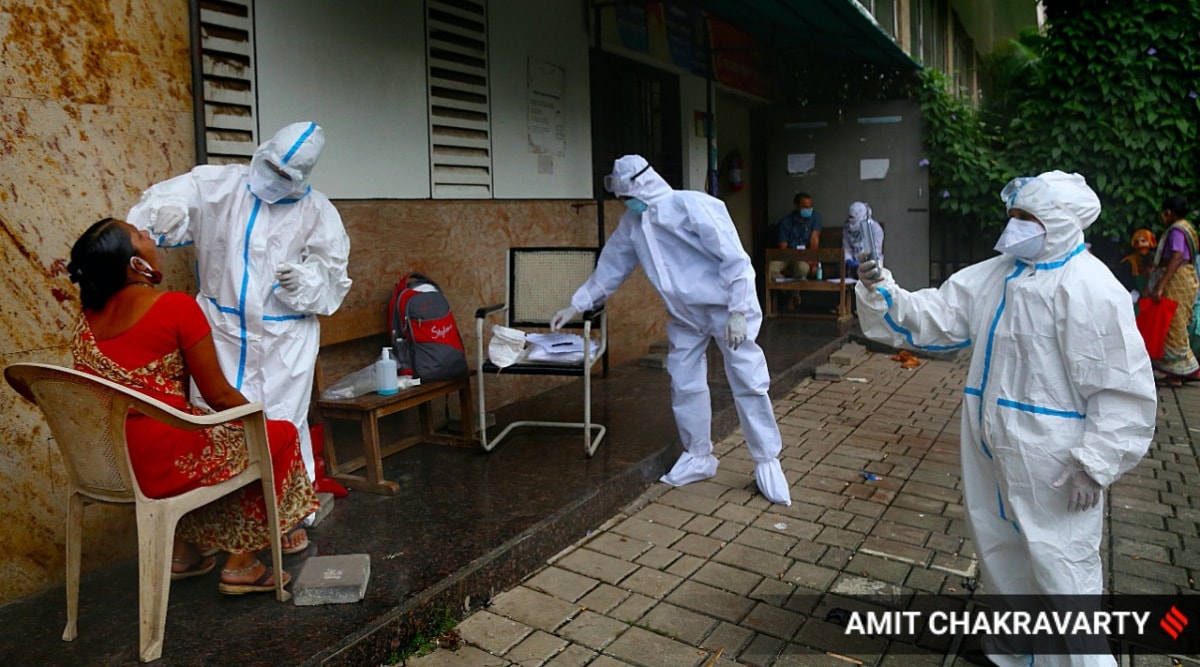 Health workers testing people for coronavirus in Mumbai. (Express Photo by Amit Chakravarty)
With over 2,000 new Covid-19 cases being reported every day, Mumbai’s positivity rate is again on the rise, with senior BMC officials attributing it to the reopening of economic activities and movement of people across the state.
Month-wise data shows the city’s positivity rate – the number of people testing positive against the total number of tests being conducted in a month – showed an “optimistic decline” from 18.3 per cent in June to 17.9 per cent in July and to 14 per cent in August, but in September it climbed back to 17 per cent. Even the number of cases, which witnessed a slide from June to August, saw a rise this month. Mumbai recorded 55,096 cases from September 1 to September 28 – a rise from 31,521 cases in August and 36,626 in July.
“Even when the number of cases started reducing in July and August, daily new cases hardly went below the 1,000 mark. Now, we are witnessing over 2,000 new cases every day. This trend will take some time to come under control,” said Additional Municipal Commissioner Suresh Kakani.
Earlier this month, BMC had set up 250 more intensive care unit (ICU) beds to cater to the rising load of critical patients. Mumbai has 1,917 ICUs and 1,128 ventilators for Covid-19 patients.
Another indicator of rising cases is the weekly case growth rate, which rose from 0.87 per cent in the last week of August to 1.04 per cent last week.
Kakani said many people who followed strict home quarantine during lockdown have started venturing out, increasing the risk of exposure.
“It is unclear whether anti-bodies against the virus remain in an exposed person for only two to three months. Also, the second sero survey indicates that the sero prevalence has not much changed in slum areas,” he added.
In the first sero survey conducted July, 57 per cent of the slum population and 16 per cent non-slum population were found exposed to Covid-19. In the second round conducted in August, a rise is sero-prevalence was noted in non-slums areas, but not in slums.
State Health Secretary Dr Pradeep Vyas said, “Wearing mask is the best precaution, the norm is being flouted commonly in Mumbai.”

 2 min read