Journalism of Courage



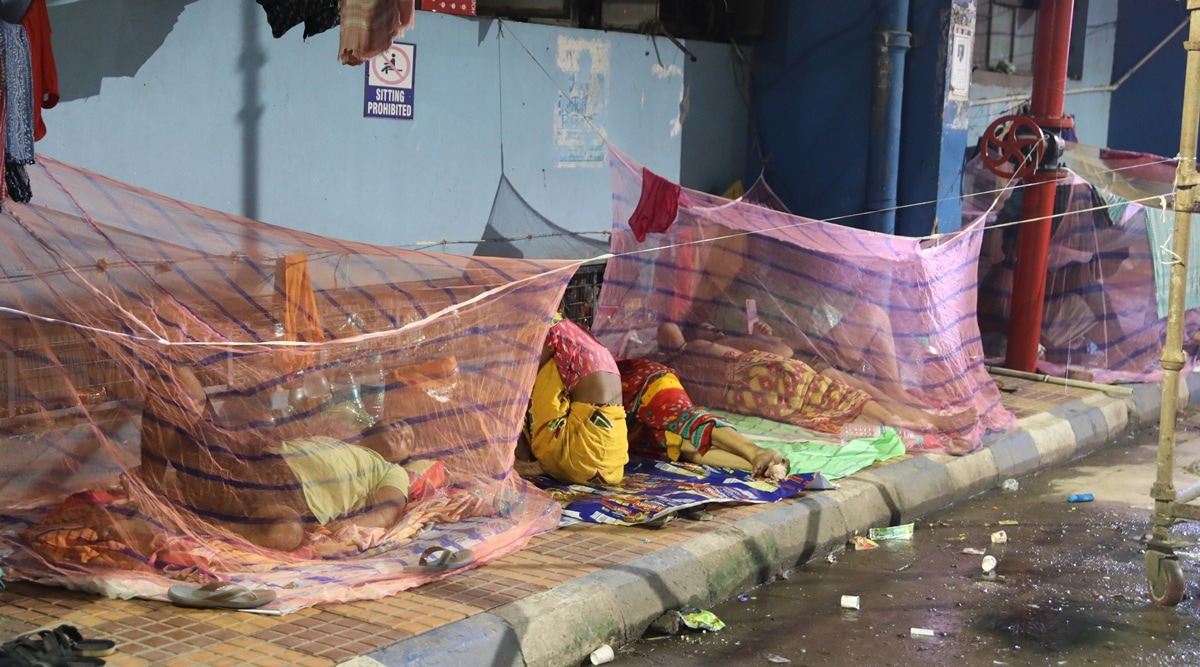 Relatives of patients at NRS Medical College in Kolkata use mosquito net to protect themselves during night. Partha Paul
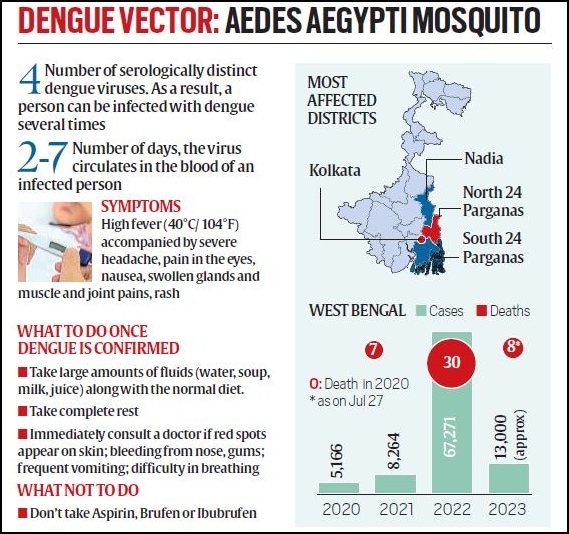
 Since July this year, dengue cases have been piling up in West Bengal — nothing new as with every onset of monsoon, the outbreak of the mosquito-borne disease is almost inevitable. However, year after year, there seems to be no end to the menace.
This year, the government has put the official death toll from dengue at 8 and number of people infected at 13,000, till August 31. Sources in the state Health Department and civic bodies, however, suggest that the death toll, as well as the number of cases, could be much higher.
While the viral disease has been reported from almost all the 23 districts of the state, the four districts of North 24 Parganas, South 24 Parganas, Nadia and Kolkata are the most hit. North Parganas tops the list with over 4,000 dengue infections, according to official sources.
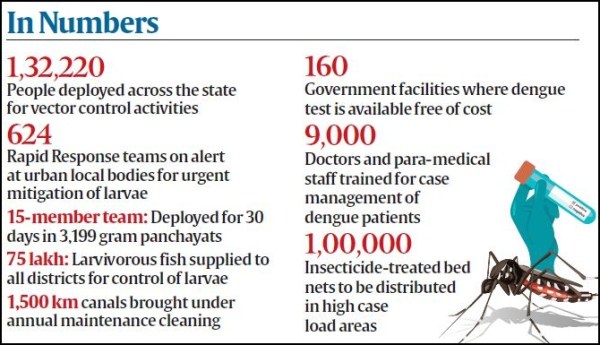
From door-to-door surveillance to find mosquito larva breeding, slapping notices, carrying out awareness drives, monitoring via drones, to allowing free blood tests, the civic bodies, especially the Kolkata Municipal Corporation (KMC), have been trying to combat the dengue menace on a war footing.
Outside the Urban Primary Health Centre in ward number 11 in Kolkata’s Hatibagan area, there is a two-km-long serpentine queue. “People having fever keep arriving here. We first ask them to have a blood test here free of cost to identify whether they are suffering from dengue, malaria or just common viral fever,” says a doctor at the centre.
At the blood testing centre, a similar queue is seen. According to lab staff, the test reports are available within 24 hours. Blood test is done free in 17 such health centres run by Kolkata Municipal Corporation (KMC), apart from the government and private hospitals.
“The number of fever patients jumped from the second week of July. First, the queues used to be long only on Mondays as our clinic used to stay shut on Sundays. Now, every day we are getting more and more patients complaining of fever and getting tested for dengue,” says lab assistant Sharmila Murmu.
Her colleague Bhashkar Guha echoes the same but with numbers. “Usually, we get 35-40 people per week with fever complaints. From July third week, it became 65-70. Nevertheless, dengue-positive cases are not more than what were last year. Now, on average one patient is found dengue positive in every 77 samples,” he says.
It’s around 7 in the morning as 53-year-old Sanjib Saha, the vector control officer of Ward Number 13, and other supervisors gather near the KMC office at Muchibazar in Kolkata. Armed with a hand-held mic, torches, sticks and anti-mosquito sprays, the small group make their way through narrow lanes and by lanes of the north Kolkata ward.
“For over three decades, I have been working here. I have seen ‘matir drain’ (kuccha drains) in Kolkata. Now, everywhere it is concrete. From 8 am to 4 pm we engage in door-to-door surveillance, awareness drives, etc. From March to November, we do this every day. This is just the beginning of the mosquito season,” says Saha.
“We search for stagnant water where mosquito breeds. Sometimes, we have conservancy department staffers accompanying us who clean garbage inside the residences,” says Gautam Kundu, a ward supervisor.
The team makes its way through Muchibazar, visiting one house to another. At one of the places, they find a dilapidated house with locked rooms and stagnant water. “This is a major problem. In many of the old dilapidated structures, there are no owners. Generally, when we spot mosquito larvae in stagnated water, we issue a notice to the house owner to clean the premises within seven days. If the house owner fails, then we move court, and a fine of up to Rs 1 Lakh can be slapped by the court. But in such abandoned or closed houses, we can’t do that,” says Kundu.
The civic body also distributes guppy fish so that they can be released in stagnant water ponds etc as they feed on mosquito larvae.
“This year, we have already distributed more than 200 guppy fish in this area,” says Irani Das (33), a member of the dengue awareness team of the KMC.
According to local councillor Anindya Raut, drones have been used to map areas where there are chances of water stagnation.
The KMC has also been using drones to not only track mosquitoes but also spray insecticides in areas where workers are unable to visit. “There are vacant land and plots with rich undergrowth. There are even snakes. Our workers cannot go in there. We use drones to identify such areas and then spray insecticides,” says Amitava Chakraborty, Deputy CMOH of KMC.
“The main challenge is community participation. We usually continue our campaign programme throughout the year. Still, some people are not aware. Dengue prevention is not only the responsibility of the Health Department. All departments of the state and the Centre have a responsibility to prevent dengue. But, in many cases, they are not cooperative. You cannot win the battle against dengue without collective effort. We need to work together,” says Debashish Biswas, OSD, Health Department, KMC.
“Many residences in Kolkata are inaccessible. Railway and Metro Rail departments do not cooperate with us,” says Biswas, adding that KMC ward numbers 6, 68, 82, 93, 94 and 97 are the most affected areas in the city.
“We need to create an atmosphere where everyone will be compelled to follow KMC’s mosquito directives,” he says.
According to vector control officers, KMC has written to Kolkata Police to check and clean all seized vehicles lying inside police station compounds. Such vehicles with accumulated rainwater are breeding grounds for mosquitoes.
The KMC has also started to distribute mosquito nets to pavement dwellers and the urban poor. “We have also started spraying insecticides on the banks of canals using boats. This project is unique and has never been used in any city in India. We started this project in 2011,” says Deputy CMOH Chakraborty.
Facing backlash from the Opposition, who accused the TMC government of failing to curb the dengue crisis, Chief Minister Mamata Banerjee claimed that dengue was spreading in West Bengal from Bangladesh. “I cannot prevent anyone from entering (From Bangladesh), but surveillance should be increased and necessary tests should be conducted on those entering India from the neighbouring country,” she told the Assembly on July 27.
But the CM’s claim of Bangladesh influx of dengue was read by many as her attempt to put the blame on the Union government since it’s the BSF that guards the international border.
Nevertheless, news reports from Bangladesh stated that over 400 people had died of dengue till mid-August with capital Dhaka being the most hit. Taking note of it, the KMC wrote to the Health Department to ask the BJP-led Centre to set up test centres along the border entry points. “The move is aimed at identifying patients and carriers of dengue… This will help us not only in the prevention but also help provide medical attention if needed to the patients,” says Deputy Mayor Atin Ghosh.

 7 min read