For years and decades, millions in Delhi have been living as temporary citizens in the city they call home. As house after house rises, so do political promises and hopes of a settled life, but residents of unauthorised colonies still fear the bulldozer. NEWSLINE visits three such villages where everything is concrete except the rules that govern them For residents of Delhi’s unauthorised colonies, terms such as “legal”, “regular” and “authorised” have been drained of meaning.
In the years that followed the initial announcements for regularisation, little changed for the residents. Even as the population in these localities continued to grow, they only received the bare minimum facilities accorded to citizens. The Delhi government, in 2008 and on the eve of the Assembly elections then, had issued provisional regularisation certificates to over 1,200 unauthorised colonies.
The government, after scrutinising all the applications for regularisation, later forwarded 1,639 applications to Municipal Corporations of Delhi, Delhi Development Authority, Archaeological Survey of India, Forest Department and Revenue department for scrutiny and verification.
Of the 1,639 colonies, 100 were found to be repeated colonies and another 48 did not exist on ground and among the remaining, 200 were on ASI and Forest Department land, leaving 1,200 colonies ready for regularisation. However, on further scrutiny, 100 colonies had no maps and approximately another 100 were located on industrial land.
Delhi Pradesh Congress Committee chief and former urban development minister Arvinder Singh Lovely said, “In the end, the Union Government found 895 colonies fit for regularisation according to the 2007 guidelines.”
Story continues below this ad
In early 2011, house owners in these unauthorised colonies were asked to pay Rs 200 per square metre as development charge for regularisation of their colonies as well as getting various basic amenities like water supply, drainage and road connectivity. Of these, 895 colonies were shortlisted after scrutiny and 733 received no objection certificates from all concerned agencies.
However, only nine of the 1,639 colonies of Delhi received the tag of “unauthorised regularised” five years after the first announcements for regularisation was made.
Now as another election to Delhi’s Assembly beckons, unauthorised colonies and their 50 lakh residents are the most sought after electorate. The Narendra Modi-led Union Government was quick to pass an executive order and increase the ambit of the amnesty scheme. “From 2007, the BJP government has increased the deadline to June 2014, thus covering all unauthorised colonies,” said Delhi BJP chief Satish Upadhyay.
Also read: ‘We are here since ’92, this is private land’
Story continues below this ad
The first step toward regularisation is the determination and identification of boundaries of these colonies. Three institutes — Jamia Millia Islamia, Institute of Planning and Architecture and Indraprastha University — were engaged to help Resident Welfare Associations in preparation of the layout plans.
Nine colonies, came forward and submitted their layout plans to the MCDs and the government. As per rules issued by the government in 2007, these should have been regularised within six to nine months from the date of submission of plans. However, these colonies are yet to received regularisation status.
The BJP led corporations blame the then Congress government for this delay. Officials state that because the Delhi government, in order to stake claim for regularisation, even forbade the MCDs from making any expenditure in these areas. “They wanted to get all the work done from their agencies which is what caused this delay.”
As the government failed to make any progress, the residents went to court, which ordered the MCDs to construct one school and an approach road in these colonies. Post this, Delhi State Industrial and Infrastructure Development Corporation took over the work of providing basic infrastructure like roads and storm water drains in unauthorised colonies of Delhi.
Story continues below this ad
With this amendment, North Delhi Mayor Yogendra Chandolia believes that all 1,639 unauthorised colonies of Delhi will be regularised “within three years”.
With this announcement from the Centre, the process of regularisation will have to begin afresh. According to senior officials of the MCD, this also renders the old provisional certificates of the government “null and void”.


 4 min read


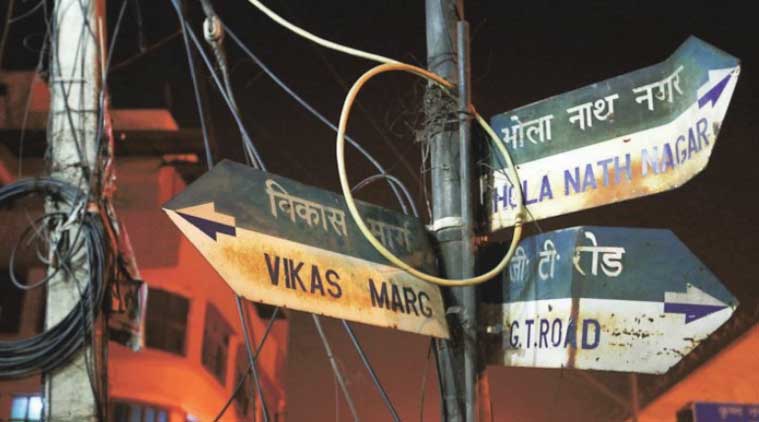 Signboards at a street crossing in East Azad Nagar; some can take you in many directions.