Journalism of Courage



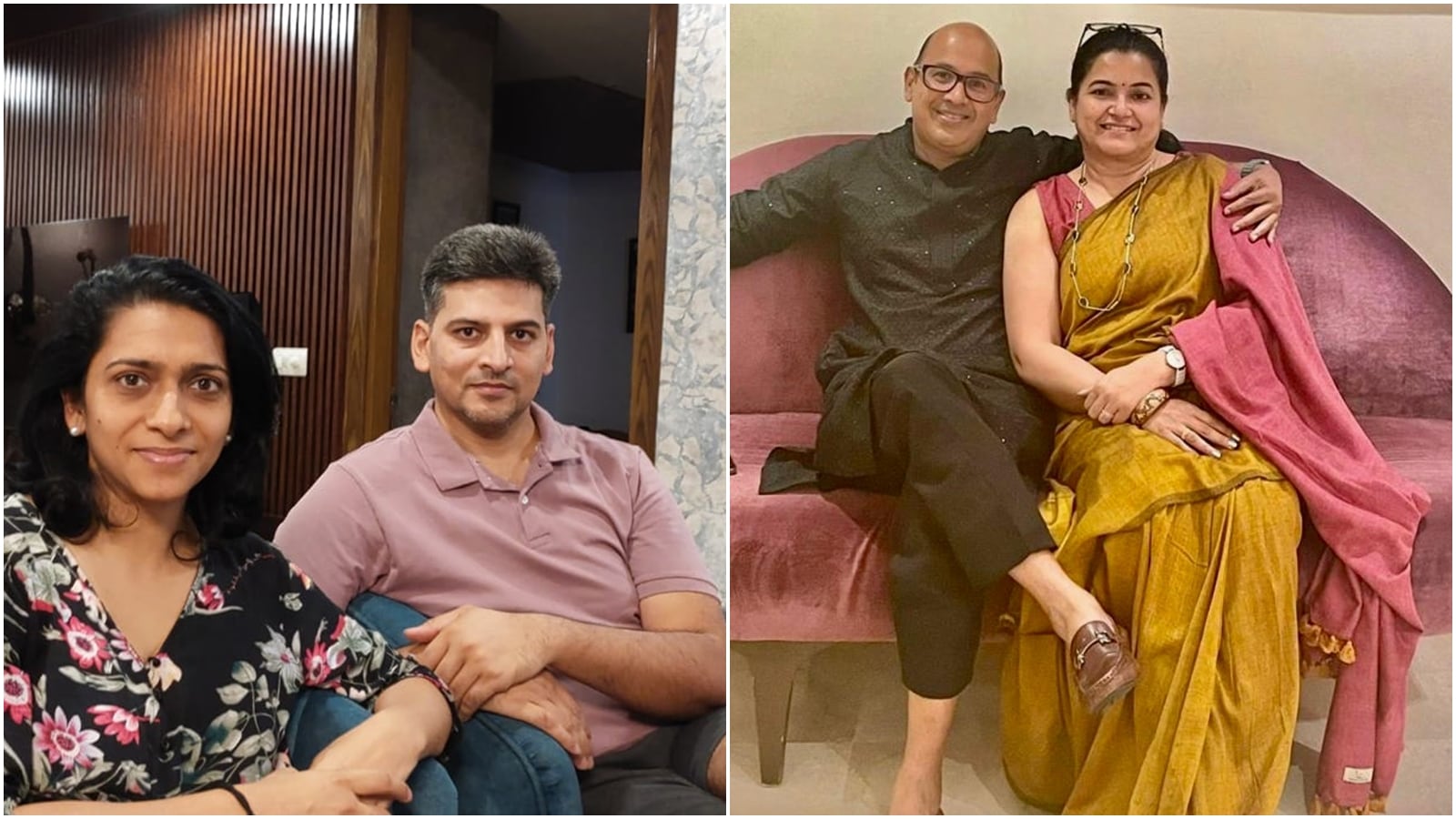 Residents Alok Khandelwal and his wife Nishma; (right) Dr Renuka Ganesh and her husband Ganesh Krishnan. (Express File Photo)
They come from different places, speak in different tongues, eat different food, and celebrate different festivals. When they meet, they speak in English and at times, broken Hindi. They are from Kerala, Tamil Nadu, Maharashtra, Uttar Pradesh, West Bengal and Rajasthan. In this city, their regional identities take a backseat and they are businessmen, CEOs, software engineers, and IT consultants.
At M3M Golf Estate in Sector 65, a condominium across 56 acres of land with a golf course and surrounded by the Aravallis, the Lok Sabha election is different — the issues that dominate the polls across the country have not made it past the gates.
Gurgaon votes on May 25, in the sixth phase. The government, in a bid to increase polling among urban residents, has set up 52 booths in 31 high-rises across the city as polling in urban centres has been lower than that in rural areas.
Sitting near a small library at the society club on a Sunday evening, Alok Khandelwal, an IT consultant, can’t recollect the last time he voted. “People here are a little reserved about voting as we have to stand in a queue at a booth in this heat. We wanted to request the administration to set up one (a booth) on the premises, but that didn’t materialise,’’ says the 41-year-old from Rajasthan’s Alwar.
“Also, governments have little impact on us as we work hard and fend for ourselves.” Khandelwal believes Prime Minister Narendra Modi has helped elevate India’s image on the global stage.
His wife, Nishma, a software engineer from Kerala, chimes in: “Even though there are issues, Modi evokes pride in people… My identity as a Malayali or support for the INDIA bloc back home won’t stop me from supporting BJP.”
She says her sole apprehension about the BJP comes from the accounts of her relative, a government employee, who has told her the “government goes after those critical of its rule”.
Sitting near the couple, Panckaj N Umrania, a businessman, declares that he’s not into politics. “I don’t support anyone. I pay taxes to the tune of Rs 1 crore and don’t get anything in return,” the 40-year-old, who has not voted since 2014, says.
Umrania, who was born and raised in Kanpur and later Lucknow, is disenchanted particularly after he lost his family to Covid-19 — he blames the government for “poor management”. However, he still believes in Modi. “I don’t blame Modi. Our system is at fault,” he says.
Umrania, who has lived in the city for 14 years, is waiting for his seven-year-old son to complete school so he can send him abroad for studies and subsequently work. “There is a marketing gimmick that India has ease of doing business and is emerging as a power. The BJP has employed intelligent people to shape this narrative,” he adds.
Entering the granite tower and stepping into the well-lit hallway, Soma Parveen takes the service lift reserved for workers. She cleans three houses every day for Rs 16,500. She takes the smaller gate to enter and exit the society.
Last August, a few miles away from her rented one-room home in Badshahpur, she recalls, the slums of migrant labourers were set on fire during the Nuh violence. “We were scared,’’ she says. “Panckaj sir (her employer Panckaj Umrania) asked if we wanted to live with them till the situation calms down…”
She says the “violence disrupted our lives for days” and then it was normal again.
Though Soma wanted to go to West Bengal to cast her vote, she couldn’t afford the trip. However, she says, if there is anyone she supports here, it would be the Congress. Back home, she says, she would prefer TMC. “We have been getting the same wages over the last five years. I asked for a hike in one of the houses I work in and was told to quit,’’ she says.
Soma emphasises that there aren’t any communal flare-ups in her village in Bengal. “The BJP isn’t in power in our area, maybe that is why…,” she says.
Sudhir Malik is all set to cast his vote for the “nation”. “I don’t like Rao Inderjit Singh (BJP’s Gurgaon candidate who is seeking re-election). He hasn’t done much here. But I am focusing on the Centre and want to bring Modi to power again,” he says.
Born in Himachal Pradesh’s Mandi, the 65-year-old businessman has been in the city for 20 years. On the violence last year, Malik says such incidents send a wrong message to the world. “We have a good image in front of the world now… The respect I get when I go to other countries is immensely different from what I would get 10 years ago,” he insists.
Bijan Halder, who cleans cars and also walks the dogs of residents, went back home to West Bengal’s Farakka to cast his vote. His wife and infant daughter accompanied him.
“It is my right and responsibility as a citizen to cast my vote. It doesn’t matter that it costs a lot and I miss a few days’ work,” the 27-year-old says. He earns, he says, Rs 15,000 a month. Halder enters the society with a card — after his employers grant access — that’s renewed every six months.
Dr Renuka Ganesh (49), a clinical psychologist from Nagpur, and her husband Ganesh Krishnan (53), a Tamilian, assert their regional identities, but insist it “doesn’t surpass national pride”. Though she was born and raised in Maharashtra, Dr Renuka is from Visakhapatnam, and her father is affiliated with the RSS. “I am a Marathi first, but I believe (Hindu) identity instills more patriotism,” she adds. Her eyes glow as she speaks of the Modi government. “The roads have improved under this government. When I visit my daughter in Chennai, the city’s progress is stagnant,’’ she says. “They (Tamil Nadu) need a regime change and K Annamalai (BJP TN president) shows promise,” she says.
Her husband agrees: “In these two South Indian states (Kerala and TN), something new has to come. They have to align with national development.” Krishnan, who was born in Thiruvananthapuram, says if the INDIA bloc wins, the country will disintegrate. “We need a stronger Centre,” he says. “If I had voted in Thiruvananthapuram, I would have supported (BJP’s) Rajeev Chandrasekhar…”

 6 min read