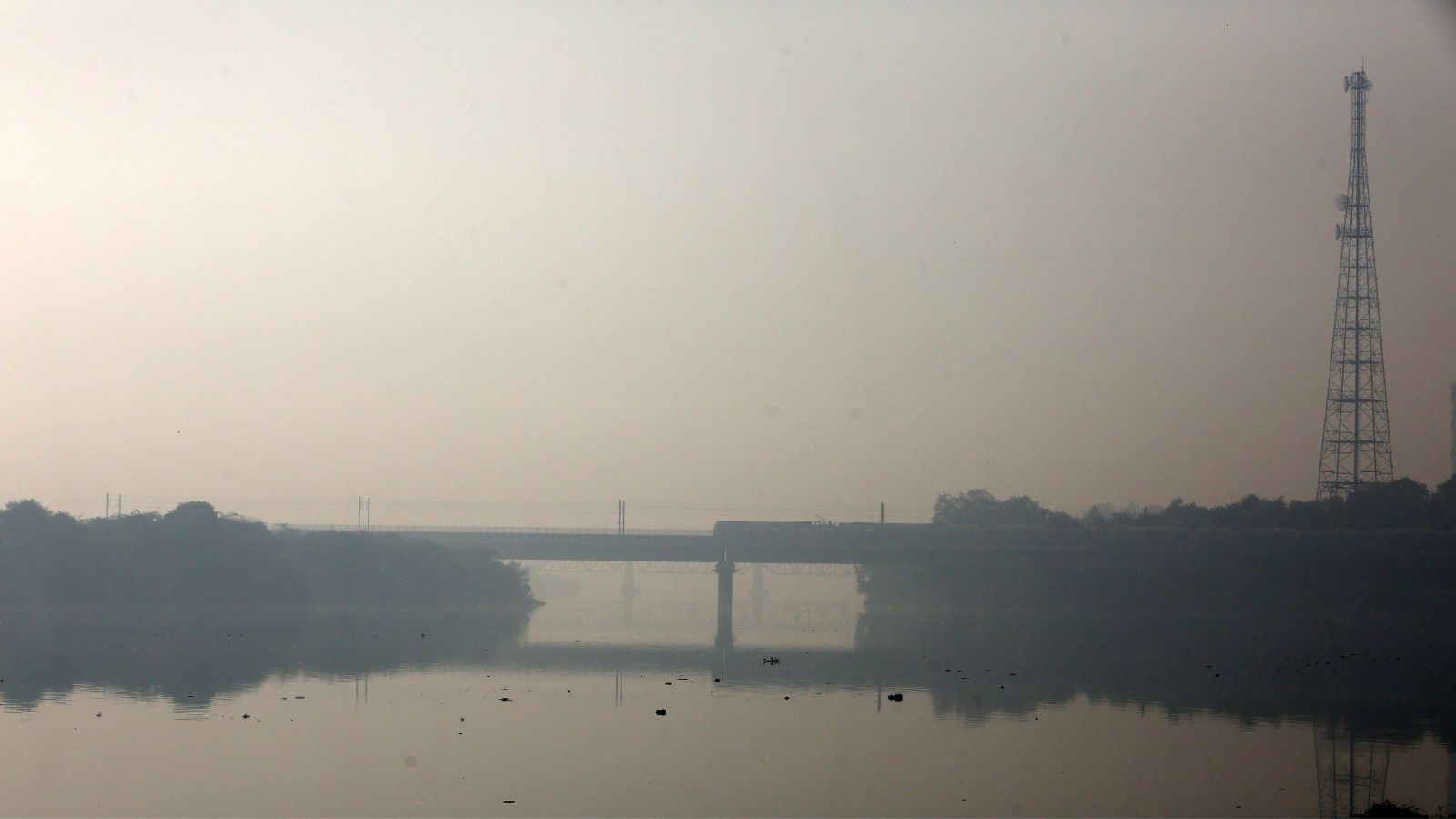
A thick smog enveloped Delhi on Sunday morning as the air quality slid further three days after Diwali. (Express/Gajendra Yadav)
In a welcome change, the number of farm fires seems to be at an all-time low despite the paddy harvest season in north India going on in full swing, official data shows. Despite a drastic reduction in its number of stubble-burning incidents so far this year, Punjab tops the list while Uttar Pradesh has replaced Haryana in the second spot.
According to the Indian Agriculture Research Institute’s (IARI’s) Consortium on Research Agroecosystem Monitoring and Modelling from Space (CREAMS), Punjab and Haryana, which have been placed one and two, respectively on the stubble-burning list for several years, have seen a massive reduction this year (see box).
While farm fires in Punjab between September 15 and November 3 are a third of what they were last year, in Haryana the reduction is around 38%. With 1,288 fire incidents, Uttar Pradesh is in the second spot so far this season, while Haryana has recorded 857 fires.
According to IARI scientists, the harvest season is in full swing with a small delay of 4-5 days. Notably, harvesting in Punjab is progressing at a slow pace with only 50% taking place so far owing to the protest by rice millers, resulting in delayed lifting of the crop. “This is the peak season for harvest as well as stubble burning. We may see fires increase a bit in the coming days, but the overall satellite data shows there is a decrease,” said an IARI scientist who did not want to be named.
According to an official response from the Punjab government, the utilisation of paddy stubble has increased to 19.5 million tonnes from 15.8 million tonnes in a year, which is also the reason behind fewer fires. Of this, the government said, in-situ management accounts for 12.7 million tonnes and ex-situ accounts for 5.9 million tonnes. The government also credited stricter enforcement measures for the decrease.
“The state has appointed 9,492 field functionaries to monitor and contain the stubble fires… between September 15 and October 31… stubble burning was observed in 1,267 incidents… of which, environment compensation amounting to Rs 33.2 lakh has been imposed on 1,257 persons and Rs 31.15 lakh has been recovered… 1,626 FIRs have been registered 1,256 red entries have been made in Khasra Girdawaris of the defaulting farmers,” the official response stated.
Haryana State Pollution Control Board chairperson P. Raghavendra Rao said that a combination of awareness activities with farmers, incentives and more machinery was responsible for the decrease.
Story continues below this ad
“Even though incentives were given last year as well, this time a lot of publicity was done for maximum utilisation. The number of machines (like happy seeders) was also increased to about 1 lakh from 80,000 last year… We are taking action against the farmers in terms of not only recovery through environment compensation, but also by lodging FIRs and red entries. It is a multiplicity of factors that has helped us in reasonably limiting fires. We are not fully satisfied with the numbers, of course. We want it to be zero, but this kind of change cannot happen overnight. A change of behaviour also takes time among the farmers,” he said.
As per the Decision Support System for Air Quality Management in Delhi, the contribution of stubble burning to the city’s air was the highest at 35 per cent Friday. It dipped to 15 per cent on Saturday.
According to IARI, the number of farm fires reported in Punjab, Haryana, Uttar Pradesh and Delhi was 379, 19, 87 and 0 Saturday.
IARI officials are studying burnt areas instead of active fires to get a more accurate picture of the progress on the ground.
“Over the years, as awareness about the satellite imaging to pinpoint fires has increased, we have noted that several farmers are burning paddy straw in the 1-2 hour duration when there is no satellite coverage. The more accurate way is to calculate the burnt area. We are already doing it, but the data is not publicly available currently. It shows that while the area burnt is higher than what the satellite counts show, it is still less than what it was last year,” said a senior IARI scientist on condition of anonymity.
Sophiya Mathew is a Correspondent at The Indian Express, based in New Delhi. She joined the Delhi bureau in 2024, and has specialization in Integrated Multimedia Journalism from the Asian College of Journalism (ACJ), Chennai.
Professional Background
Core Beats: Her reporting is primarily focused on the Environment and Education.
Specialization: She has gained recognition for her ground-level reporting on the Yamuna floodplains and the socio-economic challenges faced by those living on its banks. She also focuses on the disparities in Delhi's education system, ranging from elite private schools to government institutions and refugee education.
Recent Notable Articles (December 2025)
Her recent work has been heavily centered on Delhi's severe winter pollution crisis and the government's regulatory responses:
1. The Air Pollution Crisis
"A tale of two cities: Delhi govt schools choke in bad air, private classrooms set up air filters" (Dec 20, 2025): A high-impact feature contrasting the "Clean Air Bubbles" in elite schools with the reality of government school students who are exposed to an equivalent of 17 cigarettes a day due to outdoor exposure.
"Delhi sees season's worst air day, second worst December AQI in nearly a decade" (Dec 15, 2025): An analytical report on the meteorological patterns trapping pollutants in the NCR.
"Delhi bans non-BS VI vehicles from outside: Why curbing vehicular pollution is key" (Dec 17, 2025): Explaining the science behind targeting specific vehicle vintages to lower particulate matter.
2. Enforcement & Regulations
"No fuel at pumps in Delhi without valid PUC certificate from December 18" (Dec 17, 2025): Breaking the news on the environment ministry's strict "No PUC, No Fuel" policy.
3. Education Policy
"Law to regulate school fee in Delhi risks becoming procedural, say parents" (Dec 13, 2025): Investigating the loopholes in the new Delhi School Education (Transparency in Fixation and Regulation of Fees) Bill, 2025.
"Monsoon Session: Private school fee regulation Bill cleared after four-hour debate" (Aug 9, 2025): Covering the legislative passage of the controversial fee hike regulation.
Signature Style
Sophiya is known for her observational depth. Her reporting often includes vivid details from school corridors, hospital waitlists, or the banks of the Yamuna to illustrate how policy failures affect the city's most vulnerable residents. She is a frequent expert guest on the 3 Things podcast, where she explains the complexities of Delhi’s environmental laws.
X (Twitter): @SophiyaMathew1 ... Read More


 4 min read