6 min read

© The Indian Express Pvt Ltd



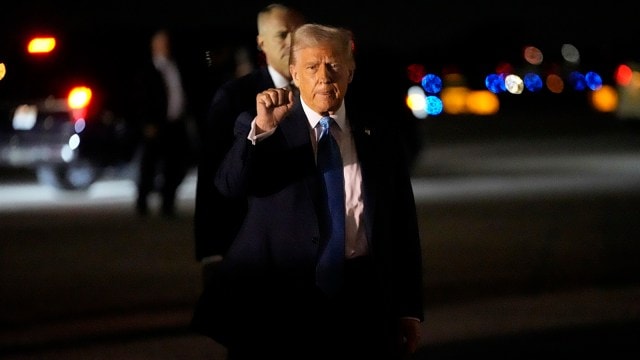 US President Donald Trump gestures as he arrives at Palm Beach International Airport on Friday. (Photo: AP)
With a 25 per cent tariff on Canada and Mexico, and 10 per cent on China effective from Tuesday, US President Donald Trump has kicked off his promise of protectionist trade policies, triggering a fresh trade war with America’s top three trade partners that are also the largest contributors to its nearly $1 trillion trade deficit.
Despite repeatedly criticising India’s tariff structure, Trump’s first executive order on February 1 to impose trade tariffs did not mention India, signalling that bilateral trade negotiations may be on the cards later this month when Prime Minister Narendra Modi is scheduled to visit the US.
International trade experts said that India has already begun lowering tariffs to favour US exports in a bid to avoid Trump’s tariffs. Duties on items primarily exported by the US, such as motorcycles with an engine capacity below 1,600cc, ground installations for satellites, and synthetic flavouring essences, among others, were slashed in the Union Budget 2025-26 presented on Saturday.
Meanwhile, exporters said that the current 10 per cent tariffs imposed on Chinese goods would create an opportunity for more Indian goods to enter the US market. According to an analysis by Oxford Economics, India was the fourth-largest beneficiary of the trade diversions that occurred between 2017-2023 after Trump launched a tariff war with China in his first term.
“US tariffs on China will have a wide impact. Major parts and component suppliers to China in South Korea and Japan will also be affected. But India is at an advantage at the moment, as those countries facing duties will become less competitive in the US market,” said Ajay Sahai, Director General of the Federation of Indian Export Organisations (FIEO).
“There is a growing concern among US companies that tariffs on China and many other countries may also increase, prompting them to move away from China. One exporter, who has factories in both India and China, began receiving larger orders in India due to concerns over supply chain risks in China. This is despite the fact that India is less competitive than China,” Sahai added.
However, a trade war that drives up inflation in the US market may not be in India’s interest, as America is India’s largest trade partner and foremost export market. On Sunday, Canada’s Prime Minister Justin Trudeau announced 25 per cent retaliatory tariffs on American goods such as beer, wine, household appliances, and sporting goods.
Responding to Trump’s tariffs, China stated that its position is firm and consistent, and that the unilateral tariff hikes severely violate WTO rules. “This move cannot solve the US problems at home and, more importantly, does not benefit either side, still less the world,” China said in a statement.
Mexican President Claudia Sheinbaum on Saturday ordered retaliatory tariffs in response to the US decision to slap 25 per cent tariffs on all goods coming from Mexico. Sheinbaum in a social media post said that her government sought dialogue rather than confrontation but that Mexico had been forced to respond in kind.
Former trade officer and head of the think tank GTRI, Ajay Srivastava, said that the Union Budget has introduced significant tariff reductions on multiple products, many of which benefit American exports. Among the key tariff reductions, India lowered the duty on fish hydrolysate for the manufacture of aquatic feed from 15 per cent to 5 per cent, a move that directly impacts US exports worth $35 million. Another notable tariff cut affects Ethernet switches, where duties have been reduced from 20 per cent to 10 per cent, Srivastava said.
“For the automobile sector, India has reduced tariffs on motorcycles based on engine capacity. For motorcycles with an engine capacity below 1,600cc, the tariff has been cut from 50 per cent to 40 per cent, while for motorcycles above 1,600cc, the tariff has been slashed from 50 per cent to 30 per cent. US motorcycle exports to India stood at $3 million in FY24, and this tariff cut could help expand market access for American manufacturers,” he said.
While Trump announced the tariffs under the International Emergency Economic Powers Act (IEEPA) to halt “illegal immigration” and stop “poisonous fentanyl and other drugs” from flowing into the US, the tariff targets were based on the size of the US trade deficit.
According to the Research and Information System (RIS), China is the largest contributor to the US trade deficit with an overall share of 30 per cent. Mexico and Canada hold the second and third positions with shares of 19 per cent and 14.5 per cent, respectively. In 2023, China had a trade surplus of $317 billion with the US, while Mexico and Canada had surpluses of $200 billion and $153 billion, respectively.
India contributes only 3.2 per cent to America’s overall trade deficit and is the ninth-highest contributor. As such, India may be on the top of Trump’s tariff hit list, but trade policy researchers suggest that India could be vulnerable in certain finished goods product categories, particularly pharmaceutical exports.
The pharmaceutical sector, followed by the gems and jewellery sector, are the largest trade segments where India enjoys a significant trade surplus. Pharma products comprised the largest share of 21.9 per cent of the $20 billion worth of final consumer goods that India exported to the US in 2023. Precious metals, with a 9.6 per cent share, and shrimps and prawns, with a 6.6 per cent share, occupied the second and third spots.
RIS noted that the new US trade regime could target a few high-value items, particularly from the pharmaceuticals, fisheries, and jewellery sectors. If the trade restrictions adopt a broad-based approach, segments such as chemical products, made-up textiles, and wood pulp may also come under scrutiny.