5 min read

Journalism of Courage



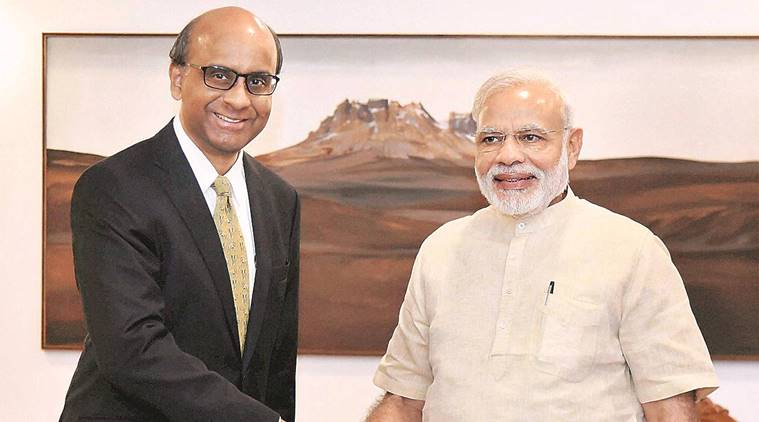 PM Narendra Modi with Singapore Dy PM Tharman Shanmugaratnam in New Delhi on Friday. (Source: PTI photo)
Prime Minister Narendra Modi said on Friday that India needed “rapid transformation”, instead of “mere incremental progress”, if it has to meet the challenges of the future. For this, the country and policymakers need to reorient existing administrative systems and laws, he said, abandon unnecessary procedures, speed up processes and adopt technology.
“We cannot march through the 21st century with the administrative systems of the 19th century. Fundamental changes in administrative mindsets usually occur through sudden shocks or crisis. India is fortunate to be a stable democratic polity. In the absence of such shocks, we have to make special efforts to force ourselves to make transformative changes,” Modi said in his opening remarks at the inaugural lecture of the NITI Aayog’s Transforming India lecture series at Vigyan Bhavan.
Modi said countries can no longer develop in isolation but needed ideas from outside, which was the purpose of the lecture series under the auspices of NITI Aayog. The first lecture was delivered by Deputy Prime Minister of Singapore Tharman Shanmugaratnam on ‘India in the Global Economy’.
“If India is to meet the challenge of change, mere incremental progress is not enough,” Modi said. He said his vision for India is “rapid transformation, not gradual evolution” but that transformation cannot happen without a transformation of governance.
“A transformation of governance cannot happen without a transformation in mindset. A transformation in mindset cannot happen without transformative ideas,” Modi added.
The prime minister asked all secretaries of the government to conduct a follow-up discussion in a week’s time with participants from their ministries. “The purpose is to convert ideas that emerge in today’s session into specific action points relevant to each group. Wherever possible, I request the ministers also to participate in these sessions,” he said.
In his speech, Modi emphasised the need to brainstorm collectively to convert ideas into action and said that ever since taking over the reins of the Union government, he had personally participated in structured brainstorming sessions with bankers, with police officers and with secretaries to government, among others. “The ideas coming from those sessions are being incorporated into policy. These efforts have been to tap ideas from inside. The next step is to bring in ideas from outside,” Modi said.
Shanmugaratnam, whom Modi introduced as a “prolific scholar and public policy maker”, spoke in his lecture about the transformative changes carried out in urban planning and administrative systems in Singapore. “India has to move with urgency to achieve its potential. 8-10 per cent growth rate is not a luxury, it will merely get India about 70 per cent of per capita income of China in 20 years time,” Shanmugaratnam said.
“India still needs to grow by 8-10 per cent over the next 20 years if it is to create jobs for a youthful population, if it is to reduce the tremendous underemployment of its population and if it is to achieve inclusive growth, including a significant shift of people from the lower income group to the middle income group,” the Singapore deputy PM said, indicating that it was something that China has achieved.
Notwithstanding the head-start that China has, Shanmugaratnam said: “India is uniquely positioned to recast the global narrative is because India is also an open society. It’s a constitutional democracy with a diverse population, and India can show how it is possible with an open society and an open economy not just rapid growth, but inclusive growth for its people.”
Modi concurred with Shanmugaratnam’s view that India needs bold economic reforms, and said that if India was to meet the challenge of change, mere incremental progress is not enough. “A metamorphosis is needed,” Modi said.
The Singapore deputy prime minister, citing India’s low-cost medical care facilities, said that in every field, the culture inculcated by leading players had to be spread to the rest of the industry.
“In India, you have the highest quality medical care, at a fraction of the price in the advanced world. Places like Narayana Health Institute of Cardiac Sciences, which was started by Dr Devi Shetty, and you have some of the best academic health systems in the world. Christian Medical College in Vellore, which the National University of Singapore collaborates very closely with in education and research. In every field, we have to spread the culture, which exists in leading players to the rest of the industry,” Shanmugaratnam said.
Minister of Law and Information Technology Ravi Shankar Prasad, on his Twitter, said that Shanmugaratnam’s speech was followed by questions from the audience, which comprised the cabinet ministers and secretaries. According to Prasad’s tweet, Shanmugaratnam also called for India to pursue innovations in various fields, and to “invest in social mobility”.
In his speech, Modi said that the NITI Aayog (the National Institution for Transforming India), which was floated as a think tank to guide India’s transformation, said change was needed not just because India needed to keep up with the world but was for internal reasons. “The younger generation in our own country is thinking and aspiring so differently, that government can no longer afford to remain rooted in the past,” he said.