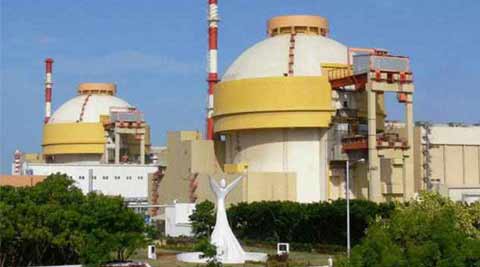
Andhra Pradesh, a state that had curiously turned down its initial electricity allocation of 530 MWe (mega watt electric) from the Kudankulam atomic power project a decade ago, is now in the race for a second nuclear site that could see it emerge as a major nuclear hub in the southern region. A team of officers from the Department of Atomic Energy (DAE) and the Nuclear Power Corporation of India Limited (NPCIL) are learnt to have met with the senior officers of the Andhra Pradesh government to discuss the feasibility of identifying a second coastal site to set up a nuclear plant in the state.
Andhra Pradesh’s concerted nuclear push marks a sharp departure from the state’s strategy of focussing on gas-based capacity in the early part of the last decade, most of which is now struggling for want of fuel.
[related-post]
At present, there are just three states in the country — Gujarat, Maharashtra and Tamil Nadu — that have two or more nuclear sites. In case of Andhra Pradesh, the Centre has already shortlisted the Kovvada site to build a nuclear project with the assistance of GE-Hitachi Nuclear Energy and discussions are currently on with an US-based nuclear vendor to arrive at a project proposal. Talks for a second site in Andhra Pradesh are aimed at housing two Russian-designed VVER 1000 reactors that were originally supposed to come up at Haripur in West Bengal. The states of Kerala, Karnataka and Odisha were also learnt to be in the reckoning for housing the units to be built with Russian assistance.
The project would be the second Russian-assisted nuclear station, after the 2,000 MWe Kudankulam project in Tamil Nadu. The DAE’s site selection committee had earlier earmarked the Haripur site as a second site for the Russians to build a 2,000 MWe nuclear project, identical to the Kudankulam project. In 2011, Rosatom, the Russian counterpart of India’s DAE, asked India for an alternate site after a series of local protests.
At the Kovvada site in Andhra Pradesh where GE-Hitachi Nuclear is expected to deploy two of its ESBWR-series reactors, pre-project activities — land acquisition and associated rehabilitation and resettlement, obtaining statutory clearances, site investigations to obtain data for design inputs — are in progress. While the exact schedule would depend on the date of commencement of work on the project after the conclusion of agreements and project sanction, the generation of electricity from the first set of units is likely after about seven years from actual start of construction.
In late 2013, when the first 1,000 MWe unit of the Kudankulam nuclear project was scheduled to be commissioned, a slugfest had erupted among the power-starved southern states to ensure that new claimants are kept out. Andhra Pradesh, which turned down its allocation of 530 MWe of power from the 2,000 MWe station when the share of the generated electricity was initially firmed up nearly a decade ago, had then stepped up its demand for access to the Centre’s 300 MWe “unallocated” quota.
But Tamil Nadu, the host state and biggest beneficiary, had then lobbied hard to completely exclude Andhra Pradesh from the “unallocated quota”.
Story continues below this ad
“Andhra Pradesh was not in favour of taking power when the construction of the nuclear power plant began in 2002-03. The state was tentatively allocated 530 MWe power from the project but APTRANSCO (Andhra Pradesh’s state-owned power utility) expressed unwillingness, and thus the power was re-distributed among other states,” said a government official involved in the exercise. According to an order issued by the union power ministry in 2007, Andhra Pradesh was the only southern state excluded from the allocations.