


Tags:


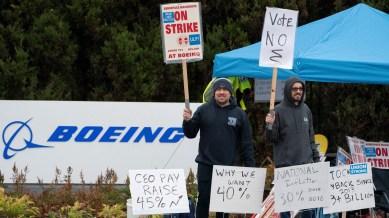
Boeing factory workers voted Wednesday to reject the company’s latest contract offer and to continue a six-week strike that has halted production of the aerospace giant’s bestselling jetliners.
Local union leaders in Seattle said 64% of members of the International Association of Machinists and Aerospace Workers who cast ballots voted against accepting the proposal.


The strike has deprived the company of much-needed cash that it gets from delivering new planes to airlines. On Wednesday, the company reported a third-quarter loss of more than $6 billion.
Union machinists assemble the 737 Max, Boeing’s best-selling airliner, along with the 777 or “triple-seven” jet and the 767 cargo plane at factories in Renton and Everett, Washington.
The offer rejected Wednesday included pay raises of 35% over four years. The version that union members rejected when they voted to strike last month featured a 25% increase over four years.
The union, which initially demanded 40% pay boosts over three years, said the annual raises in the revised offer would total 39.8%, when compounded.
Boeing workers told Associated Press reporters that a sticking point was the company’s refusal to restore a traditional pension plan that was frozen a decade ago.
“The pension should have been the top priority. We all said that was our top priority, along with wage,” Larry Best, a customer-quality coordinator with 38 years at Boeing, said on a picket line outside a Boeing factory in Everett, Washington. “Now is the prime opportunity in a prime time to get our pension back, and we all need to stay out and dig our heels in.” Theresa Pound, a 16-year Boeing veteran, also voted against the deal. She said the health plan has gotten worse, with higher premiums and more out-of-pocket expenses, and her expected pension benefits would not be enough, even when combined with a 401(k) retirement account.
“I have put more time in this place than I was ever required to. I have literally blood, sweat and tears from working at this company,” the 37-year-old said. “I’m looking at working until I’m 70 because I have this possibility that I might not get to retire based on what’s happening in the market.” Boeing CEO Kelly Ortberg told staff in a memo this month that about 10% of the company’s worldwide workforce of 170,000 would be laid off in coming months if the strike did not end.
He said the company also would further delay the rollout of a new plane, the 777X, to 2026 instead of 2025, and would stop building the cargo version of its 767 jet in 2027 after finishing current orders.
Before the third-quarter results were announced Wednesday, Boeing had reporting losing more than $25 billion since the start of 2019.
Boeing has said that average annual pay for machinists is currently $75,608.
Early in the strike, Boeing made what it termed its “best and final” offer. The proposal included pay raises of 30% over four years, and angered union leaders because the company announced it to the striking workers through the media and set a short ratification deadline.
Boeing backed down and gave the union more time. However, many workers maintained the offer still wasn’t good enough. The company withdrew the proposed contract on Oct. 9 after negotiations broke down, and the two sides announced the latest proposal on Saturday.
The last Boeing strike, in 2008, lasted eight weeks and cost the company about $100 million daily in deferred revenue. A 1995 strike lasted 10 weeks.


