© IE Online Media Services Pvt Ltd
 6 min read


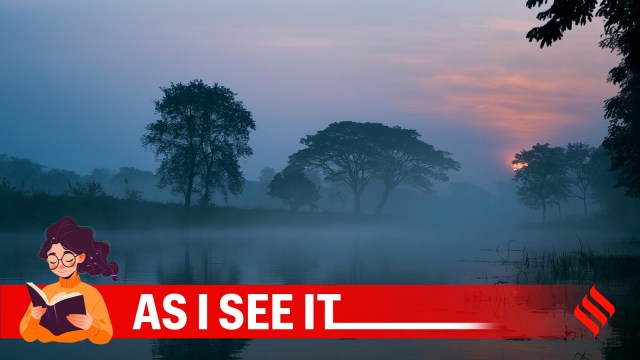 When I return to Uren, the ponds are older, their patience thinner. (Source: generated using AI)
 (Written by Ashutosh Kumar Thakur)
I learned to read water before I learned to trust it. In my village, Uren in Madhubani, close to the Nepal border, people grow up memorising its moods. They know which canal sulks in summer, which pond thickens into green despair, which rivulet turns unruly in the monsoon. Water is not scenery there. It is temperament, memory, warning.
In childhood, women drew water from narrow canals as if tracing the lines of an old letter. Rekha Devi, who sold herbs in the weekly haat, used to say, “Water is patient, but it remembers neglect.” She spoke with the certainty of someone who had already watched faith fail once. And yet, people lived as though water would always return. As though belief itself were a guarantee.
Much later, I encountered a short poem by Naresh Saxena and realised I had been living inside its meaning long before I met its words. Here is a translation:
The fish believed
that just as they longed for the water
the water must long for them too…
water is the homeland of the fish
yet the fish know nothing about their own land.
The lines arrive quietly. They do not announce themselves. You read them once and walk away. Yet they return—at odd hours, in unguarded moments—asking a single unsettling question: who belongs here?
Water is the country of fish. But the fish do not know their country.
In the Northeast, water behaves differently. It does not rush; it deliberates. In Guwahati, Hiramoni Hazarika told me, “The Brahmaputra is not a river. It is a shifting argument.” Farther east, in Silchar, Rahim Uddin lived in a bamboo house on stilts because the land refused to stay faithful. “At least the river warns,” he said. “The administration never does.” Outside, fireflies flickered like uncertain punctuation along an unstable margin.
In the Western Ghats, moisture becomes an archive. It gathers on leaves and moss-covered stones like stored memory. Maya Lobo, an ecologist, once told me, “Moisture is not dampness. It is ancestry. When it goes, the forest loses its past.” In a dripping forest near Kodagu, she held a frog species once thought extinct. It sat unafraid in her palm, as though extinction had taught it that fear is wasted on a forgetful world.
In Kashmir, the Jhelum moves like a tired elder. Farooq Ahmad, a walnut wood craftsman, said quietly, “This river has seen more funerals than festivals. It loves us, but love is not protection.” In Uttarakhand, climbing a mountain path with a village schoolteacher, I heard another truth: “Every village here lives in the aftermath of a disaster that has not fully arrived.”
Again and again, Saxena’s fish returned to me—fish trusting the loyalty of water, forests trusting the endurance of the past, villages trusting a future that has begun to fray.
In Hagalawadi, a small village in Karnataka, the lanes curve like thought and the ponds lie still, remembering what they used to be. Dr Rajgopal once told me, “Villages whisper. Most people don’t have the ear for it.” He spoke of Savitri Amma, a farmer whose land had turned brittle from defeated monsoons. “She knows the signs of rain better than any department,” he said. “She says water is losing its old affection for us.”
By the village pond, children sent ripples skimming across a tired surface. Buffaloes stood half-submerged with the calm of creatures who have known both abundance and loss. “A village,” Rajgopal said, “is not geography. It is an agreement with land. When the land breaks that agreement, people lose their place.”
I now live in Bangalore and travel often across the South. In Thiruvannamalai, I watched farmers lift water from narrow tanks and whisper prayers to the sacred hill. In Anantapur, skeletal crops burned under a brutal sun as villagers repaired wells by hand. In Kochi, a fisherman named Saized Chacko showed me a canal where fresh and saltwater argued endlessly. “We once spoke to the water,” he said. “Now it feels as if it has forgotten us.” His hand skimmed the surface as though searching for a response that no longer came.
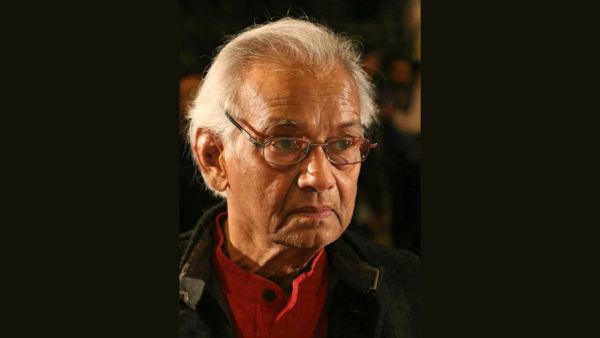 I encountered a short poem by Naresh Saxena and realised I had been living inside its meaning long before I met its words. (Facebook)
These landscapes are not merely physical. They carry the quiet tension between belief and endurance. Different geographies, one shared uncertainty: the water remembers, even when people forget.
Today, water behaves like a reminder—that it never belonged to us. That it was only lent. We built cities where lakes once breathed. We stripped forests that held moisture like memory. We chased rivers with concrete and courts. And now water answers with shortage or flood, with silence or fury.
Saxena’s poem is not a metaphor. It is a diagnosis.
We are the fish.
The drought is the net.
And the water, our country, slips through the holes.
When I return to Uren, the ponds are older, their patience thinner. People speak of erratic rains like unreliable relatives. One evening I sit by the old pond near our house. Frogs argue. A lotus still tries to rise. A boy throws a stone and watches the ripples fade.
Water is the country of fish.
But fish do not know their country.
Perhaps neither did we. Perhaps we believed rivers were loyal, seasons contractual, belonging automatic. But countries change. People forget. Rivers remember.
And sometimes, when the net rises, the water chooses to leave.
That is the story of our time: a nation learning it has misread itself. A people discovering that belonging is not a birthright but a negotiation. A country trying to understand the temper of water, even as it slips quietly, steadily away.
Fish do not know their country.
It is time we learned ours.