10 min read
© The Indian Express Pvt Ltd



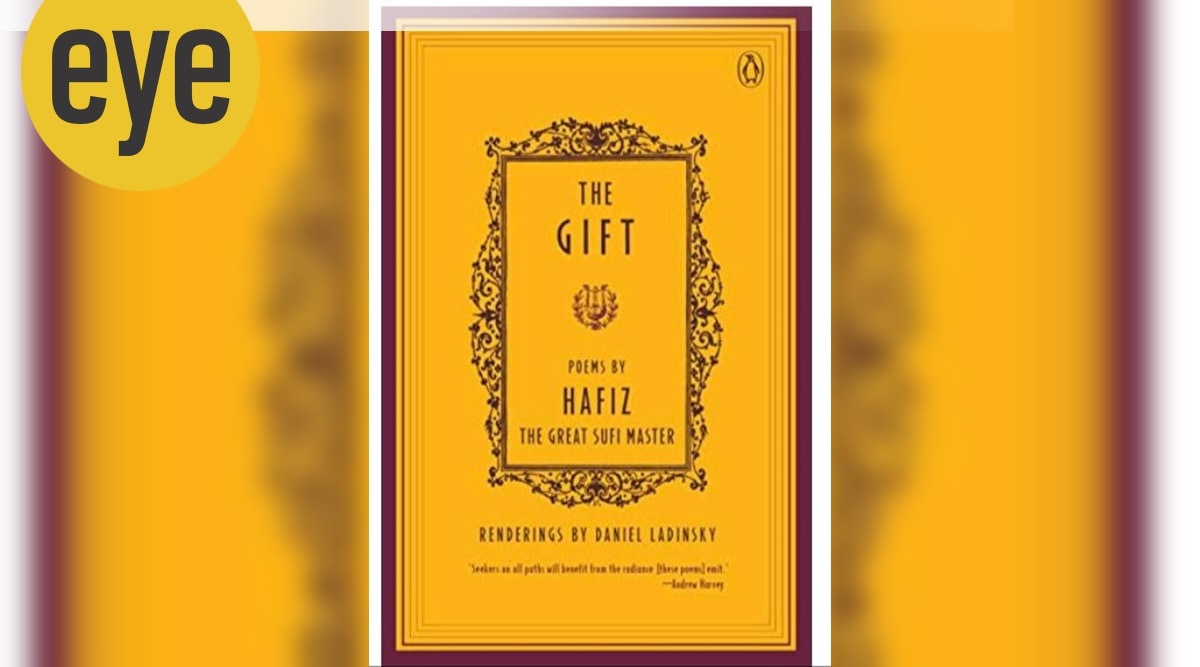 The Gift: Poems by Hafiz the Great Sufi Master
Daniel Ladinsky
Penguin Books
352 pages
Rs 1,199
(Source: Amazon.in)
The Gift: Poems by Hafiz the Great Sufi Master
Daniel Ladinsky
Penguin Books
352 pages
Rs 1,199
(Source: Amazon.in)‘A poet is someone/ who can pour light into a cup,/ then raise it to nourish/ your beautiful, parched, holy mouth.’
When I first read these lines in Daniel Ladinsky’s renditions of the poet Hafiz, I remember the hush that fell upon my world. There was the sense of having stumbled upon the right table at the dinner party (or the tavern, which is Hafiz’s preferred habitat), and the added delight of being seated exactly beside the right company. Who was this poet? How did he put word to experience with such immaculate precision? How did he speak so directly from the cave of one heart to another, making the hiatus of centuries so utterly irrelevant?
I have spent years gifting The Gift to poet and seeker friends. That was my small salaam to the bard of Shiraz, the poet who sings of the sensuous and the sublime, the earthy and the existential, and never seems to admit of any contradiction between the two. There is not much I knew of this fourteenth century Persian lyric poet other than the fact that Goethe famously said, ‘Hafiz has no peer’, Emerson proclaimed him ‘a people’s poet’, Debendranath Tagore quoted him widely, and that his verse so permeates the music, art, calligraphy and everyday language of Farsi speakers that in Iran he can outsell the Koran. What I do know today is this: as a poet in the ecstatic mode, he is a member of that peripheral but undying tribe of the lost, the heartbroken, the moonstruck, where the only rule of membership is to be vulnerable and to be human. Whether he is a courtly love poet or a Sufi mystic, whether the passion to which he alludes is romantic or sacred, is immaterial; the ambivalence only enriches the sumptuous textures of his verse. Acclaimed English translations by Dick Davis, Peter Avery, Elizabeth Gray, Geoffrey Squires, Patrick Sykes and Fatehmeh Keshavarz exist, but I will confess it was Ladinsky’s work that first ignited my interest in these.
More recently, I discovered that Ladinsky sees his poems as ‘renderings’, rather than translations of Hafiz. Evidently, Ladinsky knows no Persian. This has led to his work being criticized as an act of cultural and religious appropriation. The pain of those who love the original, and see no evidence of it in these books, is understandable. Personally, however, I view Ladinsky in the long tradition of free improvisers within a tradition—a figure with which I am familiar in the Indian arts—where a signature is a declaration of allegiance to a family, a guild, a tribe, a gharana. Ladinsky works within the raga, the atmospherics, the wisdom school of sacred delirium, the essential climate or mahaul of Hafiz. I read him the way I would read Arvind Krishna Mehrotra’s translations of Kabir, where references to ‘Faber poets’ and ‘dreadlocked Rastas’ are clearly playful contemporary riffs, true to Mehrotra’s perception of the spirit, rather than the letter, of Kabir. Ladinsky similarly directs our gaze from ideas of literary purity around a central Ur-text towards a vibrant tradition of improvisation as an act of homage.
These renditions aim, then, to be true to essence rather than to chapter and verse. As Ladinsky writes, “I quickly discovered that even in English, a single Hafiz poem, often a single couplet, could be approached from many points of view. A single stanza of Hafiz could generate whole families of independent poems in English, each exploring some aspect of the original.” He acknowledges other translations as resource material, but asserts that he is not interested in rendering the ‘form’ of Hafiz, but in ‘releasing’ the ‘spirit’ in another language – ‘a spirit of infinite tenderness and compassion, of great exuberance, joy and laughter, of ecstatic love and fervent longing…’
His approach is, in many ways, a reminder of the moving spirit behind the Sufi and Bhakti traditions: one that prizes the joyful amateur over the professional, the lover over the expert, the mystic over the cleric. For the lover, the aim is always to channel, meld with and embody the sacred, not simply worship it. There is moisture in Ladinsky’s work — the smell of green truth and wild rain, a radiant intimacy, unobscured by the smog of organised faith and cultural politics. Some might find these simple renditions at some variance with Hafiz’s legendary linguistic virtuosity, but as invitations to the experience of sacred intoxication, they are compelling. There is an expansiveness here, a warm-heartedness, a non-judgmental embrace. In these poems, Hafiz is a wise companion, standing on the other side of the fog of shame, fear and pain, chuckling, telling us that he knows what it means to taste every forbidden fruit and liquor, transgress every cultural boundary, and still tumble into the lap of a compassionate, humorous, unshockable divine. God here is not a long-faced, long-bearded elder; he is one that laughs. And what a great, cosmos-quaking belly laugh it is! (Not surprisingly, the title of Ladinsky’s first book, published in 1996, is I Heard God Laughing.) One might even argue that Ladinsky puts Hafiz back where he belongs: not in the academy, but in the tavern.
Fresh, colloquial, whimsical, euphoric, here is a whiff of Hafiz as channeled by Ladinsky: ‘O wondrous creatures,/ by what strange miracle do you/ so often not/ smile?’ And: ‘What/ Would/Happen if God leaned down/ And gave you a full wet/ Kiss?’ And again: ‘Next time you meet Him in the forest/ Or on a crowded city street/ There won’t be anymore/ “Leaving”./ That is,/ God will climb/ Into your pocket./ You will simply just take/ Yourself/ Along.’ A personal favourite: ‘Complaint/ Is only possible/ While living in the suburbs/ Of God.’ And another: ‘One regret that I am determined not to have/ when I am lying upon my/ death bed/ is that we did not kiss/ enough.’
Not surprisingly, the mainsprings of this relationship between Ladinsky and his Muse were not merely literary. “When I was twenty years old,” he wrote to me recently in an email, “while on a retreat in the desert in Arizona, USA, I had a life-changing spiritual awakening. I felt everywhere I looked there could be found and so clearly seen — a majestic beauty in nature, and in the sky, in people and all creatures. I felt like I was seeing the divine in all things, and as existence itself.” That led to a lifelong quest for ‘the Source’ of this experience.
In 1978, seven years later, the quest took him from Midwestern America to Western India, where he spent spells of time over the next several years, time in Meherazad, near Ahmednagar, the home of Meher Baba, the twentieth century mystic. Meher Baba was gone, but Ladinsky immersed himself in the company of Eruch Jessawalla, one of Baba’s closest disciples. Of him, Ladinsky remarks, “I had a distinct feeling that this guy was more me than I was. It was startling.” And again, “When one spends time around a true saint, a wedding begins to be planned in the saint’s mind.”
The wedding in this case was obvious: a lifelong romance between Ladinsky and Hafiz. Ladinsky remembers with vivid clarity his daily walks with Eruch, during which conversations around the great Persian poet unfolded. Ladinsky learnt that Meher Baba had described Hafiz as ‘a perfect Master and a perfect poet’. It was Eruch who inspired Ladinsky’s Hafiz project, and even helped ‘choreograph’ it. “Your work is God’s work,” Eruch apparently told him. And on another occasion, added somewhat enigmatically, “Hafiz and I drink in the same Tavern.”
For Ladinsky, that was an injunction to the heart. He began marinating in Hafiz. He never stopped. Thirty years and seven books later, he lives in an old homestead ranch outside Taos, New Mexico, surrounded by mountains, near a log cabin and a horse barn, where he spends his days, he tells me, working, writing haiku and ‘deepening the wonder’. In our email exchanges, liberally peppered by quotes from the Buddha, bumper stickers and Elvis Presley, he talks of the crazy love of his murshid, the great resonance of freedom that is Hafiz and his preference for the reclusive life. The fact that his books have become bestsellers, quoted by Eckhart Tolle, Ram Dass, Oprah and Elif Shafak, is something he modestly attributes to the ‘gourmet nourishment’ that Hafiz provides in plenitude.
For Ladinsky, Hafiz is not a remote saint relegated to sanctified museum status; he is our contemporary, a deeply familiar fellow-traveller, ‘one of the greatest spiritual lovers and guides that humankind has ever known’. ‘Come swimming with me in the wine barrels of Hafiz,’ he writes time and again, and the poems tell me he knows what it’s like to have had a dousing.
And yet, I don’t know if it is Hafiz that I find in these books. Perhaps not. Perhaps it is Ladinsky, infused by the grace of his pir, Meher Baba. And I do understand how it might disappoint those who want a historic Hafiz, rather than an archetypal one. But what I smell in these poems is the wonder of awakening and the palpable love of a spiritual master. And I smell the oasis. I am reminded of the 12th century Kannada poet Akka Mahadevi’s phrase: ‘the Brahman hiding in yearning’. I am reminded that yearning is not desolation, that the seemingly fallen world is not in opposition to the kingdom of God. That the parched mouth is also beautiful and holy.
I think that, for me, might be reward enough.
Arundhathi Subramaniam is an award-winning poet and writer