5 min read

Journalism of Courage



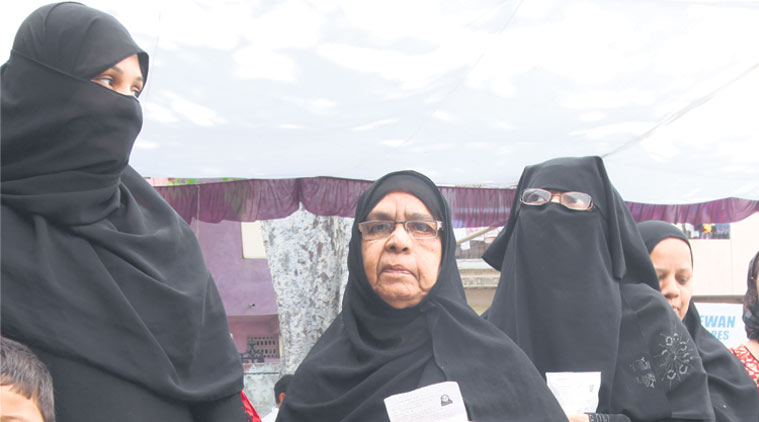 Muslim voters in Ahmedabad. (Javed Raja/file)
IN THE Congress effort to build a caste combination in Gujarat — Patel, Dalit, tribal and OBC — it is not by accident that Muslims are not explicitly part of the party’s election formula. Muslim leaders in the Congress said that while the party will continue to rely on Muslim votes, it is part of its electoral strategy to avoid being projected as pro-Muslim, and pre-empt any effort by the BJP to exploit such an image to mobilise the Hindu vote.
This is an election that has been marked so far by caste rather than religious polarisation. To win over Patidar leader Hardik Patel, OBC leader Alpesh Thakor (now in the Congress) and Dalit activist Jignesh Mevani — besides sharing seats with tribal leader Chhotu Vasava — the Congress has agreed to meet many of their demands, some of which are set to be part of the party’s manifesto. On the other hand, the Congress leadership has reportedly told its Muslim leaders that the manifesto cannot include demands specific to Muslims.
“The first priority is to win the elections and bring the party back to power in Gujarat, irrespective of whether Muslims are seen with the Congress or they remain behind the curtain. It makes no difference,” senior Congress leader Badruddin Sheikh told The Indian Express. At a meeting with other Muslim leaders, Sheikh reportedly stressed the importance of victory and that “other things can be taken care of later”.
Congress leaders said this does not mean the party does not need Muslim votes. Rather, it is optimistic that the Muslim voters will stay with the party for want of an alternative.
So, while Rahul Gandhi visited a series of temples in the state in the last two months, the Congress has not campaigned in any predominantly Muslim area. For the BJP, Chief Minister Vijay Rupani took out a roadshow through Muslim-dominated Jamalpur-Khadia in Ahmedabad while Minority Morcha leaders have campaigned among Muslims in Surat. The BJP, however, has not given a ticket to any Muslim, while the Congress has fielded six Muslim candidates. Muslims account for 9.6% of the state’s population, as per Census 2011.
Social and political activists Abdul Hafeez Lakhani and Zubair Gopalani, who are widely seen as leaning towards the Congress, endorse the strategy. They say the BJP has been in power by projecting the Congress as a pro-Muslim party. While agreeing that the Congress strategy to distance itself from Muslims in public may be called “soft Hindutva”, they told The Indian Express that it is the first time that the Congress has created an atmosphere in its favour by “neutralising” the BJP’s effort to polarise voters.
Lakhani and Gopalani referred to the government’s attempt to link an alleged IS operative to Congress MP Ahmed Patel who, the government claimed, ran a hospital that had once employed the alleged operative (now arrested). “But the caste agitations overshadowed everything else and the BJP strategy did not succeed,” Lakhani said.
At a meeting of the All India Muslim Majlis Mushawarat, leaders stressed the need for Muslims not to object to the Congress strategy, according to sources who attended it. Human rights activist Professor Juzar Bandukwala, too, agreed with this view. On the other hand, Sufi Muslim and legal activist Anwar Sheikh, also said to have Congress leanings, claimed that it is part of a long-term Congress strategy to marginalise Muslims politically. “The party is moving towards soft Hindutva,” said Sheikh.
To see if the Congress is justified in its faith of retaining the Muslim vote, The Indian Express contacted a number of Muslim citizens. Most of them said they would vote for the Congress.
Said Muhammed Amin Sheth of Godhra, engaged in the shoes business, said: “It is not important if Rahul Gandhi or local Congress leaders go to Muslim localities during elections or not. What is important is that… they try their best to do impartial justice as far as possible.”
Ibrahim Kapadia, who runs a cloth shop in Vadodara’s Mandvi Chowk, said, “The Congress tries to take all communities and groups along, unlike the BJP which cannot adjust with minorities, particularly Muslims…” And Ahmedabad resident Mukhtiar Sheikh echoed: “The Congress is the best option in this atmosphere… Whether Congress leaders go to the Muslim localities or avoid people with beards and topis, or women in burqas, is immaterial.”
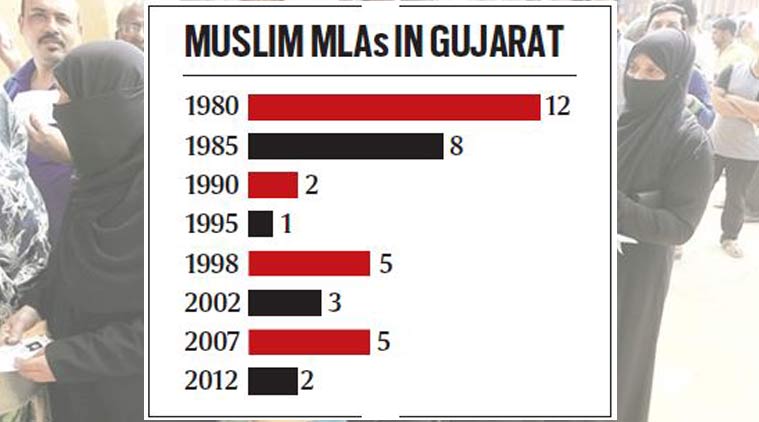
While Muslims account for a 10th of the population, they have never been proportionately represented in elections or the assembly. The maximum number of Muslim MLAs, 12, were elected in 1980; this dropped to 8 in 1985, and has never crossed 5 since.