
Opinion Strange, said the BJP
‘Strangeness’ of SC Arunachal verdict lies in its upholding of constitutional morality in these times.





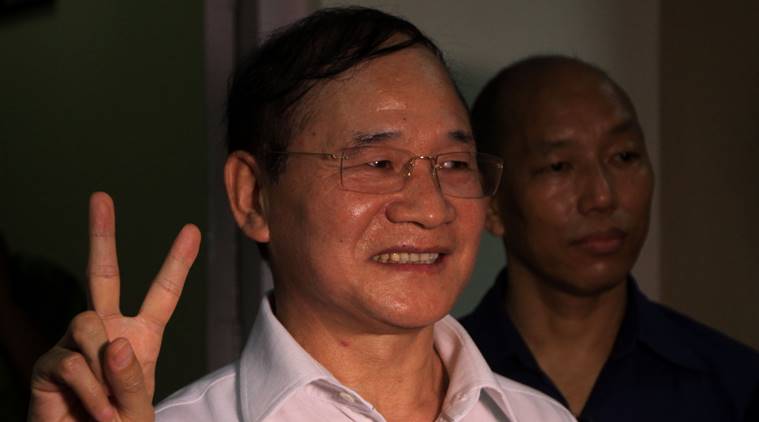 Nabam Tuk took charge as Chief Minister of the state at Arunachal Bhavan in Delhi. Express photo
The BJP has faulted the Supreme Court ruling on Arunachal as “strange”. Politics in India is indeed a complex and strange terrain. If one thinks of principles alone, the latest ruling of the constitution bench of the Supreme Court can be very reassuring. The moment one begins situating it in the ground realities, the limited point the ruling makes becomes obvious. To be sure, there is something called constitutional morality that goes beyond the literal meaning of words, clauses and articles of the constitution. On the whole, the court in India has sided with the former more than the latter. Unfortunately, however, actual politics tends to have very limited association with constitutional morality which is only a different name for the ethos of democracy. On this test of democratic ethos, India’s politics falters again and again. In the case of Arunachal Pradesh, you would sulk if you are a BJP supporter, you would rejoice if you are a Congress supporter, but if you are neither, you would only worry about the gap between the constitutional morality advanced by the court and the “strange” understanding of democracy shown by political actors.
The Congress has made all the correct noises about democracy and vindication of its stand on the imposition of president’s rule in Arunachal Pradesh. Indeed, it is a victory of sorts for the party since the Supreme Court has not only squarely rejected imposition of president’s rule (and installation of a new chief minister) in the state but directed restoration of the Nabam Tuki government. This is indeed an extraordinary step. The crucial question is, can the Congress retain what the court gave it?

By the time the import of the ruling sinks in and this column is in print, the challenge of proving majority in the House would be staring the Congress in the eye. It has been clear since last December that the state party is deeply divided and without the help of the flawed anti-defection laws, it is not likely that the Congress can easily survive the floor test in the state legislature. And even if it did, that would be predicated on the stand taken by the speaker. So, in either event, whether the Tuki government proves majority or fails, the Congress cannot really claim that its strength on the ground has improved. Needless to say, in politics, court rulings bring only limited victories; ultimately the ground realities matter and the Congress does not have much to rejoice about on that score, but much to worry about.
But the real warning from this ruling comes for the BJP — both as government and as party. The current Union government has been sometimes hailed as being more truly federal in its dealings with the states. However, the experience of states like Himachal, Arunachal and Uttarkhand has been in the opposite direction. In Arunachal Pradesh and Uttarakhand, much trouble emanated from the office of the governor and even elsewhere. Governors under this BJP government have been prone to rake in controversies. So, appointments of governors, political expectations from the new appointees and the eagerness with which the home ministry acts on their reports are all non-federal acts of the BJP government and reflect negatively on the democratic ethos that informs the SC ruling and the prevailing interpretation of the constitution.
The amoral exercise of constitutional provisions by the present government reminds the student of Indian politics of the impunity with which similar actions were taken by the Centre half a century ago. As this writer has argued, the present dispensation resembles that period of authoritarian populism of the late Sixties and early Seventies — the memory of which the present government always employs to demean its opponent, the Congress. Indira Gandhi was using “garibi hatao” rhetoric to defend her contempt for constitutional morality while the present government uses the rhetoric of “sabka vikas” and “shreshth Bharat” to adopt the same cynical approach.
It is an ironic coincidence that the SC ruling on Arunachal came on the day the BJP launched its major offensive in the Northeast — the North East ‘Democratic’ Alliance (NEDA). Handling states of the Northeast has always been a precarious project. The Congress frittered away its natural advantage by succumbing to the temptations of its local leaderships. The BJP has an ultra-nationalist approach to the region and it has been actively engaged in the attempt to impose the Hindi-heartland imagination of the nation onto this region — as elsewhere too. Now, it has taken to the political offensive. Through NEDA the party aims at consolidating its political gains from Assam. The political success, however, might leave the region more bruised and more bewildered. The BJP, of course, has a right to expand in the Northeast; but the delicate issues of regionalism, ethnicity and a negotiated settlement of disparate claims would be ill served if the BJP steamrolls local power equations as it sought to do in Arunachal or if it bypasses local sensitivities in the region.
It is indeed a tough call for political parties to balance three things: Their constant search for power; responsibility to national interest; and the pious challenge of expanding democracy. But leaders go down in history and parties become historic only by trying to balance their power instinct with larger constraints. Even before it lost as a power machine, the Congress lost historically on this particular aspect and that led to its undoing in the end. It would be interesting to watch what course the BJP takes on this path.
The BJP sees itself as the politically ascendant force for the coming decade beyond 2019. What do developments in Arunachal and Uttarakhand indicate? In both instances, it came out as impatient. The BJP seems to be content with formally replacing Congress, if necessary, through Congressmen. It is willing to include Congressmen (and leaders from other parties) in its fold, give them prominence, tickets and ministerial berths, thereby effecting the initial change of ruling parties in states. This has happened in UP, Maharashtra and other places too. This strategy gives quick results and helps the BJP spite the Congress but this model of party building is flawed. The flaw is not just that “outsiders” gain ground within the BJP — that is the party’s internal problem relating to its ideology and idea of being different. In the process, democratic ethos is the real casualty. No wonder the party finds the court ruling “strange”.
The “strangeness” of the ruling lies in the fact that it upholds constitutional morality in the context of overall contempt for democratic ethos. If a party that hopes to be the main national party of the next decade has a cynical approach to the democratic ethos, then surely there is much to worry about notwithstanding the glimmer of hope provided by the court ruling.
 Share
Share


