3 min read
Stay updated with the latest - Click here to follow us on Instagram

Journalism of Courage



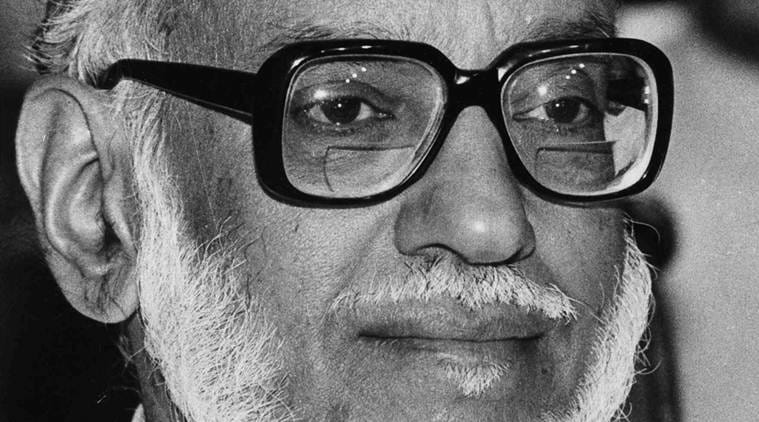 MGK Menon, Scientific advisor to Prime Minister. Express archive photo.
Noted physicist M G K Menon, who became one of the most famous names of Indian science, died here Tuesday after prolonged illness.
Menon, 88, was suffering from a rare form of Parkinson’s Plus syndrome and was confined to bed for most of the last one year.
Watch What Else Is making News
A particle physicist who contributed immensely in the study of decay of sub-atomic particles, Menon distinguished himself as a science administrator as well, going on to head the most prestigious scientific institutions in the country, including the Tata Institute of Fundamental Research (TIFR) and Indian Space Research Organisation (ISRO).
During his long administrative career, he held almost every top-level scientific position in the government. He served as Director General of Council of Scientific and Industrial Research (CSIR), Secretary in Department of Science and Technology as well as Department of Environment, Scientific Adviser to Defence Minister, Chairman of the Scientific Advisory Committee to the Cabinet, and Scientific
Adviser to the Prime Minister, before being appointed Minister of State for Science and Technology in the V P Singh government in 1989. Between 1990 and 1996, he also served as a Rajya Sabha MP.
“He was one of the most brilliant scientists that I have met. If he had continued with his scientific research, he would have made many more outstanding contributions in physics. He sacrificed his career to the cause of nation building. He loved India and worked for India,” said scientist and Bharat Ratna awardee C N R Rao. Prof Rao had a long association with Menon.
Menon earned a PhD from the University of Bristol, UK in 1953 and two years later, joined the TIFR in Mumbai at the invitation of Homi Jehangir Bhabha.
Following the untimely death of Bhabha in an air-crash in 1966, J R D Tata, the chairman of governing council of TIFR, backed him to become the director. Menon was only 38 at that time. That started his journey as a science administrator that saw him serve in every major scientific position for the next five decades.
“He built institutions and not himself. He served as mentor to several generations of Indian scientists and preferred to work silently in the background,” said CSIR Director General Girish Sahni.
Stay updated with the latest - Click here to follow us on Instagram