Premium
This is an archive article published on October 26, 2015

Troubled waters

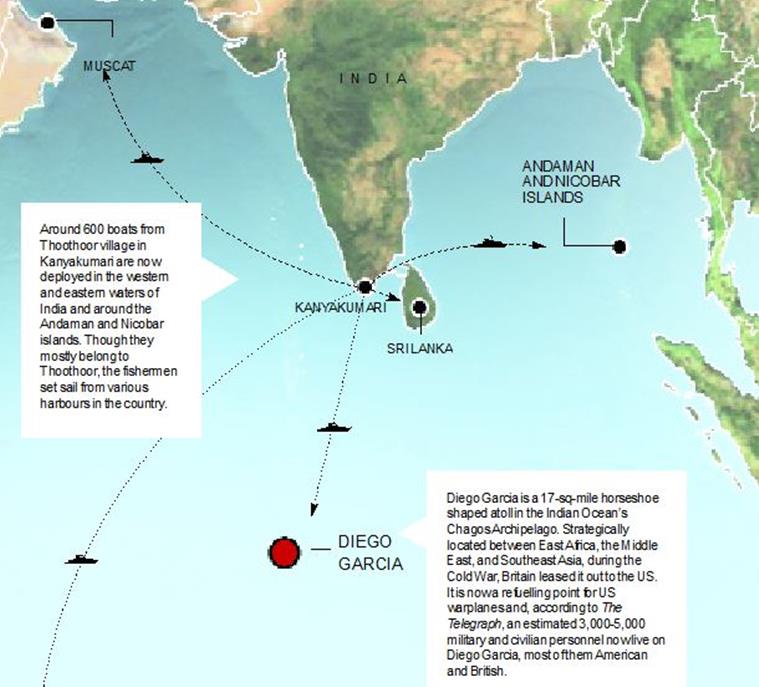
For the past two weeks, 23 fishermen have been in the custody of the British Navy after they strayed into the British Indian Ocean Territory of Diego Garcia.

For the past two weeks, 23 fishermen — nine from Kerala and the others from Tamil Nadu — have been in the custody of the British Navy after they strayed into the British Indian Ocean Territory of Diego Garcia, a fishermen union claimed last week

Why Diego Garcia

The Indian waters are said to be over-exploited with too many trawlers and fishing boats competing for stock, forcing the fishermen to venture out deep into the sea, often crossing maritime boundaries. Fishermen from the Kerala and Tamil Nadu coast often go up to Diego Garcia (967 nautical miles or 1,796 km away from Kanyakumari coast), Muscat and Andaman and Nicobar Islands in search of sea wealth. The waters of Diego Garcia are known for their abundant fish wealth, particularly tuna and shark.

The fishermen

* Deep-sea-going fishermen of the southern region are concentrated in five villages in Kanyakumari, including Thoothoor, Chinnathurai, Kattathurai, Vallavilai and Poothurai. The 23 fishermen now in the custody of the British Navy are from of Thoothoor.

* Thoothoor, 45 km from Nagercoil in Tamil Nadu’s Kanyakumari district, from where most boats set sail, has over 800 boats. The Thoothoor fishermen are traditional shark hunters, masters of deep-sea fishing who have complete command over India’s seaboard of around 8,000 km and 2 million square km of exclusive economic zone waters.

* Each of their boats can carry up to 14 people. A single trip in the deep seas takes 15 days to six weeks. The fishermen set sail in groups with provisions to last at least five weeks. The boats are equipped with wireless radios. As they stray into international waters, a voter card is often their only identification paper, their ‘passport’.

map759x

Deep-sea fishing

India’s stretched marine resources are often blamed on the overuse of mechanised trawlers that use bag-shaped nets that suck the seabed clean, thus damaging the marine ecosystem. Deep-sea fishing is considered the more traditional form of fishing, with the fishermen using hooks and lines for their catch of shark, tuna and other deep-sea fish. It’s a technique that is seen as more sustainable and less exploitative.

Each of these boats have 15,000 to 20,000 hooks of various types, one for almost every kind of shark or tuna. Around 2,000 hooks are placed along a 5 km-long nylon line that’s lowered into the water, a process that’s called shooting. The shooting and the hauling of the hooks back into the boat take about nine hours.

Recent arrests

Story continues below this ad

May 2015: British Navy at Diego Garcia intercept two boats from Thoothoor and take 23 fishermen into custody.

February 2015: The Seychelles Island Coast Guard arrest 20 fishermen from Thoothoor coast.

December 2014: Twenty six fishermen from Kanyakumari district arrested by the Bangladesh Navy in mid-sea near Kolkata.

October 2012: Twenty two fishermen from fishing hamlets in Kanyakumari arrested by the Qatar police for crossing their maritime boundary line.

***********

Story continues below this ad

* 12-200 nautical miles is India’s marine exclusive economic zone (EEZ). With a seaboard of 8,000 km, the EEZ, spread over an area of 2 million square km, is the zone in which the country has special rights regarding exploration and use of marine resources. The extent of EEZ has been the source of conflicts between countries. Between 1958 and 1976, UK and Iceland were involved in a series of confrontations, called the Cod Wars, over fishing rights in the North Atlantic.

* 10.07 million tonnes (mt) is India’s total fish production in 2014-15. Of this, 6.58 mt is inland fishery and 3.49 mt is marine fishery. India is one of the world’s largest producers of fish, making up 5.6 per cent of global fish production.

Shaju Philip is a Senior Assistant Editor at The Indian Express, where he leads the publication's coverage from Kerala. With over 25 years of experience in mainstream journalism, he is one of the most authoritative voices on the socio-political, religious, and developmental landscape of South India. Expertise, Experience, and Authority Decades of Regional Specialization: Shaju has spent more than two decades documenting the "Kerala Model" of development, its complex communal dynamics, and its high-stakes political environment. Key Coverage Beats: His extensive reporting portfolio includes: Political & Governance Analysis: In-depth tracking of the LDF and UDF coalitions, the growth of the BJP in the state, and the intricate workings of the Kerala administration. Crime & Investigative Journalism: Noted for his coverage of high-profile cases such as the gold smuggling probe, political killings, and the state’s counter-terrorism efforts regarding radicalization modules. Crisis Management: He has led ground-level reporting during major regional crises, including the devastating 2018 floods, the Nipah virus outbreaks, and the Covid-19 pandemic response. ... Read More

Arun Janardhanan is an experienced and authoritative Tamil Nadu correspondent for The Indian Express. Based in the state, his reporting combines ground-level access with long-form clarity, offering readers a nuanced understanding of South India’s political, judicial, and cultural life - work that reflects both depth of expertise and sustained authority. Expertise Geographic Focus: As Tamil Nadu Correspondent focused on politics, crime, faith and disputes, Janardhanan has been also reporting extensively on Sri Lanka, producing a decade-long body of work on its elections, governance, and the aftermath of the Easter Sunday bombings through detailed stories and interviews. Key Coverage Areas: State Politics and Governance: Close reporting on the DMK and AIADMK, the emergence of new political actors such as actor Vijay’s TVK, internal party churn, Centre–State tensions, and the role of the Governor. Legal and Judicial Affairs: Consistent coverage of the Madras High Court, including religion-linked disputes and cases involving state authority and civil liberties. Investigations: Deep-dive series on landmark cases and unresolved questions, including the Tirupati encounter and the Rajiv Gandhi assassination, alongside multiple investigative series from Tamil Nadu. Culture, Society, and Crisis: Reporting on cultural organisations, language debates, and disaster coverage—from cyclones to prolonged monsoon emergencies—anchored in on-the-ground detail. His reporting has been recognised with the Ramnath Goenka Award for Excellence in Journalism. Beyond journalism, Janardhanan is also a screenwriter; his Malayalam feature film Aarkkariyam was released in 2021. ... Read More


Latest Comment
Post Comment
Read Comments
Advertisement
Advertisement
Advertisement
Advertisement