Premium
This is an archive article published on August 1, 2016

Fewer minor faiths in India now, finds Census; number of their adherents up

Hindus, Muslims, Christians, Sikhs, Buddhists, Jains make up over 99% of Indians, “other religions, persuasions” fall from 108 in 2001 to 82 in 2011

Through the decade of the noughties, the country lost its religious plurality somewhat, although absolute numbers of Indians professing religious persuasions other than the six major faiths continued to rise.

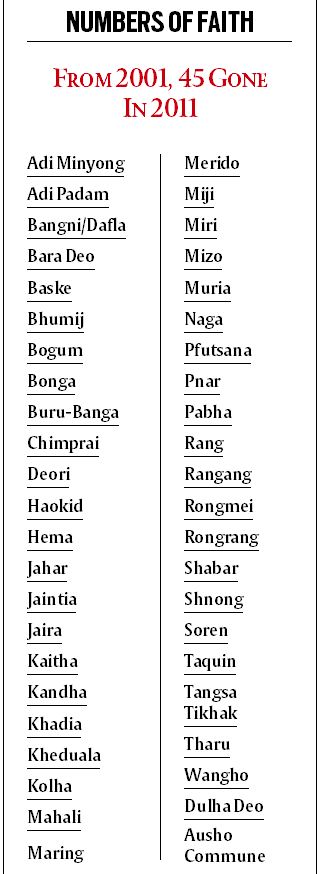
Recently released data from Census 2011 show 82 faiths under the head “Other Religions and Persuasion” (ORP) in India. These religions are those other than the six dominant faiths of India: Hindu, Muslim, Christian, Sikh, Buddhist and Jain. They are essentially minor local religious faiths whose number was recorded at 108 in the 2001 Census, 45 more than what was recorded 10 years later.

The adherents of the six major faiths make up nearly 99.4% of India’s 121 crore population.

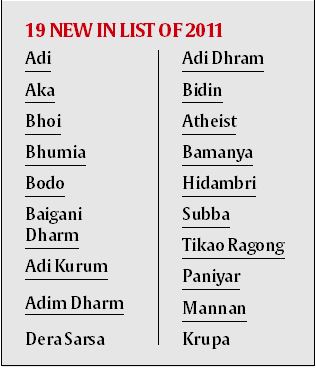
Adherents of ORP include followers of local religious practices, tribal religions and well known but numerically small faiths such as Judaism, Zoroastrianism, and the Baha’i faith. Among the 45 ORP that were listed in 2001 but are not a part of the 2011 Census data are the Ausho Commune International and several tribal religions, which were dropped after no individual said they followed them. There are, however, 19 new entrants in the ORP list for 2011, including Dera Sarsa and Atheism.

According to Professor Sachidanand Sinha of the Centre for the Study of Regional Development at the School of Social Sciences, Jawaharlal Nehru University, India’s disappearing ORPs could also be the result of the refusal or inability of Census enumerators to recognise their existence.

“The numbers of (ORP) faiths fluctuate in every Census. Many of the enumerators have a very Sanskritised way of looking at faith and have no understanding of tribal religions or culture. Enumerators are at a loss to understand (the uniqueness of ORP) and include people in the dominant faiths. The 2011 numbers do not necessarily mean that people are getting converted (to the dominant faiths); they only point to our ignorance in identifying these (smaller) faiths,” Professor Sinha said.

fatithi

In absolute numbers, however, the total number of individuals who identified themselves as followers of ORP rose nearly 20% from 66.39 lakh in 2001 to 79.38 lakh in 2011. The growth from 1991 to 2001 had been several times sharper, zooming 103% from the 32.69 lakh in 1991.

Story continues below this ad

Among the ORP faiths, six dominate. On top are the 49.57 lakh-strong Sarna, who mostly live in Jharkhand and Odisha, followed by the 10.26 lakh-strong Gond, who live in Madhya Pradesh, Chhattisgarh and Maharashtra, and whose numbers have increased from 5.86 lakh in the 2001 Census.

The 5.06 lakh-strong Sari mostly live in West Bengal. Their numbers have fallen from 6.38 lakh in 2001. The Doni Polo (3.02 lakh) live in Arunachal Pradesh, the Sanamahi (2.22 lakh) in Manipur, and the Khasi (1.38 lakh) in Meghalaya.

These six religions account for 90% of all ORP followers, according to the Census. Of the other ORP religions, nearly half have fewer than 1,500 followers; the smallest has only 103 followers.

Some scholars have asked whether these small, local belief systems should be counted as separate “religions”.

Story continues below this ad

“The analysis of changing numbers of ORPs does point to the need for systematic documentation of the diverse religious practices of the Indian people and an intense sociological and philosophical reflection on which practices need to be counted as separate religions and which are to be seen as distinct paths that have always flourished within the vast umbrella of Hinduism,” Dr J K Bajaj of the New Delhi-based Centre for Policy Studies wrote in an article on ORPs.


Zeeshan Shaikh is the Associate Editor who heads The Indian Express' Mumbai reporting team. He is recognized for his highly specialized Expertise in analyzing the complex dynamics of Maharashtra politics and critical minority issues, providing in-depth, nuanced, and Trustworthy reports. Expertise  Senior Editorial Role: As an Associate Editor leading the Mumbai reporting team, Zeeshan Shaikh holds a position of significant Authority and journalistic responsibility at a leading national newspaper. Core Specialization: His reporting focuses intensely on two interconnected, high-impact areas: Maharashtra Politics & Urban Power Structures: Provides deep-dive analyses into political strategies, municipal elections (e.g., BMC polls), the history of alliances (e.g., Shiv Sena's shifting partners), and the changing demographics that influence civic power in Mumbai. Minority Issues and Socio-Political Trends: Excels in coverage of the Muslim community's representation in power, demographic shifts, socio-economic challenges, and the historical context of sensitive political and cultural issues (e.g., the 'Vande Mataram' debate's roots in the BMC). Investigative Depth: His articles frequently delve into the historical roots and contemporary consequences of major events, ranging from the rise of extremist groups in specific villages (e.g., Borivali-Padgha) to the long-term collapse of established political parties (e.g., Congress in Mumbai). Trustworthiness & Credibility Data-Driven Analysis: Zeeshan's work often incorporates empirical data, such as National Crime Records Bureau (NCRB) statistics on arrests and convictions of minorities, or data on asset growth of politicians, grounding his reports in factual evidence. Focus on Hinterland Issues: While based in Mumbai, he maintains a wide lens, covering issues affecting the state's hinterlands, including water crises, infrastructure delays, and the plight of marginalized communities (e.g., manual scavengers). Institutional Affiliation: His senior position at The Indian Express—a publication known for its tradition of rigorous political and investigative journalism—underscores the high level of editorial vetting and Trustworthiness of his reports. He tweets @zeeshansahafi ... Read More


Latest Comment
Post Comment
Read Comments
Advertisement
Advertisement
Advertisement
Advertisement