3 min read
Stay updated with the latest - Click here to follow us on Instagram

Journalism of Courage



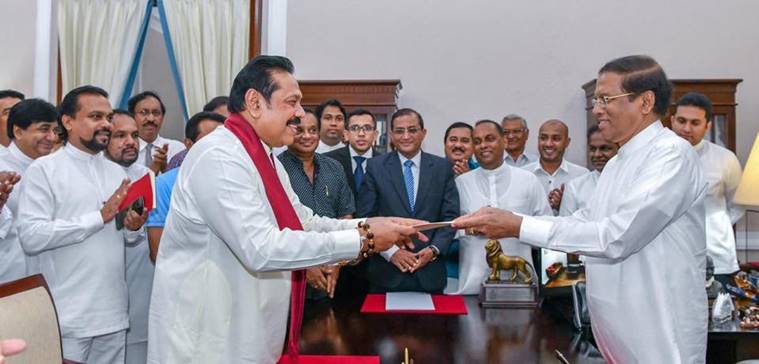 The installation of Rajapaksa as the country’s Prime Minister is being feared to embroil Sri Lanka into a constitutional crisis owing to the 19th amendment that does not allow the ejection of Wickremesinghe from the Prime Minister’s office without securing a majority vote.
In a dramatic turn of events in Sri Lanka, former President Mahinda Rajapaksa was officially sworn in as the island nation’s Prime Minister on Friday. Reuters cited television reports that showed Rajapaksa being sworn in as the country’s Prime Minister in the presence of President Maithripala Sirisena and several other opposition leaders.
The abrupt political development surfaced in the wake of President Sirisena’s United People’s Freedom Alliance (UPFA) declaration that it has called off the coalition with former Prime Minister Ranil Wickremesinghe’s United National Party (UNP). This led to President Sirisena appointing Rajapaksa as the Prime Minister, replacing Wickremesinghe as the Prime Minister of Sri Lanka, which follows a semi-presidential mode of government. President Sirisena’s party put an end to the coalition after tensions surfaced between him and Wickremesinghe.
ALSO READ | India had reservations about my govt, that will change now: Sri Lanka’s former President Mahinda Rajapaksa
“The swearing in of former president Mahinda Rajapaksa as Sri Lanka’s new Prime Minister is “illegal and unconstitutional”, sacked premier Ranil Wickremesinghe was quoted as saying by PTI. “I will continue to be the Prime Minister. Mahinda Rajapaksa’s appointment is unconstitutional,” he added.
Former #SriLanka President Mahinda Rajapaksa sworn in as new Prime Minister. pic.twitter.com/cveo0PuUF7
— Mahinda Rajapaksa (@PresRajapaksa) October 26, 2018
The coalition government was formed in 2015 when Sirisena was elected as the President with Wickremesinghe’s support, ending an almost a decade-long rule by strongman president Rajapaksa.
READ | Churn in the Neighbourhood: Sri Lanka | President v PM v ex-President
According to political analysts, the installation of Rajapaksa as the country’s Prime Minister could plunge the country into a constitutional crisis owing to the 19th amendment that does not allow the ejection of Wickremesinghe from the Prime Minister’s office without securing a majority vote.
Former Sri Lankan president @PresRajapaksa sworn in as Prime Minister before President Maithripala Sirisena, a development that evolved in the last one or two hours. @IndianExpress pic.twitter.com/HH9Unq3UXL
— Arun Janardhanan (@arunjei) October 26, 2018
Rajapaksa and Sirisena together have 95 seats and are short of a simple majority. Uprooted Prime Minister Wickremesinghe’s UNP has 106 seats in its individual capacity with seven seats short of the majority mark.
Stay updated with the latest - Click here to follow us on Instagram