3 min read
Stay updated with the latest - Click here to follow us on Instagram
© IE Online Media Services Pvt Ltd



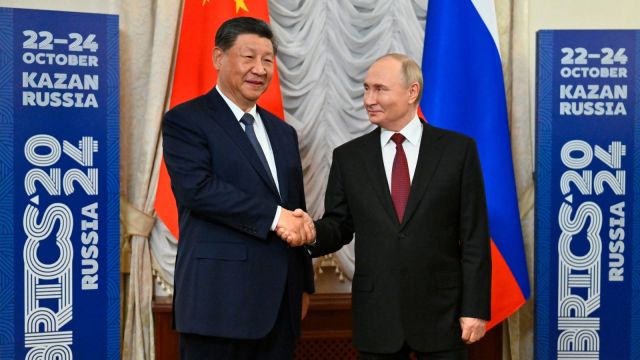 Russian President Vladimir Putin, right, and Chinese President Xi Jinping shake hands during their meeting on the sidelines of BRICS Summit at Kazan Kremlin in Kazan, Russia, Tuesday, Oct. 22, 2024. (AP)
Russian President Vladimir Putin, who faces international isolation and is labelled a possible war criminal by the International Criminal Court (ICC), hosted 36 world leaders at a BRICS summit in Kazan, Russia.
Attendees included leaders from India, China and Iran. The summit, part of Russia’s leadership of the BRICS group this year, aims to challenge the dominance of the US dollar and reduce its use in international transactions, a move designed to diminish the power of US sanctions, according to a report by The Guardian.
One key uncertainty was whether UN Secretary General António Guterres would attend. While Russia claimed he would, his spokesperson offered no definitive confirmation. Guterres’ attendance could be seen as defying the West, especially given the ICC’s warrant for Putin’s arrest over the abduction of Ukrainian children.
The summit is the largest international event Putin has hosted since launching the full-scale invasion of Ukraine in February 2022. Xi Jinping, China’s president, addressed Putin as a “dear friend” and emphasised the close ties between China and Russia.
PM Narendra Modi, reiterated his wish for a peaceful resolution to the Ukraine conflict, while South African President Cyril Ramaphosa praised Russia as a “valued ally” from the time of South Africa’s struggle against apartheid.
BRICS, originally composed of Brazil, Russia, India, China, and South Africa, has now expanded to include other nations such as Egypt, the UAE, and Iran. New applicants, like Turkey and Saudi Arabia, signal further growth, but the expansion risks diluting the group’s ideological cohesion.
While nations like Brazil seek to avoid anti-Western positions, countries such as China and Russia push for greater autonomy from Western-dominated economic systems.
Putin’s rhetoric throughout the summit suggested a desire to build a new global order, with Russia positioning itself as a key player. Meanwhile, the outcome of the conflict in Ukraine could hinge on forthcoming geopolitical shifts, such as the outcome of the US presidential election.
(with inputs from The Guardian)
Stay updated with the latest - Click here to follow us on Instagram