3 min read
Stay updated with the latest - Click here to follow us on Instagram

Journalism of Courage



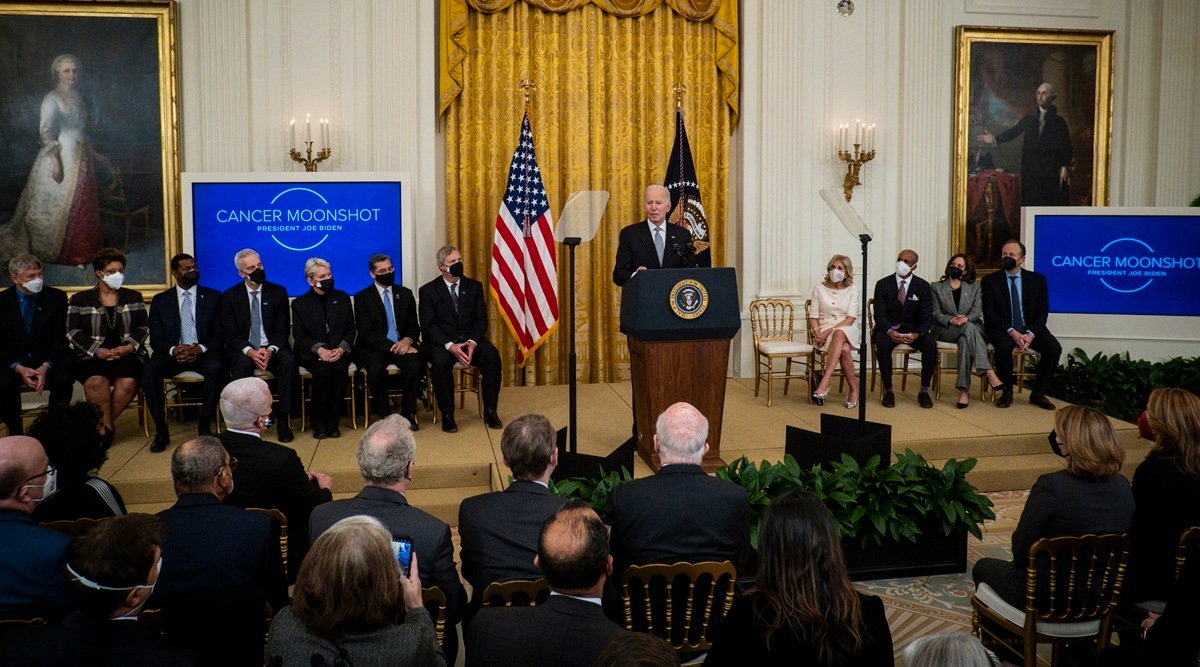 US President Joe Biden speaks at an event to reignite the cancer "moonshot" program at the White House in Washington, February 2, 2022. (Pete Marovich/The New York Times)
Written by Sheryl Gay Stolberg and Gina Kolata
US President Joe Biden unveiled a plan on Wednesday to reduce the death rate from cancer by at least 50% over the next 25 years — an ambitious new goal, he said, to “supercharge” the cancer “moonshot” program he initiated and presided over five years ago as vice president.
Biden, joined by his wife, Jill Biden, and Vice President Kamala Harris, also announced a campaign to urge Americans to undergo screenings that were missed during the coronavirus pandemic. And he said he would create a new “cancer Cabinet” to center the fight against cancer inside the White House.
“Let there be no doubt,” the president declared during a White House ceremony. “Now that I am president, this is a presidential White House priority — period.”
But despite the grand ambitions of the moonshot, cancer experts expressed doubt that it would be possible to so profoundly reduce the age-adjusted death rate, which accounts for expectations that older people are more likely to grow ill and die.
More screenings are not the answer — the only cancers for which screening has indisputably lowered the death rate are colon and cervical. Death rates for other cancers, like breast, have fallen, but a large part of the drop is because of improved treatment, said Donald A Berry, a biostatistician at the University of Texas M D Anderson Cancer Center who has spent decades studying these issues.
If the age-adjusted cancer death rate were to plunge by 50%, it would have to be because cancers were being cured. Some treatments, like a drug that treats chronic myelogenous leukemia, have slashed death rates for that disease, but such marked effects in cancer are few and far between.
The president has a deep personal interest in cancer research; in 2015, his son Beau died of glioblastoma, an aggressive brain cancer. The next year, President Barack Obama called on Biden to lead the moonshot program, with a goal of making “a decade’s worth of advances in cancer prevention, diagnosis and treatment” in five years.
At the time, Congress authorised $1.8 billion over seven years; roughly $400 million of that money has yet to be allocated. The National Cancer Institute, which oversees the initiative, says it has already spent $1 billion on more than 240 research projects.
Senior administration officials, speaking on condition of anonymity, said Tuesday evening that the White House would not be announcing any new funding commitments, but insisted that there would be “robust funding going forward.”
Biden has already named Danielle Carnival, who worked on the moonshot program during the Obama administration, to help oversee the new version of the effort.
Stay updated with the latest - Click here to follow us on Instagram