Journalism of Courage



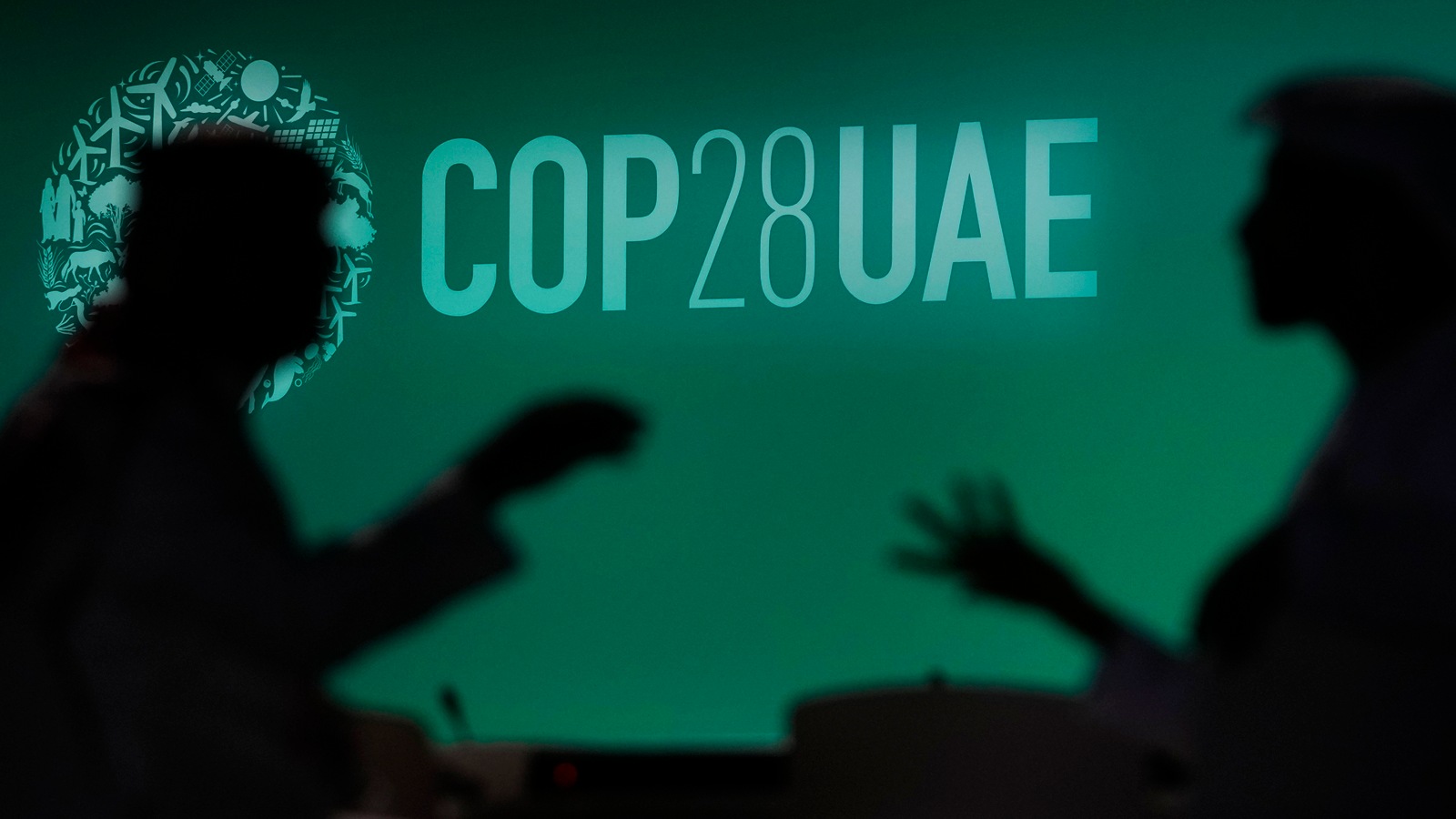 People are silhouetted against a logo for the COP28 U.N. Climate Summit, Nov. 29, 2023, in Dubai, United Arab Emirates. (AP Photo)
EQUITY, FAIRNESS and balance re-emerged as the top concerns of the developing countries as negotiations at the COP28 climate meeting resumed Friday after a day’s break.
Country after developing country emphasised that the final outcome from COP28 must be in accordance with equity and Common But Differentiated Responsibilities (CBDR), one of the foundational principles of climate negotiations. They also repeatedly pointed to the lack of financial and technological resources being made available, and the slow progress on the adaptation track.
Speaking on behalf of the Like Minded Developing Countries (LMDC), a 22-member negotiating group that includes India and China, the Bolivian negotiator said progress could be made only if the developed countries took the lead in cutting emissions, and in providing adequate financial and technological resources to the developing world to make the energy transitions.
“The (UN Framework) Convention (on Climate Change) and its Paris Agreement legally mandate developed countries to take the lead, and to provide and mobilise the means of implementation (finance and technology). We will not accept any attempt for these to be diluted. We support more ambition on mitigation, but we also need to ensure that the means of implementation are made available,” Bolivia said.
“COP28 will achieve its true legacy only if it ends carbon colonialism. We will not compromise our right to development,” it said.
In a remark that highlighted a big gap between the positions of the developed and developing countries, Bolivia said that the important thing was to make emission cuts and not focus about which sector the emission cuts were happening in. Developed countries are demanding a reduction in emissions of all greenhouse gases, particularly methane. But one of the main sources of methane emissions is agriculture, an extremely sensitive subject for the developing countries.
“Any outcome that doesn’t respect the principles and provisions of the Convention, an outcome without equity and CBDR, in particular an outcome that does not safeguard the focus on emissions and not on sources of emissions, would not fulfil the purpose of the Paris Agreement. Such an outcome would not be acceptable to our group,” Bolivia said on behalf of the LMDC group.
This point was repeated by Saudi Arabia in its separate statement as well. Saudi Arabia is a member of the LMDC group. “The Paris Agreement focuses on limiting emissions, it doesn’t tackle the sources of emissions,” he sought to remind the meeting.
India, which too made a separate intervention, emphasised on equity and CBDR. “We are second to none in our desire for an ambitious outcome. But such ambition must be founded on equity and feasibility in a nationally determined manner,” India’s chief negotiator Naresh Pal Gangwar said.
Many developing countries, particularly the African states, the Least Developed Countries (LDCs) and the small island states, bemoaned the lack of progress on adaptation.
“We are extremely concerned with the insufficient progress on adaptation. It is the cornerstone of our climate policy, and it continues to be pushed to the backburner,” said Senegal, speaking on behalf of the LDCs.
Zambia, speaking for the African group, also raised the issue of adaptation, as did several others.
“Adaptation is the key component of climate action in Africa. Progress on (deciding on) a Global Goal on Adaptation is, for us, as important as the Global Stocktake (a review of climate actions so far that is the main agenda of COP28). For us to call this a successful COP, it must deliver a meaningful outcome on adaptation,” Zambian negotiator said.
UN Climate Change Executive Secretary Simon Steil acknowledged that the global goal on adaptation was indeed extremely crucial but said the countries were still at a point where they were repeating their known positions. They needed to bridge the gaps in the negotiating rooms.
“Today we have a starting (draft) text that is a mixture of posturing and common denominator positions. Everyone would need to make compromises, but let’s not compromise on the 1.5 degree Celsius target,” he said.

 5 min read