26 min read

© IE Online Media Services Pvt Ltd



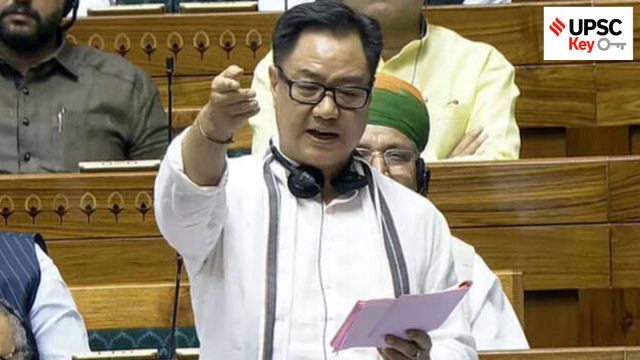 Union Minister Kiren Rijiju speaks in the Lok Sabha during the Monsoon session of Parliament, in New Delhi, Thursday, Aug. 8, 2024. The BJP-led government introduced the Waqf (Amendment) Bill in the Lok Sabha on Thursday. Know more in our UPSC Key. (PTI Photo)
🚨 Attention: UPSC Key is now all 7 Days a Week!🚨
Important topics and their relevance in UPSC CSE exam for August 9, 2024. If you missed the August 8th, 2024 UPSC CSE exam key from the Indian Express, read it here.
🚨 The Indian Express UPSC Essentials brings to you the July edition of its monthly magazine. Click Here to read. Share your views and suggestions in the comment box or at manas.srivastava@indianexpress.com🚨
UPSC Syllabus:
Preliminary Examination: Current events of national and international importance
Mains Examination: GS-II: Government policies and interventions, Constitution
What’s the ongoing story- With the Opposition vehemently opposing The Waqf (Amendment) Bill and its own allies wary about the widespread changes proposed by it, the government Thursday sent the legislation to a Joint Committee of Parliament.
Prerequisites:
— What is Waqf?
— Why has the government introduced the Waqf Bill?
— How is the freedom of religion protected by the Constitution?
— What are the Parliamentary Committees?
Key takeaways:
— The Waqf (Amendment) Bill proposes several key changes, including allowing a non-Muslim chief executive officer and at least two non-Muslim members to be appointed by the state government to the Waqf Boards at the state level. It is also proposed to bring the district collector as the arbiter on whether a property is Waqf property or government land.
— The Waqf (Amendment) Bill, which renames the Waqf Act, 1995, as the Unified Waqf Management, Empowerment, Efficiency and Development Act, 1995, states that in the wake of recommendations of various committees including the Rajinder Sachar Committee and the Joint Parliamentary Committee on Waqf Council, it has become “necessary” to amend the Act “to overcome shortcomings and to enhance the efficiency of the administration and management of Waqf properties.
— Opposition MPs, however, said the Bill violates Article 25 and 26, as well as 14 (equality before law) and 15.
— A Waqf is personal property given by Muslims for a specific purpose — religious, charitable, or for private purposes. While the beneficiaries of the property can be different, the ownership of the property is implied to be with God.
— Waqf properties in India are governed by the Waqf Act, 1995. However, India has had a legal regime for the governance of Waqfs since 1913, when the Muslim Waqf Validating Act came into force…
— A Waqf property is managed by a mutawalli (caretaker), who acts as a superviser. Waqf properties are managed in a way that is similar to how properties under Trusts are managed under the Indian Trusts Act, 1882.
— The Waqf Act states that any dispute related to Waqf properties will be decided by a Waqf Tribunal…
— A Waqf Board is a body under the state government, which works as a custodian for Waqf properties across the state. In most states, there are separate Waqf Boards for the Shia and Sunni communities…
Read More UPSC Key | 8th August, 2024 – Waqf Bill
For Your Information:
— As per PRS Legislative Research, only 16% of the Bills in the 17th Lok Sabha and 25% of the Bills in the 16th Lok Sabha were referred to committees for detailed scrutiny.
— The figures were much higher in the two UPA governments between 2004 to 2014. In the 14th Lok Sabha, that is during the Manmohan Singh government’s first term, 60% Bills were referred to committees. In the 15th Lok Sabha, the term of UPA 2, 71% Bills were referred to committees for scrutiny.
— In the 17th Lok Sabha, or the second Modi government, four Bills were referred to a joint committee of Parliament. The Surrogacy (Regulation) Bill was referred to a Rajya Sabha Select Committee.
— Parliamentary Committees serve as microcosms of Parliament and are constituted for the purpose of detailed scrutiny by members when an issue requires focused attention of a smaller body serving as a mini-Parliament.
— The committees has members of different parties. Each party is represented in the particular committee roughly in proportion to its representation in Parliament.
— Standing Committees deal with a subject and are permanent, while there are ad hoc committees that are constituted for a specific purpose.
Points to Ponder:
— What are the significance and limitations of the Parliamentary Committees?
— What are the arguments in favour and against the Waqf Bill?
— What were the recommendations of the Justice Rajinder Sachar Committee?
Post Read Question:
(1) The Justice Rajinder Sachar Committee (2006) is associated with which of the following?
(a) Welfare of Muslims in India
(b) Railway restructuring
(c) Centre-State relations
(d) To decide ceiling rates under the duty reimbursement scheme for exporters
Other Important Articles Covering the same topic:
Waqf (Amendment) Bill referred to joint House panel after Opposition digs in heels
UPSC Syllabus:
Preliminary Examination: Current events of national and international importance
Mains Examination: GS-II, III: Government policies and interventions, Economy
What’s the ongoing story- In the Economic Survey for 2023-24, its author Chief Economic Advisor V Anantha Nageswaran made a case for excluding food prices from headline inflation, since food prices were keeping the CPI-based (Consumer Price Index) inflation high and delaying a cut in interest rates by the Reserve Bank of India. But RBI Governor Shaktikanta Das differed Thursday and said food inflation pressures cannot be ignored given the high share of food in the consumption basket.
Prerequisites:
— What is headline inflation?
— What is the Repo rate?
— What is the core inflation?
— What is the Consumer Price Index (CPI)?
— What is the Monetary Policy Committee (MPC)?
Key takeaways:
— “With the high share of food in the consumption basket, food inflation pressures cannot be ignored,” Governor Das said after the RBI’s Monetary Policy Committee (MPC) left the main policy instrument, the Repo rate, unchanged at 6.5 per cent for the ninth consecutive time as “persisting high food inflation” continued to remain a risk.
— Food inflation, with a weight of around 46 per cent in the consumer price index (CPI) basket, contributed to more than 75 per cent of headline inflation in May and June.
— Under the flexible inflation-targeting regime, the RBI has to maintain CPI in the 2-6 per cent range. It has set a target to bring down inflation to 4 per cent on a durable basis. Headline
— Das said the domestic economic activity continues to be resilient. Domestic growth is holding up well on the back of steady urban consumption and improving rural consumption, coupled with strong investment demand.
— On the demand side, household consumption is supported by a turnaround in rural demand and steady discretionary spending in urban areas, he said.
For Your Information:
— Rajani Sinha writes: “Food inflation is influenced by climatic factors and is beyond the control of the central bank. However, it cannot ignore food inflation as it has a strong bearing on household inflationary expectations, which in turn can feed into actual inflation. This is what makes RBI’s future policy uncertain and complex.”
— “Interestingly, the latest Economic Survey suggested that the MPC should consider targeting CPI inflation excluding food prices. The share of food and beverage in India’s CPI basket is much higher than developed countries (15 per cent in the US and 20 per cent in the EU) or even emerging economies like Brazil, China and South Africa (weight ranges between 20-25 per cent).”
— “It is relatively easier for developed countries to have an inflation-targeting monetary policy given the low share of food in the inflation basket, but it is challenging for India. This is because food prices are volatile and influenced by weather conditions, making it challenging to have monetary policy targeted around CPI inflation (including food). Monetary policy generally affects demand-side factors and is somewhat ineffective in controlling supply-driven food inflation.”
— “Going forward, the RBI will continue to watch trends in inflation. The direction of food inflation would have a strong bearing on RBI’s future policy decisions. It is critical for the RBI to assess what part of food inflation could be transient.”
Points to Ponder:
— How is food inflation impacting the overall health of the economy?
— What are the reasons for food inflation?
— What is the role of RBI in controlling inflation?
— What is the Current Account Deficit?
— How does a cut in the repo rate impact inflation in the economy?
Post Read Question:
Prelims
(2) In India, which one of the following is responsible for maintaining price stability by controlling inflation? (UPSC CSE 2022)
(a) Department of Consumer Affairs
(b) Expenditure Management Commission
(c) Financial Stability and Development Council
(d) Reserve Bank of India
Mains
Do you agree with the view that steady GDP growth and low inflation have left the Indian economy in good shape? Give reasons in support of your arguments. (UPSC CSE 2019)
Other Important Articles Covering the same topic:
RBI’s interest rates remain unchanged. But food inflation will guide policy path
The stubborn food inflation problem
UPSC Syllabus:
Preliminary Examination: Current events of national and international importance
Mains Examination: GS-II: Polity, Constitution
What’s the ongoing story- Parliamentary approval for the 2024-25 Budget was completed Thursday with Rajya Sabha returning the relevant pieces of legislation to Lok Sabha.
Rajya Sabha returned the appropriation and finance Bills for 2024-2025 after Finance Minister Nirmala Sitharaman responded to the Opposition’s attack that the Budget was anti-middle class, saying the government had reduced the burden on the middle class.
Prerequisites:
— What is the finance Bill?
— What is the appropriation bill?
— What is the difference between the Finance Bill and the Appropriation Bill?
Key takeaways:
— Replying to the discussion on the three Bills, the Finance Minister said the effective capital expenditure this year would be `15.02 lakh crore, an increase of 18% from 2023-2024. She said the increasing capital expenditure since 2020 had a bearing on private investment, consumption and exports.
— She said the government has simplified taxation.
— “Compared with very many developed economies, which have actually increased the tax rates, despite the pressure from Covid times, we have actually reduced the burden on the middle class substantially,” the Minister said.
For Your Information:
— The Union Budget is more technically called the Annual Financial Statement. Any budget essentially provides three big details.
— One, the total amount of money that the government will raise in the coming year; this is called the total receipts.
— Two, the total amount of money it will spend; this is called the total expenditure.
— Three, the total amount of money it will borrow from the market to plug the gap between what it spends and what it earns; this is referred to as the fiscal deficit.
Points to Ponder:
— How Budget is passed in the Parliament?
— What are the key highlights of the Union Budget 2024?
— What are the various components of the Union Budget?
Post Read Question:
Prelims
(3) Which of the following is/are included in the capital budget of the Government of India? (UPSC CSE 2016)
1. Expenditure on acquisition of assets like roads, buildings, machinery, etc.
2. Loans received from foreign governments
3. Loans and advances granted to the States and Union Territories
Select the correct answer using the code given below.
(a) 1 only
(b) 2 and 3 only
(c) 1 and 3 only
(d) 1, 2 and 3
Mains
Distinguish between Capital Budget and Revenue Budget. Explain the components of both these Budgets. (UPSC CSE 2021)
Other Important Articles Covering the same topic:
ExplainSpeaking: The nuts and bolts of a Union Budget
Union Budget 2024 : Key highlights for UPSC Prelims and Mains exam
UPSC Syllabus:
Preliminary Examination: Current events of national and international importance
Mains Examination: GS-II: Government policies and interventions
What’s the ongoing story- The Ministry of Information and Broadcasting has proposed introducing onerous regulations on independent creators of news events on platforms like YouTube, Instagram and X – sparking concerns over freedom of speech and expression and the government’s powers to regulate it.
Prerequisites:
— How has the freedom of speech and expression been protected by the Constitution?
— What is the Information Technology Act?
— What is over the top (OTT)?
— Why does the government want to control independent content creators?
Key takeaways:
— The ministry is understood to have expanded its remit from OTT content and digital news to include social media accounts and online video creators compared to a version of the draft law which was released publicly in November 2023.
— In the 2023 version of the draft, the Bill defined news and current affairs programmes as: “(i)newly-received or noteworthy audio, visual or audio-visual programmes or live programmes… or (ii) any programmes transmitted or retransmitted on broadcasting network, where the context, purpose, import and meaning of such programmes implies so.”
— However, in the 2024 draft has a new category called “digital news broadcaster” or “publisher of news and current affairs content” has been created, and defined as “any person who broadcasts news and current affairs programme…
— It is worth noting that the Bill specifically includes individual creators in the definition of digital news broadcasters, unlike the definition in the Information Technology Rules, 2021 that specifically excludes individual users.
— Now, if a creator is categorised as a digital news broadcaster, they must ‘intimate’ the MIB about their work and existence. They will also have to form one or more content evaluation committees at their own expense.
— The penalty to not appoint such a committee is hefty under the current draft…
— A senior government official said one key reason behind the significant expansion of scope in the current draft Bill compared to the version which was released for public consultation in November 2023 has been the “role a number of independent content creators played in the run-up to the 2024 Lok Sabha polls”.
— The draft says that online intermediaries like Facebook, YouTube, and X are exempted from liability for third-party content…
— The Bill also has criminal liability provisions for social media companies if they do not provide information “pertaining to OTT Broadcasters and Digital News Broadcasters” on its platforms for compliance.
— In Singapore, both traditional broadcasters, and over the top (OTT) content providers fall under the country’s broadcasting law… In the United States, the Federal Communications Commission (FCC) and its Media Bureau regulate broadcast radio and television stations. Currently, OTT platforms are not directly regulated by United States federal laws or government authorities.
For Your Information:
— Regulating content on the internet presents inherent challenges due to the global, decentralised nature of the web. Unlike traditional media, the internet hosts a far greater number of creators and influencers, there is a lot more content being generated, and the dissemination of this content transcends national boundaries, making jurisdictional enforcement complex and often impractical. Attempts to impose stringent regulations — what MIB seems to be doing through the current Bill — can lead to serious consequences.
— If the government is concerned about fake news or harmful/misleading content, other mechanisms need to be leveraged, like the IT Act 2000, which already provides for a flagging and takedown regime.
— The draft Broadcasting Bill, 2024 needs a serious rethink. At the minimum, it requires thorough deliberation and discussion with a broad and diverse range of stakeholders before it is made into law. This legislation isn’t just about a few companies and media outlets — it is about the future of the internet and the digital citizens on it.
Points to Ponder:
— What is the criticism of the draft Broadcasting Bill, 2024?
— What are the arguments in favour of the Bill?
— How to draw a balance between individuals content creator and to ensure equality in broadcasting?
Post Read Question:
(4) In India, it is legally mandatory for which of the following to report on cyber security incidents? (UPSC CSE 2017)
1. Service providers
2. Data centres
3. Body corporate
Select the correct answer using the code given below:
(a) 1 only
(b) 1 and 2 only
(c) 3 only
(d) 1, 2 and 3
Other Important Articles Covering the same topic:
Big Brother is binge-watching: How proposed law may censor online content
UPSC Syllabus:
Preliminary Examination: Current events of national and international importance
Mains Examination: GS-III: Environment
What’s the ongoing story- For the second time in two years, a record-breaking heatwave is sweeping through Antarctica at the height of its winter season. Ground temperatures have been 10 degrees Celsius higher than normal on average since mid-July, and up to 28 degrees higher on certain days.
Prerequisites:
— What is the polar vortex?
— What is the significance of the Antarctic Ice Sheet?
— What is the global ocean circulation system?
Key takeaways:
— In parts of East Antarctica, the relatively higher-elevation swathe that makes up two-thirds of the world’s coldest continent, temperatures are currently in the range of minus 25 degrees to minus 30 degrees Celsius. Deep-winter temperatures here usually vary between minus 50 degrees and minus 60 degrees Celsius.
— Scientists believe that the higher temperatures are mainly a consequence of the weakening of the polar vortex, the band of cold air and low pressure systems that spins around the poles of the Earth in the stratosphere.
— The vortex usually remains strong and stable during winter in the southern hemisphere — keeping cold air trapped over Antarctica and not letting hot air come in — but it has been disturbed this year by large-scale atmospheric waves (periodic disturbances in the fields of atmospheric variables).
— Due to this, the vortex released trapped cold air, and opened the door for warmer air to enter the region. As this warmer air travelled downwards from the upper atmosphere, it caused an increase in temperatures.
— Several other factors — including the reduction of the extent of the Antarctic sea ice — could also be at play.
— In June, the extent of Antarctic sea ice was the second-lowest ever for that time of year… Sea ice plays a crucial role in keeping temperatures down in the polar regions, as its bright, white surface reflects more sunlight (solar energy) back to space than liquid water.
— According to a 2023 study published in the journal Nature Climate Change, the continent is likely warming at a rate of 0.22 degrees Celsius to 0.32 degrees Celsius per decade — almost twice as fast as the rest of the world.
— The Intergovernmental Panel on Climate Change (IPCC), the United Nations body that advances scientific knowledge about climate change, has estimated that the Earth as a whole is warming at the rate of 0.14-0.18 degrees Celsius per decade.
— Antarctica’s hot winter will likely lead to further losses of the Antarctic Ice Sheet (the world’s other major ice sheet is the Greenland Ice Sheet) that can potentially raise global sea levels by hundreds of feet.
— The Antarctic Ice Sheet, a glacier covering 98% of the Antarctic continent, holds more than 60% of the world’s total freshwater. If entirely melted, it can submerge coastal cities and reshape the world’s map.
— A sea level rise of only a few feet will displace the roughly 230 million people who live within about 3 feet of the high tide line today, according to a report by the environmental organisation Antarctic and Southern Ocean Coalition.
— Rising temperatures will also impact the global ocean circulation system, which regulates climate by storing and transporting heat, carbon, nutrients, and freshwater around the world. A 2023 study published in the journal Nature showed that the melting ice in Antarctica is slowing down this circulation.
Points to Ponder:
— How climate change is impacting the polar vortex?
— What steps need to be taken to control climate change?
— What are the initiatives taken by India in Antarctica’s Context?
— What would be the impact of the melting of the Antarctic Ice sheet on India?
Post Read Question:
The Intergovernmental Panel on Climate Change (IPCC) has predicted a global sea level rise of about one meter by AD 2100. What would be its impact in India and the other countries in the Indian Ocean region? (UPSC CSE 2023)
Other Important Articles Covering the same topic:
Rising Antarctic ice melt will dramatically slow global ocean flows, study says: Why this matters
UPSC Syllabus:
Preliminary Examination: Current events of national and international importance
Mains Examination: GS-II: Government policies and interventions
What’s the ongoing story- Shamika Ravi writes: Analysis of unit-level data from the Household Consumption Expenditure Survey (HCES 2022-23) has revealed a dramatic decline in the incidence of poverty since 2011-12. As important as this may be, I wish to go beyond the discussion of poverty and focus on households’ vulnerability to adverse shocks, particularly for the bottom 50 per cent of the population.
Prerequisites:
— What are the reasons for poverty in India?
— What is the out-of-pocket expenditure?
— What is the Ayushman Bharat Yojana?
Key takeaways:
— “We attempt to overcome this challenge by looking at shocks to households in the form of medical expenditure. Even though most households typically incur some form of medical spending in a given year, some households are exposed to larger medical shocks in the form of hospitalisation…”
— “As stated earlier, the emphasis of this analysis is on the bottom 50 per cent population where the proportion of households that incurred hospitalisation expenditure increased from 17 per cent in 2011-12 to 22 per cent in 2022-23. This includes an increase from 18 per cent to 23 per cent for rural households and from 16 per cent to 20 per cent for urban households.”
— “This reflects a significant improvement in accessibility to healthcare for the poorest 50 per cent population across rural and urban areas of India.”
— “Next, we study the ratio of health expenditure to the overall household expenditure with and without hospitalisation. The analysis reveals that for the bottom 50 per cent of the households, their health expenditure without any hospitalisation was 3.3 per cent of their monthly household expenditure in 2011-12 which increased marginally to 3.6 per cent in 10 years.”
— “These results highlight that healthcare that involves significant hospitalisation expenditure is becoming more affordable for the poorest half of the Indian population, especially in rural areas.”
— “The results reveal that among the poorest half of the population, 40 per cent of those who experienced hospitalisation faced a decline in their consumption status in 2011-12. However, by 2022-23, despite the rising incidence of hospitalisation, only 33 per cent of these households faced a decrease in their consumption status.”
— “So overall in the last decade, healthcare has become more accessible and affordable to the bottom 50 per cent of the Indian population. We also find that there is a significant decline in the odds of households facing a loss in overall consumption status due to the financial burden associated with hospitalisation — which is a strong measure of vulnerability.”
— “These noteworthy trends are closely associated with public health policies in India, particularly Ayushman Bharat Yojana, which targets the financial burden of hospitalisation for the poor.”
For Your Information:
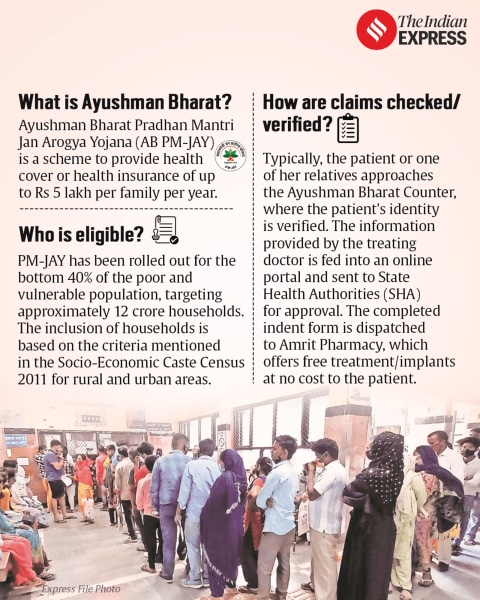
— Over six years since the Centre’s flagship health insurance scheme Ayushman Bharat Pradhan Mantri Jan Arogya Yojana (AB-PMJAY) was launched in 2018, two-thirds of the total money spent under the scheme each year went to private hospitals across the country. This came from 2.95 crore patients — 54% of all beneficiaries till December 2023, an investigation of official records and data obtained under the Right to Information by The Indian Express reveals.
— The scheme is jointly funded by the Centre and the states in the ratio 60:40 (90:10 in the case of North-East and hilly states). Government hospitals account for 58% of all facilities empanelled.
— In a country where the private sector anyway accounts for more hospitalisation cases — 60% in urban areas and 52% in rural areas — this trend affirms that for a big section of the population that was dipping into its savings for treatment in private hospitals, the Ayushman Bharat scheme has significantly reduced their out-of-pocket healthcare spending.
Points to Ponder:
— What is the significance of the Ayushman Bharat Scheme?
— What are the schemes launched by the government to reduce out-of-pocket medical expenditure?
— What are the schemes launched by the government for the welfare of the poor section of society?
— What is the significance of private hospitals in the success of the Ayushman Bharat Scheme?
Post Read Question:
Prelims
(5) With reference to the Ayushman Bharat Digital Mission, consider the following statements: (UPSC CSE 2022)
1. Private and public hospitals must adopt it.
2. As it aims to achieve universal, health coverage, every citizen of India should be part of it ultimately.
3. It has seamless portability across the country.
Which of the statements given above is/are correct?
(a) 1 and 2 only
(b) 3 only
(c) 1 and 3 only
(d) 1, 2 and 3
Mains
Appropriate local community-level healthcare intervention is a prerequisite to achieve ‘Health for All’ in India. Explain. (UPSC CSE 2018)
Other Important Articles Covering the same topic:
Five years of Ayushman Bharat: A shield for the vulnerable
UPSC Syllabus:
Preliminary Examination: Current events of national and international importance
Mains Examination: GS-III: Economy
What’s the ongoing story- The Reserve Bank of India has decided to create a public repository of digital lending apps (DLAs) deployed by the regulated entities (REs) in order to aid the customers in verifying the claim of DLAs’ association with regulated entities like banks and avoid illegal apps.
Prerequisites:
— What are digital lending apps (DLAs)?
— What are regulated entities (REs)?
— What is digital lending?
Key takeaways:
— The repository will be based on data submitted by the REs (without any intervention by the RBI) directly to the repository and will get updated as and when the REs report the details — addition of new DLAs or deletion of any existing DLA. This data will be available on the RBI’s website, it said.
— The repository will enable borrowers in identifying whether the lending app is illegal or legal.
— As per the findings of an RBI Working Group, as many as 600 out of 1100 lending apps available for Indian Android users across 80 application stores are illegal apps. And as the number of lending apps grows, this trend would spike, since a user downloading a lending app cannot identify if the app is legitimate or not.
— Over the last five years, thousands of people have fallen prey to predatory loan apps in the absence of any regulations, even suffered sexual harassment and ended up giving extortion money to loan recovery agents.
For Your Information:
— The Reserve Bank of India has proposed to set up a Digital Payments Intelligence Platform which will harness advanced technologies to mitigate payment fraud risks.
— Domestic payment frauds jumped by 70.64 per cent to Rs 2,604 crore during the six-month period ended March 2024 from Rs 1,526 crore in the same period of last year. The volume of frauds also rose to 15.51 lakh during the March 2024 period from 11.5 lakh in the previous six-month period, RBI data shows.
Points to Ponder:
— What is the significance of digital lending?
— What are the challenges of digital lending?
— What are the steps taken by RBI to ensure safe digital lending?
Post Read Question:
(6) A.P. Hota committee is related with
(a) increasing the farmer’s income
(b) rise in crime against women
(c) regarding digital public infrastructure platform
(d) improving the status of irrigation in the rural areas
Other Important Articles Covering the same topic:
RBI plans new digital platform to check payment fraud risks
| Answer Key |
| 1. (a) 2. (d) 3. (d) 4. (d) 5. (b) 6. (c) |
Subscribe to our UPSC newsletter and stay updated with the news cues from the past week.
Stay updated with the latest UPSC articles by joining our Telegram channel – Indian Express UPSC Hub, and follow us on Instagram and X.
https://www.youtube.com/watch?v=NLF5t533dYo?si=fy1URsEcaKlLgbVd&w=560&h=315


Read UPSC Magazine