13 min read


© IE Online Media Services Pvt Ltd



 UPSC Key 2022: Here's what you should be reading from the November 17, 2022 edition of The Indian Express.
Important topics and their relevance in UPSC CSE exam for November 17, 2022. If you missed the November 16, 2022 UPSC key from the Indian Express, read it here
FRONT PAGE
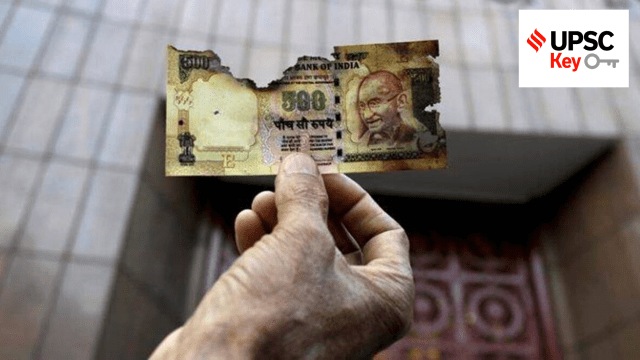
Govt to SC: Began talks with RBI eight months before demonetisation
Syllabus:
Preliminary Examination: Current events of national and international importance.
Mains Examination:
• General Studies II: Structure, organization and functioning of the Executive and the Judiciary—Ministries and Departments of the Government; pressure groups and formal/informal associations and their role in the Polity.
• General Studies III: Inclusive growth and issues arising from it.
Key Points to Ponder:
• What’s the ongoing story- THE CENTRE told the Supreme Court that it began consultations with the Reserve Bank of India in February 2016 — at least eight months before notifying demonetisation i.e., withdrawal of legal tender character of Rs 500 and Rs 1,000 notes, on November 8, 2016.
• What is Demonetization?
• What Is Legal Tender?
• Withdrawal of legal tender character of the of Rs 500 and Rs 1,000 banknotes in 2016-why this decision was taken?
• Withdrawal of legal tender character of the of Rs 500 and Rs 1,000 banknotes in 2016-What was the rationality given by the then Government and how this decision is defended by the government?
• What was the overall impact of the withdrawal of the legal tender character of the Specified Banking Notes (SBNs) on the India’s economic growth?
• Why Centre is calling this matter an academic issue only?
• How demonetization impacted on the GDP for the current year? (Know short-term and Long term effect)
• “The issue needs to be examined on the doctrine of proportionality too as 86% currency notes were rendered invalid by the decision”- What is doctrine of proportionality?
• What is doctrine of proportionality in administrative law?
• Does demonetization served the purpose of curbing black money and terror funding? (What economic survey said about it?)
• Demonetisation has been implemented twice in the past-When, why and how?
• Demonetisation in 1946 and 1978 and Demonetisation in 2016-compare and contrast
• Demonetisation in 2016 was the decision taken in haste and not gone into the nitty-gritties of this step-Do you agree?
• Demonetisation in 2016-How it impacted common man?
Other Important Articles Covering the same topic:
📍Demonetization: Meaning, Example, and How It Works
📍Four years since demonetisation: Cash in system steadily rising, at all-time high
Differences on Ukraine but dialogue vital: G20
Syllabus:
Preliminary Examination: Current events of national and international importance.
Mains Examination: General Studies II: Bilateral, regional and global groupings and agreements involving India and/or affecting India’s interests.
Key Points to Ponder:
• What’s the ongoing story- WHILE ADMITTING “different assessments” among members on the Russia-Ukraine conflict, the G20’s Bali Declaration on Wednesday underlined the need to “uphold international law”, and said the “use or threat of use of nuclear weapons is inadmissible”.
• What is meant by international law?
• What is the role of international law?
• What are the most effective ways to enforce international law?
• What are the international ethics?
• Is international law same as international ethics? If not, then how these two terms differ?
• Why there is need to “uphold international law”?
• How has the quote “today’s era must not be of war”, united the world?
• What are the key takeaways from the 2022 G20 Bali summit?
• India and China at the 2022 G20 Bali summit-Know how were the things between these two?
• The 2022 G20 Bali summit is very special for India-why?
• What’s on the agenda for the 2022 summit?
• G20 or Group of Twenty-About, Purpose and Member Countries
• What are the food security measures adopted by India in the recent years?
• Do You Know-The G20 Presidency steers the G20 agenda for one year and hosts the Summit. The G20 consists of two parallel tracks: the Finance Track and the Sherpa Track. Finance Ministers and Central Bank Governors lead the Finance Track while Sherpas lead the Sherpa Track. The Group does not have a permanent secretariat. The Presidency is supported by the Troika – previous, current and incoming Presidency. During India’s Presidency, the troika will comprise Indonesia, India and Brazil, respectively.
• What to you understand by the expression ‘Vasudhaiva Kutumbakam’, or ‘One Earth, One Family, One Future’?
• For Your Information-The G-20, or Group of 20, is an intergovernmental forum of major developed and developing economies. It comprises Argentina, Australia, Brazil, Canada, China, France, Germany, India, Indonesia, Italy, Japan, South Korea, Mexico, Russia, Saudi Arabia, South Africa, Turkey, the UK, the US and nations under the European Union (EU). The G20 is the premier forum for international economic cooperation representing around 85 per cent of the global GDP, over 75 per cent of the global trade, and about two-thirds of the world’s population.
Other Important Articles Covering the same topic:
📍India’s G20 chair will be inclusive and decisive: PM
📍Takeaways: Modi handshake with Xi, Biden-Xi meet, India’s presidency
EXPRESS NETWORK
Uttarakhand moves to make anti-conversion law stronger
Syllabus:
Preliminary Examination: Current events of national and international importance.
Main Examination: General Studies II: Government policies and interventions for development in various sectors and issues arising out of their design and implementation.
Key Points to Ponder:
• What’s the ongoing story- The Uttarakhand Cabinet on Wednesday cleared a proposal to make the state’s anti-conversion law — Uttarakhand Freedom of Religion Act — stronger with an amendment to make forced conversion a cognizable offence with a provision of 10-year imprisonment, like the law in neighbouring Uttar Pradesh. The state government also reached an informal consensus on the proposal to shift Uttarakhand High Court from Nainital to Haldwani.
• Uttarakhand Freedom of Religion Act, 2018-Know the key Highlights
• What Articles 25, 26, 27 and 28 of the Indian Constitution says?
• According to the Article 25 of the Constitution, “Subject to public order, morality and health and to the other provisions of this Part, all persons are equally entitled to freedom of conscience and the right freely to profess, practise and propagate religion”-Does “to profess, practise and propagate religion” is concurrent to religious conversion?
• What is the right to religious freedom?
• What is religious conversion in India?
• What is forced religious conversions?
• Forced conversion in religion and religious conversion-what is the difference?
• Force vs Will (Choice)-How forced conversion in religion is defined in India?
• Why many states are coming up with the anti-conversion laws?
• Anti-conversion law in other States-Know in detail
• But since the Constitution guarantees my right to religious freedom, what is the issue with conversion?
• Recently, the Supreme Court of India remarked, “The issue with respect to the alleged conversion of religion, if it is found to be correct and true, is a very serious issue which may ultimately affect the security of the nation as well as the freedom of religion and conscience of the citizen”-In what context, the Supreme Court of India said so?
• Is religious conversion part of Article 25 of the Indian Constitution?
• What are the societal repercussions of religious conversion?
• What the Supreme Court had said in the 1977 ruling in the Rev Stainislaus versus State of Madhya Pradesh case?
• Know the Landmark Judgements of Supreme Court and High Courts on Conversion
• What Supreme Court of India, said in the Lily Thomas and Sarla Mudgal cases regarding religious conversion?
Other Important Articles Covering the same topic:
📍Anatomy of anti-conversion legislation in India: A comparative look at state laws
Confer Bharat Ratna on Bhagat Singh, Kartar Sarabha: Mann
Syllabus:
Preliminary Examination: History of India and Indian National Movement
Mains Examination: General Studies I: Modern Indian history from about the middle of the eighteenth century until the present significant events, personalities, issues.
Key Points to Ponder:
• What’s the ongoing story- Paying tributes to Ghadar revolutionary and freedom fighter Kartar Singh Sarabha on his 107th death anniversary, Punjab CM Bhagwant Mann Wednesday urged the Centre to confer the highest civilian honour – Bharat Ratna – to Bhagat Singh, Sarabha and other freedom fighters who died during the country’s freedom struggle.
• Personality in News-Kartar Singh Sarabha
• Ghadar party and Kartar Singh Sarabha-Connect the dots
• How was Bhagat Singh influenced by Kartar Singh Sarabha?
• Know the legacy of Kartar Singh Sarabha
Other Important Articles Covering the same topic:
📍Shaheed Kartar Singh Sarabha
📍The Boy General who was Bhagat Singh’s hero
EXPLAINED
Syllabus:
Preliminary Examination: Economic and Social Development-Sustainable Development, Poverty, Inclusion, Demographics, Social Sector Initiatives, etc.
Main Examination: General Studies II: Welfare schemes for vulnerable sections of the population by the Centre and States and the performance of these schemes; mechanisms, laws, institutions and Bodies constituted for the protection and betterment of these vulnerable sections.
Key Points to Ponder:
• What’s the ongoing story- Congress and AAP are promising to switch to the Old Pension Scheme. Congress has already reverted to the Old Pension Scheme in Rajasthan and Chhattisgarh, and AAP has said it would do the same in Punjab. Turning the clock back on reform is bad politics, and certainly bad economics.
• The demand for restoration of the Old Pension Scheme (OPS) has emerged as a major poll plank both in Gujarat and in Himachal Pradesh-why?
• What is the Old Pension Scheme (OPS)?
• Why the old pension scheme was discontinued?
• What were the concerns with the OPS?
• What is the argument over the financial burden of OPS?
• What was planned to address this situation?
• In 1998, the Union Ministry of Social Justice and Empowerment commissioned a report for an Old Age Social and Income Security (OASIS) project. An expert committee under S A Dave, a former chairman of SEBI and Unit Trust of India, submitted the report in January 2000-What was the committee’s recommendation?
• What is the New Pension Scheme (NPS)?
• What was the origin of the New Pension Scheme?
• What is the difference between the old and new pension schemes?
• Why have some employees criticised the New Pension Scheme?
Other Important Articles Covering the same topic:
📍One-time poll sop OK but revival of pension scheme sinful: Panagariya
Patan Patola: Gujarat’s Ancient Weave, Modi’s Gift To Italy PM
Syllabus:
Preliminary Examination: History of India
Mains Examination: General Studies I: Indian culture will cover the salient aspects of Art Forms, literature and Architecture from ancient to modern times.
Key Points to Ponder:
• What’s the ongoing story-At the G20 summit, Prime Minister Narendra Modi gifted traditional artworks from Gujarat and Himachal Pradesh to world leaders. According to a PTI report, PM Modi presented US President Joe Biden with Kangra miniature paintings; UK PM Rishi Sunak with ‘Mata Ni Pachedi’, a handmade Gujarat textile offered in temples; ‘Pithora’, a tribal folk art from Chhota Udaipur, to Australian leader Anthony Albanese; agate bowls from Kutch to the leaders of France, Germany and Singapore; and a ‘Patan Patola’ scarf to his Italian counterpart Giorgia Meloni.
• What is Patan Patola?
• Do You Know-The ancient art of double ikat or Patola woven in pure silk dates back to the 11th century. The Patola fabrics bear an equal intensity of colours and design on both sides. This peculiar quality has its origins in an intricate and difficult technique of dyeing or knot dyeing, known as ‘bandhani’, on the warp and weft separately before weaving.
• What is Ikat, Single ikat and double ikat?
• Patan Patola is single ikat or double ikat?
• The Puttapaka Saree and Odisha Ikat are also known for their unique style. How patan patola ikat is different from Puttapaka Saree and Odisha Ikat?
• Know about Mata ni pachedi
Other Important Articles Covering the same topic:
📍PM’s gifts for G20 leaders: Who got what
India to host terror funding meet: On table, dark web, non-profits’ misuse
Syllabus:
Preliminary Examination: Current events of national and international importance.
Mains Examination: General Studies III: Challenges to internal security through communication networks, role of media and social networking sites in internal security challenges, basics of cyber security; money-laundering and its prevention.
Key Points to Ponder:
• What’s the ongoing story– India will host the Third No Money for Terror (NMFT) Conference on November 18-19. Delegates from 75 countries and international bodies are expected to attend the event, which will take up ways to combat global terrorist financing. Prime Minister Narendra Modi is likely to inaugurate the conference, with Union Home Minister Amit Shah among the attendees.
• What is the Third No Money for Terror conference?
• What happened in the 2018 and 2019 conference?
• What is the agenda for 2022 terror conference?
• What is the dark web?
Other Important Articles Covering the same topic:
📍Issues on table at terror funding meet: Use of dark web and crowdfunding
THE WORLD
NASA’S ARTEMIS LAUNCHES TO WARD MOON
Syllabus:
Preliminary Examination: Current events of national and international importance.
Mains Examination: General Studies III: Awareness in the fields of IT, Space, Computers, robotics, nano-technology, bio-technology and issues relating to intellectual property rights.
Key Points to Ponder:
• What’s the ongoing story-NASA’s giant Moon rocket lifted off on its debut flight at 1.47 am EST (12.17 pm IST) on Wednesday (November 16), heralding an exciting new phase of deep space exploration a half century after the six Apollo human Moon landings between 1969 and 1972.
• What is Artemis 1 and what is it going to do?
• Why is Artemis 1 going to the Moon?
• But humans went to the Moon 50 years ago, so what’s new?
• Where is the current status of human space exploration?
• And what will Artemis do to fulfil those promises?
• What is the Artemis 1 mission carrying to the Moon?
• What about the rocket itself?
Other Important Articles Covering the same topic:
📍NASA Artemis 1 Moon mission lifts off: Third time’s the charm for SLS rocket
For any queries and feedback, contact priya.shukla@indianexpress.com
The UPSC KEY Indian Express is now on Telegram. Click here to join our channel and stay updated with the latest Updates.

Read UPSC Magazine