15 min read


© IE Online Media Services Pvt Ltd



 UPSC Key 2022: Here's what you should be reading from the November 16, 2022 edition of The Indian Express.
Important topics and their relevance in UPSC CSE exam for November 16, 2022. If you missed the November 15, 2022 UPSC key from the Indian Express, read it here
FRONT PAGE
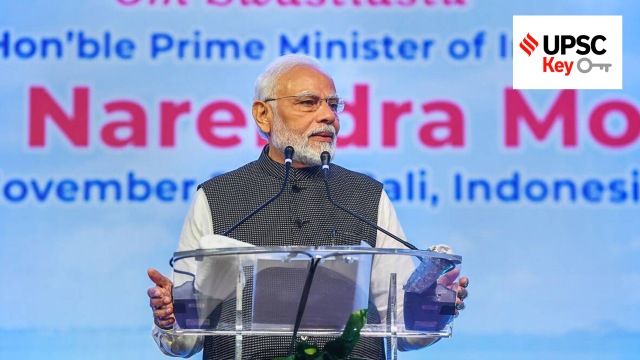
PM calls for new world order: Covid, Ukraine, climate have caused havoc
Syllabus:
Preliminary Examination: Current events of national and international importance.
Mains Examination: General Studies II: Bilateral, regional and global groupings and agreements involving India and/or affecting India’s interests.
Key Points to Ponder:
• What’s the ongoing story-Prime Minister Narendra Modi said on Tuesday that the Covid pandemic, climate change and Ukraine conflict have together caused “havoc in the world”, leaving supply chains “in ruins” and triggering a “crisis of essentials”, adding that the poor face a “more severe” challenge. Addressing the G20 summit in Bali, he called for a “new world order for the post-Covid period”.
• “New world order for the post-Covid period”-Deconstruct the given statement
• What are the key takeaways from the 2022 G20 Bali summit?
• The 2022 G20 Bali summit is very special for India-why?
• What’s on the agenda for the 2022 summit?
• Know the origin of G20
• How G20 Works?
• G20 or Group of Twenty-About, Purpose and Member Countries
• Addressing the session on “food and energy security” at the G-20 summit in Bali, Indonesia, PM Modi said that the “The current shortage of fertilizers in terms of food security is also a huge crisis”- Why today’s fertilizer shortage is tomorrow’s food crisis?
• What are the food security measures adopted by India in the recent years?
• Do You Know-The G20 Presidency steers the G20 agenda for one year and hosts the Summit. The G20 consists of two parallel tracks: the Finance Track and the Sherpa Track. Finance Ministers and Central Bank Governors lead the Finance Track while Sherpas lead the Sherpa Track. The Group does not have a permanent secretariat. The Presidency is supported by the Troika – previous, current and incoming Presidency. During India’s Presidency, the troika will comprise Indonesia, India and Brazil, respectively.
• What to you understand by the expression ‘Vasudhaiva Kutumbakam’, or ‘One Earth, One Family, One Future’?
• ‘Vasudhaiva Kutumbakam’ and Globalisation-Connect the dots?
• ‘Vasudhaiva Kutumbakam’ Sanskrit phrase found in which Hindu texts?
• What is the theme and the logo for India’s G20 Presidency?
• Why ‘Vasudhaiva Kutumbakam’ matters more in the post covid period?
• For Your Information-The G-20, or Group of 20, is an intergovernmental forum of major developed and developing economies. It comprises Argentina, Australia, Brazil, Canada, China, France, Germany, India, Indonesia, Italy, Japan, South Korea, Mexico, Russia, Saudi Arabia, South Africa, Turkey, the UK, the US and nations under the European Union (EU). The G20 is the premier forum for international economic cooperation representing around 85 per cent of the global GDP, over 75 per cent of the global trade, and about two-thirds of the world’s population.
Other Important Articles Covering the same topic:
📍Modi & Xi meet in Bali, first time in public view since Ladakh standoff
📍Big difference since 2014, India no longer thinks small, says PM
Data protection Bill revised: Penalty up to Rs 200 crore if firms don’t have safeguards
Syllabus:
Preliminary Examination: Current events of national and international importance
Main Examination: General Studies II: Government policies and interventions for development in various sectors and issues arising out of their design and implementation.
Key Points to Ponder:
• What’s the ongoing story-Companies dealing in personal data of consumers that fail to take reasonable safeguards to prevent data breaches could end up facing penalties as high as around Rs 200 crore under the revamped version of the Data Protection Bill, The Indian Express has learnt. The Data Protection Board, an adjudicating body proposed to enforce the provisions of the Bill, is likely to be empowered to impose the fine after giving the companies an opportunity of being heard.
• What is the role of the Data Protection Board as per the revamped version of the Data Protection Bill?
• Why does data matter?
• What is Data Protection?
• What is personal data?
• What is non-personal data?
• Personal data and Non-personal data-compare
• In August, the government withdrew the earlier Personal Data Protection Bill from Parliament. Why did the Government withdrawn the Personal Data Protection Bill?
• Joint Committee of Parliament Report on the Personal Data Protection Bill-Know key highlights
• Supreme Court on Right to Privacy (Justice K.S. Puttaswamy vs. Union of India, 2017)-know the verdict
• Justice B N Srikrishna committee recommendation on Data Protection-Know key recommendations
• Personal Data Protection Bill 2019- how this Bill propose to regulate data transfer?
• Key features of Personal Data Protection Bill 2019-know in brief
• What is data localisation? Know the Case for Data Localisation in India.
• What Srikrishna Committee Report says on data localisation?
• Initiative/steps taken by Government of India for Data Protection and Data Privacy-Know in detail
Other Important Articles Covering the same topic:
📍Report Summary on A Free and Fair Digital Economy
📍Explained: The issues, debate around Data Protection Bill
EXPRESS NETWORK
People in public office should not blabber disparaging things: SC
Syllabus:
Preliminary Examination: Indian Polity and Governance-Constitution, Political System, Panchayati Raj, Public Policy, Rights Issues, etc.
Main Examination: General Studies IV: Public/Civil service values and Ethics in Public administration
Key Points to Ponder:
• What’s the ongoing story- PEOPLE HOLDING public office should exercise self-restriction and not blabber things which are disparaging or insulting to other countrymen, the Supreme Court said on Tuesday.
• Public functionaries right to freedom of speech and expression-absolute or relative?
• “Irrespective of what Article 19(2) may say, there is a constitutional culture in the country where there is an inherent limitation or a restriction on what people holding responsible positions say”-Deconstruct and discuss
• By the way, what Article 19 (2) of the Indian Constitution says?
• “Any person holding a public office or is public servant, there is an unwritten rule”-Unwritten rule of what?
• Why Ethics is important for the person holding a public office or for the public servant?
• What are the components of ethics in public administration?
• Who do the Nolan principles apply to?
• First of all, what are the Seven Principles of Public Life, or Nolan Principles?
Other Important Articles Covering the same topic:
📍UPSC ethics simplified: Politics plus or minus ethics
📍UPSC ethics simplified: From ‘babus’ to ‘civil servants’
Govt brings listed essential drugs under price cap
Syllabus:
Preliminary Examination: Current events of national and international importance.
Mains Examination: General Studies II: Government policies and interventions for development in various sectors and issues arising out of their design and implementation.
Key Points to Ponder:
• What’s the ongoing story- The new National List of Essential Medicines (NLEM), released by the Union Health Ministry in September, has now been brought under the Drug Prices Control Order, which fixes ceiling prices for these essential formulations based on average cost to retailers. The gazette notification was issued on November 11 by the Ministry of Chemicals and Fertilizers, which is responsible for ensuring the pricing cap.
• What is drug price control Order?
• What is the aim for drug price control Order?
• Why National List of Essential Medicines (NLEM), has now been brought under the Drug Prices Control Order?
• How ceiling price is determined?
• For Your Information-The NLEM guides the government’s procurement policy and decides the price cap for medicines. The updated list has deleted 26 drugs from the previous one and added 34 drugs, increasing the list to 384 drugs.
• What is National List of Essential Medicine (NLEM)?
• Do You Know-The NLEM was first formulated in 1996 and was revised in 2003, 2011, and 2015. It takes into account any changing profile of diseases, newer drugs available in the market, and changing treatment protocols. The price of medicines in the list is controlled by the Centre and cannot be changed by companies themselves. Many of these medicines are also available free at government health facilities.
• National List of Essential Medicine (NLEM) in India-Know in detail
• Who is National Pharmaceutical Pricing Authority (NPPA)?
• National Pharmaceutical Pricing Authority (NPPA) and National List of Essential Medicine (NLEM)-Connect the dots
• Why National List of Essential Medicine (NLEM) is significant?
Other Important Articles Covering the same topic:
📍How govt’s essential medicines list ensures supply, keeps prices in check
THE EDITORIAL PAGE
Syllabus:
Preliminary Examination: Economic and Social Development-Sustainable Development, Poverty, Inclusion, Demographics, Social Sector Initiatives, etc.
Main Examination: General Studies III: Indian Economy and issues relating to planning, mobilization, of resources, growth, development and employment.
Key Points to Ponder:
• What’s the ongoing story- Pratap Bhanu Mehta writes: There has always been a propensity to overestimate domestic demand. This has been compounded by the unequal distribution of income
• “Current positions over the prospects of the Indian economy seem to swing between alarmism and triumphalism”- What do you understand by ‘swing between alarmism and triumphalism’?
• “A lot of economic debate is shaped by political mood affiliation. There are genuine difficulties figuring out what is going on”-How far you agree with the given statement?
• ‘What may seem like a structural impediment to growth at a particular time can be compensated for by changing circumstances’-How this is relevant to analyse data?
• What is the current economic situation in India as per the Morgan Stanley report?
• The Morgan Stanley report 2022 makes certain claims with respect to the Indian Economy-What are they? (just know in brief)
Other Important Articles Covering the same topic:
THE IDEAS PAGE
Syllabus:
Preliminary Examination: General issues on Environmental ecology, Bio-diversity and Climate Change – that do not require subject specialization.
Mains Examination: General Studies III: Conservation, environmental pollution and degradation, environmental impact assessment.
Key Points to Ponder:
• What’s the ongoing story- Vaibhav Chaturvedi , Pallavi Das Writes: India’s long-term strategy for low carbon development is consistent with its net-zero targets and outlines a road map for key industries.
• India’s announcements at the 26th and 27th Conference Of Parties (COP) are now the pillars of its climate leadership-Know India’s commitment for the climate change
• “If COP26 last year was a watershed moment because of the Prime Minister’s announcement of the country’s plan to go net-zero by 2070, this year’s COP27 in Egypt will be remembered for the country’s path-breaking announcement of a long-term strategy (LTS) for low carbon development”-Discuss
• ‘India joins the coveted list of 56 countries that have submitted their LTS documents to the United Nations Framework Convention on Climate Change (UNFCCC)’-What is India’s long-term strategy (LTS) for low carbon development?
• What are the key takeaways from the India’s long-term strategy (LTS) for low carbon development?
• India’s LTS has prioritised six strategic sectors-What are they?
• ‘There is a lot of scepticism about carbon dioxide removal (CDR), but India’s addition of CDR in its LTS shows we are open to new technology and will pilot these for climate change’-What do you understand by the term ‘Carbon dioxide removal (CDR)’?
• According to the authors of this article, “there’s a crucial element missing in India’s long-term strategy”-What is that crucial element?
• What is the main agenda in COP27?
• What do you understand by “climate disasters” and “climate negotiations”?
• Why “climate disasters” and “climate negotiations” were much talked in the COP27?
• What is the meaning of climate finance?
• What is the financial mechanism? What are the other funds?
• What is the Standing Committee on Finance? What is the long-term finance process?
• Green finance and climate finance-Compare
Other Important Articles Covering the same topic:
📍COP-27: An opportunity for rich nations to help vulnerable communities
EXPRESS NETWORK
World@ 8bn, India set to be most populous
Syllabus:
Preliminary Examination: Economic and Social Development
Mains Examination: General Studies I: Population and associated issues
Key Points to Ponder:
• What’s the ongoing story- While India’s population growth is stablising, it is “still growing at 0.7% per year” and is set to surpass China in 2023 as the world’s most populous country, according to the United Nations Population Fund, which said the world’s population reached 8 billion on Tuesday.
• On 15 November, the world’s population is projected to reach 8 billion people. This unprecedented growth is due to what?
• For Your Information-According to the UN, 60% of the global population lives in a region where the fertility rate is below replacement level — up from 40% in 1990 — and international migration is now the driver of growth in many countries, with 281 million people living outside their country of birth in 2020. All South Asian nations — India, Pakistan, Nepal, Bangladesh and Sri Lanka — have seen high levels of emigration in recent years.
• Do You Know-According to the 2022 edition of the United Nations’ World Population Prospects (WPP), which was released in July 2022 said that, India is projected to surpass China as the world’s most populous country in 2023. It also projected the world’s population to reach 8 billion on November 15, 2022. World Population Prospects 2022 is the twenty-seventh edition of the official estimates and projections of the global population that have been published by the United Nations since 1951.
• World Population Prospects 2022- What are the main takeaways for the global population?
• According to the World Population Prospects 2022, Population growth is caused in part by declining levels of mortality, as reflected in increased levels of life expectancy at birth-true or false?
• According to the World Population Prospects 2022, International migration is having important impacts on population trends for some countries. How?
• The size of the population is intimately connected to the power dynamics shaping the relationship between nations, regions and generations-Do you agree with the given statement?
• What is ‘Demographic gravitation’?
• Can you highlight population transformations around the globe?
• In what ways, the COVID-19 pandemic has affected all components of population change, including fertility, mortality and migration?
• How Population data provide critical information for use in development planning?
• What are the factors influencing the population growth?
• Most countries have population policies and programmes to influence fertility levels. What are the policies and programmes in India to influence fertility levels?
• What is Total Fertility Rate (TFR)?
• What does Total Fertility Rate (TFR) of 2.1 mean?
• What National Family Health Survey 5 said about Total Fertility Rate (TFR)?
• What is Replacement Fertility Rate?
• How is the Total Fertility Rate calculated?
• What is the difference between birth rate and Total Fertility Rate (TFR)?
• Does an increase in births mean that TFR will go up?
• What is demographic dividend?
• The UN projections say that by 2050, India’s population will reach 1,668 million, far exceeding China’s declining population at 1,317 million. What will be its implications?
• What is the significance of India overtaking China?
• What pattern of population distribution is India?
• What are the policy implications arising out of these two trends?
• How reliable is the UN projection, and how do they compare with India’s Census?
• Family Planning in India-Issues and Challenges
• Population growth brings what sort of challenges for Indian public policy?
• Do you think that massive growth in population in India is blessing in disguise?
Other Important Articles Covering the same topic:
📍Global life expectancy falls after Covid years
For any queries and feedback, contact priya.shukla@indianexpress.com
The UPSC KEY Indian Express is now on Telegram. Click here to join our channel and stay updated with the latest Updates.

Read UPSC Magazine