🚨 It’s our first anniversary! The Indian Express UPSC Essentials brings to you the September issue of its monthly magazine, the special anniversary edition. Click Here to read. Share your views and suggestions in the comment box or at manas.srivastava@indianexpress.com🚨
Govt & Politics
UPSC Syllabus:
Preliminary Examination: Current events of national and international importance
Mains Examination: GS-II: India and its neighbourhood- relations, Bilateral, regional and global groupings and agreements involving India and/or affecting India’s interests.
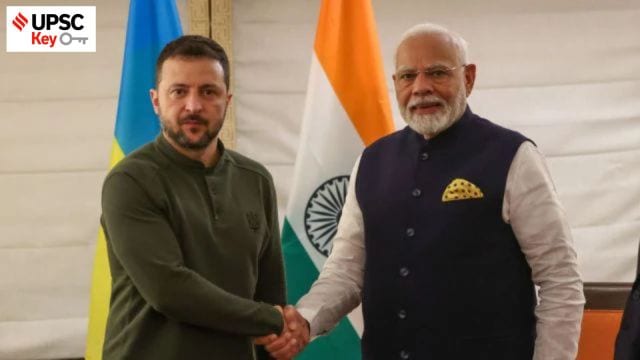
What’s the ongoing story- Meeting Prime Minister Narendra Modi for the third time in four months, Ukraine’s President Volodymyr Zelenskyy on Tuesday expressed gratitude for “the clear support of our sovereignty and territorial integrity”.
Prerequisites:
— Read about the Russia-Ukraine war: Origin, ongoing conflict, and peace resolution
— Geography location of Ukraine- rivers and countries bordering it
Key takeaways:
Story continues below this ad
— Modi met Zelenskyy in New York on the sidelines of the UN Summit of the Future, before wrapping up his three-day visit to the US.
— Briefing the media about the meeting, Foreign Secretary Vikram Misri cited Mahatma Gandhi’s statement that “there is no path to peace, peace is the path”, and said there needs to be an agreement on that.
(Thought process: Consider this quote’s applicability across UPSC GS papers and Essays.)
— The Prime Minister conveyed that India remains open to providing “all support within its means to facilitate a lasting and peaceful resolution of the conflict”.
For Your Information:
Story continues below this ad
— PM Modi visited Kyiv on August 23, when Zelenskyy proposed India as the site of a peace summit amid the ongoing Russia-Ukraine conflict. The visit came shortly after PM Modi held talks with President Vladimir Putin in Moscow in July.
— C. Raja Mohan writes, “As it considers a more active peacemaking role, Delhi should be clear about the possibilities and limitations of what it can do. To be sure, India is in favour of peace and has been pressing for dialogue and diplomacy since the very start of the Russian invasion of Ukraine in February 2022. But calling for peace is very different from the capability to produce it.”
— “While Delhi must try and make some contributions to peacemaking, it should be clear in its mind that peace in Ukraine, if and when it happens, will be about a new grand European bargain between Washington and Moscow.”
Points to Ponder:
— What are the recent peace-making efforts made in the Russia-Ukraine war?
Story continues below this ad
— What is the role of Global South in the Russia-Ukraine peace effort?
— What are the challenges for India in the ongoing Russia-Ukraine conflict?
Post Read Question:
(1) Consider the following countries:
1. Serbia
2. Romania
3. Ukraine
4. Turkiye
5. Georgia
Which of the following countries share a border with the Black sea?
(a) 1, 2, 4 and 5
(b) 2, 3, 4 and 5
(c) 1, 3 and 5
(d) 1, 2, 3, 4 and 5
Other Important Articles Covering the same topic:
C Raja Mohan writes: India’s role in peacemaking in Ukraine
Story continues below this ad
Express Network
UPSC Syllabus:
Preliminary Examination: Indian Polity and Governance – Constitution, Political System, Panchayati Raj, Public Policy, Rights Issues
Mains Examination: GS-II: Appointment to various Constitutional posts, powers, functions and responsibilities of various Constitutional Bodies.
What’s the ongoing story- Observing that the CAG plays a key role in ensuring transparency and accountability in public finance, President Droupadi Murmu said Tuesday the office of the CAG has lived up to the expectations of the Constitution-makers.
Prerequisites:
Story continues below this ad
— What constitutional provision relates to the Comptroller and Auditor General (CAG)?
— Read about CAG: Appointment, Salary, Independence, and reports submitted by CAG.
Key takeaways:
— Addressing the opening session of the 16th assembly of Asian Organization of Supreme Audit Institutions (ASOSAI), Murmu said, “The CAG of India plays a key role in ensuring transparency and accountability in country’s public finance…”
— Stating that Mahatma Gandhi should be a “role model”, especially for independent supreme audit institutions, the President said, “He would have wanted public auditors to speak truth – without ambiguity. Sharpness and bluntness are opposing qualities, but an ideal public auditor is one who combines them.”
Story continues below this ad
(Thought Process: Relevance of Gandhi and how his philosophy applies to ensuring good governance.)
— Highlighting that the mandate of public sector audits has expanded beyond traditional auditing to include assessing effectiveness of public welfare schemes and projects, she said, “Audit, therefore, needs to keep up with the technological evolution in order to be able to perform its oversight functions effectively.”
For Your Information:
— The Comptroller and Auditor General of India (CAG) plays a crucial role in this democratic framework by ensuring transparency, accountability, and financial integrity in government’s functioning.
— CAG helps maintain the separation of powers between legislature and executive by ensuring that the government’s financial activities align with legislative intentions. Through its audit findings and recommendations, the CAG promotes good governance practices and helps governments streamline their operations, reduce inefficiencies and adhere to financial discipline. — As India’s democracy matures, the CAG’s role becomes even more vital in promoting good governance and safeguarding the people’s interests.
Points to Ponder:
Story continues below this ad
— How CAG acts as a guide, friend and philosopher of the Public Accounts Committee of the Parliament?
— What are the challenges in the effective functioning of CAG?
— What are the necessary reforms related to CAG?
Post Read Question:
Prelims
(2) Which of the following articles is related to the CAG?
(a) Article 148
(b) Article 165
(c) Article 280
(d) Article 324
Mains
“The Comptroller and Auditor General (CAG) has a very vital role to play.” Explain how this is reflected in the method and terms of his appointment as well as the range of powers he can exercise. (UPSC CSE 2018)
Other Important Articles Covering the same topic:
CAG of India writes: As our democracy matures, my role is becoming more vital
Explained
UPSC Syllabus:
Preliminary Examination: Current events of national and international importance
Mains Examination: GS-III: Achievements of Indians in science & technology; indigenization of technology and developing new technology.
What’s the ongoing story- The Union Cabinet last week approved India’s first mission to Venus that ISRO aims to launch in March 2028. This is the country’s second interplanetary mission after the Mars Orbiter Mission launched in 2013.
Prerequisites:
— What is the significance of Venus for the scientists?
— What is the recent Cabinet decision on ISRO’s mission?
Key takeaways:
— The Venus mission is meant to study the planet from an orbit around it. The mission will carry scientific instruments from India and abroad to examine the surface and sub-surface of Venus, its atmosphere, its ionosphere, and its interaction with the Sun.
— Venus is often called Earth’s twin because it is similar in mass, density, and size. Therefore, studying Venus may offer scientists clues about the evolution of Earth. Notably, Venus is thought to have had water at some point in its history but has now become a dry and dusty planet.
— The planet, however, differs from Earth in very significant ways. First, it has an extremely high surface temperature of around 462 degree Celsius, even hotter than Mercury — the planet that is closest to the Sun. Scientists think this is because of a runaway greenhouse effect.
— Second, the atmospheric pressure on Venus is much higher than on Earth. It is almost similar to the pressure felt underneath the oceans on Earth.
— Third, 96.5% of the atmosphere of Venus is made up of carbon dioxide and there are sulphuric acid clouds on the planet.
— Fourth, Venus rotates very slowly on its axis as compared to Earth. One rotation of Venus lasts around 243 Earth days.
For Your Information:
— The mission will carry scientific payloads weighing around 100 kg… Once the satellite exits the Earth orbit, it will take around 140 days to reach Venus.
— The mission will also see India perform aero-braking for the first time.
— The Indian payloads include an L and S band Synthetic Aperture Radar that can help in imaging the surface of the planet.
— There will also be a thermal camera, an experiment to study the flow of interplanetary dust particles, and an experiment to study the high-energy particles entering the Venusian atmosphere leading to its ionisation….
— There have been several missions to Venus in the past by the United States, the erstwhile USSR, Japan, and a collaborative mission of the European Space Agency (ESA) with Japan.
— The US has planned at least two more missions to Venus in the future — DaVinci in 2029 and Veritas in 2031 — and the ESA has planned the EnVision mission for 2030.
Points to Ponder:
— Read about ISRO’s – Sun Mission, Moon Mission and Mars Mission
— What is the significance of ISRO’s Venus Mission?
Post Read Question:
(3) Consider the following statements:
1. The surface temperature of Venus is around 462 degree Celsius which is less than mercury.
2. The atmospheric pressure on Venus is much higher than on Earth.
3. More than 90% of Venus’s atmosphere is made up of nitrogen.
How many of the above statements is/are correct?
(a) Only one
(b) Only two
(c) All three
(d) None
Other Important Articles Covering the same topic:
Union Cabinet approves Venus mission, Indian space station among 4 key Isro projects
UPSC Syllabus:
Preliminary Examination: Indian Polity and Governance – Constitution, Political System, Panchayati Raj, Public Policy, Rights Issues
Mains Examination: GS-II: Important aspects of governance, transparency and accountability, e-governance applications, models, successes, limitations, and potential; Government policies and interventions for development in various sectors and issues arising out of their design and implementation.
What’s the ongoing story- The Karnataka High Court allowed an investigation into Chief Minister Siddaramaiah in the alleged Mysore Urban Development Authority (MUDA) scam on Monday (September 24). In doing so, it upheld Karnataka Governor Thawarchand Gehlot’s earlier decision to sanction the investigation.
Prerequisites:
— What is the MUDA scam?
— What is the role of the Governor?
— What is the Prevention of Corruption Act, 1988?
Key takeaways:
— Under the law, the governor is typically bound by the aid and advice of the Council of Ministers in a state. However, the court held that this was a case where “exceptional circumstances” justified the decision to sanction.
— The governor sanctioned the proceedings against Siddaramaiah under the Prevention of Corruption Act, 1988, and the Bharatiya Nyaya Sanhita, 2023, on August 16.
— This sanction is necessary to investigate and prosecute public officials for offences under the PCA. The provision deals with investigation of offences related to public servants, allegedly committed during the “discharge of official functions or duties”.
— The Chief Minister challenged this sanction … that the Governor of a state is bound by the aid and advice of the Council of Ministers, including the August 1 resolution…
— Dr A M Singhvi argued that the Governor “cannot assume the advice of the cabinet of ministers is biased and assume discretionary powers” and “must explain orders that the cabinet decision suffers from manifest irrationality”.
— The governor’s side relied on a 2004 Supreme Court precedent in Madhya Pradesh Special Police Establishment v. State of Madhya Pradesh. Here, the court held that the governor could provide sanction if the material on record shows a prima facie (at face value) case against the public official.
For Your Information:
— Prevention of Corruption Act (PCA): Following a 2018 amendment, Section 17A says that an inquiry against a public servant for alleged crimes committed in the line of their official duties can only be launched after sanction has been accorded for investigation.
— The Karnataka government had argued that the Governor could not have given sanction to private persons, and that a police officer should have approached the Governor at the stage of the registration of an FIR on the basis of a court order, or through a suo motu decision by police.
— Two of the complainants filed private complaints in court seeking investigations against Siddaramaiah prior to the grant of sanction by the Governor.
— In the past, sessions courts have rejected private complaints for investigations against public servants in the absence of a sanction — including a corruption case filed in 2021 against former CM B S Yediyurappa by T J Abraham.
Points to Ponder:
— How are public officers prosecuted under PCA?
— What is the United Nations Convention against Corruption (UNCAC)?
— What does the constitution say about the aid and advice of the council of ministers to the governor?
Post Read Question:
What are the reasons for the prevalence of corruption in India? What are the Legal and Regulatory Frameworks for Fighting Corruption in India?
Other Important Articles Covering the same topic:
What Karnataka Chief Minister Siddaramaiah has been accused of in the alleged MUDA scam
The Ideas Page
UPSC Syllabus:
Preliminary Examination: Current events of national and international importance
Mains Examination: GS-II, III: Bilateral, regional and global groupings and agreements involving India and/or affecting India’s interests; Achievements of Indians in science & technology; indigenization of technology and developing new technology.
What’s the ongoing story- C Raja Mohan writes: Technology has been at the centre of Modi’s bilateral interactions with President Joe Biden, the minilateral summit of the Quad leaders, his interaction with the US CEOs, and the address to the United Nations Summit of the Future.
Prerequisites:
— What is the status of the India-US relationship?
— What is technology diplomacy?
— What is the United Nations Summit of the Future?
— What is QUAD?
Key takeaways:
— “This is not the first time though that technology has figured at the top of India’s national strategy and diplomacy. There have been at least three earlier occasions in independent India’s history when technology took centrestage.”
— “Today, the domestic and the external are coming together to turn the fourth phase of India’s technology diplomacy into a consequential one for India’s security and prosperity.”
— “The NDA government’s new focus on building advanced technology capabilities, Washington’s quest for capable partners amid the deepening rivalry with Beijing, and the effort to rearrange global supply chains are driving India on the one hand and the US on the other.”
— “Technology has become an important focus of India’s engagement not just with the US but several countries including France, Germany, Britain, Australia, Japan, South Korea and Singapore, and the European Union.”
— “The return of a majority government to power in 2014 unleashed fresh energy into India’s technology diplomacy in the fourth phase. For one, the Modi government began to tie up some loose ends of the US nuclear deal and put digital and green technologies at the top of the policy agenda in the first term.”
— “The technological focus expanded to include AI and semiconductors in the second term. These initiatives were in tune with the technological revolution unfolding in the world and have acquired fresh momentum in the third term.”
For Your Information:
— India and the US have entered into an agreement to set up a semiconductor fabrication plant to make chips for use in “national security, next generation telecommunications and green energy applications”, according to the Indo-US joint fact-sheet.
— The fab, focused on “advanced sensing, communication and power electronics”, will be enabled by support from the India Semiconductor Mission as well as a strategic technology partnership between Bharat Semi, 3rdiTech, and the US Space Force, the statement said.
Points to Ponder:
— What is the India Semiconductor Mission?
— What is the significance of the recent India-US deals for India?
— Why has technology become an important focus of India’s engagement?
Post Read Question:
‘What introduces friction into the ties between India and the United States is that Washington is still unable to find for India a position in its global strategy, which would satisfy India’s National self-esteem and ambitions’. Explain with suitable examples. (UPSC CSE 2019)
Other Important Articles Covering the same topic:
India, US ink pact to set up semiconductor fab for national security, next-gen telecom
UPSC Syllabus:
Preliminary Examination: Economic and Social Development – Sustainable Development, Poverty, Inclusion, Demographics, Social Sector Initiatives, etc
Mains Examination: GS-II: Issues relating to the development and management of Social Sector/Services relating to Health, Education, Human Resources.
What’s the ongoing story- Manish Sabharwal and Pramath Sinha write: A great university has low fees and high costs (quality faculty, rigorous research and a nice campus). In contrast, low fees and low costs create low quality, while high fees and high costs create exclusion.
Prerequisites:
— What is the status of Higher Education in India?
— What is brain drain?
— Budget allocation for higher education
Key takeaways:
— In theory, public universities have what Hungarian economist Janos Kornai called soft budget constraints — they can get higher government allocations irrespective of performance.
(Thought Process: Use these kinds of terms in your Mains answer writing to get an edge.)
— In practice, even high-quality public universities in rich places like California, Canada and England face brutal budget cuts because of the cost disease (productivity in education can’t rise as fast as costs do), policy-mandated fee caps, and tighter visa regimes for full-fee-paying international students. Higher education regulators in England and Canada suggest 40 and 50 per cent of their institutions will run a deficit this year.
— Our civilisation recognised the power of learning centuries ago — Vidya Dadati Vinayam, Vinaya Dadati Patram (knowledge gives humility, which gives capability) — but public funding faces the tyranny of dividing money between K-12 schooling, vocational training and universities.
(Thought Process: Think about the highlighted quote and its applicability across GS papers and essays.)
— All three matter, but the first two deliver more inclusive public goods and face financing market failures. Colleges create wage premiums and have more options for funding.
— Consequently, about 75 per cent of India’s 40 million university students study in non-profit, non-government institutions (only 25 per cent of America’s 18 million and 15 per cent of the UK’s three million students do so).
— Empire of Ideas by William Kirby suggests leaving out universities from studies of global political and economic power in the last three centuries has been a mistake.
— Kirby’s thesis reinforces our belief that 20 Indian universities among the world’s top 100 are a national security goal for the next decade because shastra & shaastra (knowledge and weapons), vidya & vikas (learning and development), and praudyogiki & pratibha (technology and talent) are inseparable.
— A new crop of innovative Indian non-profit universities are diversifying their funding beyond fees. Only 4 per cent of the costs of Azim Premji University are met by fees… Over 200 donors have enabled Ashoka University to offer 24 per cent of students a 100 per cent tuition waiver and 60 per cent some financial aid.
— The biggest challenge for non-profit universities is convincing philanthropy to fund revenue expenses because it is easy to confuse university buildings with building universities.
— The best teachers in the next few decades will use technology but recognise that humans have an unfair advantage in being human. They will combine being an adhyaapak (information provider), upadhyay (combiner of information and knowledge), pandit (deep subject knowledge), acharya (imparts specific skills), drushta (visionary view of a subject) and guru (awakens potential).
— While the new wave of non-profit universities has built a strong track record of not loading capital expenditures onto fees, the next frontier for them is raising untied funding for operating costs. Early trends in scholarship funding commitments and research grants augur well.
For Your Information:
— Sukanta Chaudhuri writes: Funds for public universities, especially those at state level, are not routine handouts. In the heyday of the UGC, when independent India‘s university system was being put in place, UGC funding was a reward for enterprise.
— The other great source of funds was the Five-Year Plan. Although Plan funding was a regular feature, the quantum of funds was not: It was determined by past performance and the merit of the proposals.
— Hence, the wide disparity in standards between public universities — success bred success. The one major complaint might be that lack of success was not adequately penalised. The public university system started to falter when the ambitious professional classes opted out, seeking more exclusive access to jobs and ascendancy through privatised higher education.
— The decline in status of the public universities inevitably translated into a decline in funding. Today, the UGC and plan funding have both vanished. The Rashtriya Uchchatar Shiksha Abhiyan is a scaled-down and unreliable substitute.
Points to Ponder:
— What are the funding challenges faced by universities in India?
— What are the challenges of higher education?
— What are the initiatives taken by the government to address the shortcomings in higher education?
— Pros and cons of allowing foreign universities to open campus in India?
Post Read Question:
Discuss the main objectives of Population Education and point out the measures to achieve them in India in detail. (UPSC CSE 2021)
Other Important Articles Covering the same topic:
Making campus equal, excellent
India’s universities are coming apart, political class ignores damage caused by the exit of the ablest from the country
UPSC Syllabus:
Preliminary Examination: Current events of national and international importance
Mains Examination: GS-II: Bilateral, regional and global groupings and agreements involving India and/or affecting India’s interests.
What’s the ongoing story- Lakshmi Puri writes: India has an unbroken, civilisational heritage of Vasudhaiva Kutumbakam. This ethos was imprinted on to our G20 presidency by Prime Minister Narendra Modi. The country has the largest youth population in the world, it is the largest and most vibrant democracy, and is technologically future-facing.
Prerequisites:
— What is the Pact for the Future?
— What is the purpose of the UN Summit of the Future?
— Read about the United Nations Security Council (UNSC)
Key takeaways:
— This is what the Pact for the Future (PFF), the Declaration on Future Generations (DFG) and the Global Digital Compact (GDC) adopted at the UN Summit of the Future on September 23 attempts.
— PM Modi joined 142 counterparts at the Summit and positioned India as a vishvamitra representing a sixth of humanity. He emphasised India’s vision of human-centric development and successes in SDGs, DPI and solar energy, which he offered to share. He brought the message of the G20 New Delhi Declaration (NDLD) and amplified the voice of the Global South.
— He urged eschewing war and addressing threats from new arenas — terrorism, cyber, maritime and space. Warning that reform is the key to relevance, he pointed to the admission of the African Union to the G20 . “Global action must match global ambition” he urged .
(Thought Process: This quote by PM Modi can be used an conclusive remarks in your Mains answers.)
— Much-needed financing from donors and unreformed and underfunded Multilateral Financial Institutions (MFIs), critical green technologies and debt relief have not materialised for developing countries. There is a serious solidarity deficit, undermining multilateralism by resorting to coercive unilateralism, transactional bilateralism, plurilateralism, minilateralism and regionalism .
— Against this background, the Summit represented “a once-in-a-generation opportunity to help rebuild trust and bring outdated multilateral institutions and frameworks into line with today’s world, based on equity and solidarity.”
— India has reason to be satisfied with the commitment “to pursue a future free from terrorism” and “violent extremism conducive to terrorism” in every way and at all levels including through revitalising the Convention against Terrorism.
— An elaborate text pledged to make the UNSC “more representative, inclusive, transparent, efficient, effective, democratic and accountable,” and enunciated principles for expansion and reform including Africa being given priority and implicitly presaging the inclusion of developing countries like India.
— The Global Digital Compact is a significant normative outcome and takes forward India’s G20 thrust on bridging the digital divide, fostering the digital economy and digital public infrastructure for achieving SDGs.
— The UN can’t make miracles unless “we the people”, the UN Secretariat and the member states believe so and dare to act. As a Sanskrit saying goes,“Yad Bhavam, Tad Bhavati” — you become what you believe.
Points to Ponder:
— What are the initiatives taken by India in Digital Public Infrastructure?
— What are the proposed reforms in UNSC?
— What is the significance of the Global Digital Compact?
Post Read Question:
(4) The Security Council of UN consists of 5 permanent members, and the remaining 10 members are elected by the General Assembly for a term of (UPSC CSE 2009)
(a) 1 year
(b) 2 years
(c) 3 years
(d) 5 years
Other Important Articles Covering the same topic:
Only comprehensive reform can enable UNSC to effectively manage global conflicts: India
UPSC Essay and Ethics Snippets
Seen crawling to panchayat office, 74-year-old woman gets pension delivered at doorstep
(Thought Process: How does this case highlight failures in governance and service delivery systems? Could this situation reflect the poor implementation of welfare schemes and a disregard for the dignity of vulnerable citizens? Isn’t this a lack of proactive administration? )
| ALSO IN NEWS |
| Antyodaya Diwas 2024 |
Antyodaya Diwas is an annual occasion in India commemorating the birth anniversary of Indian leader Pandit Deendayal Upadhyaya. (What is Antyodaya?) |
| PRELIMS ANSWER KEY |
| 1. (b) 2. (a) 3. (a) 4. (b) |
Subscribe to our UPSC newsletter and stay updated with the news cues from the past week.
Stay updated with the latest UPSC articles by joining our Telegram channel – Indian Express UPSC Hub, and follow us on Instagram and X.


 24 min read