30 min read

© IE Online Media Services Pvt Ltd



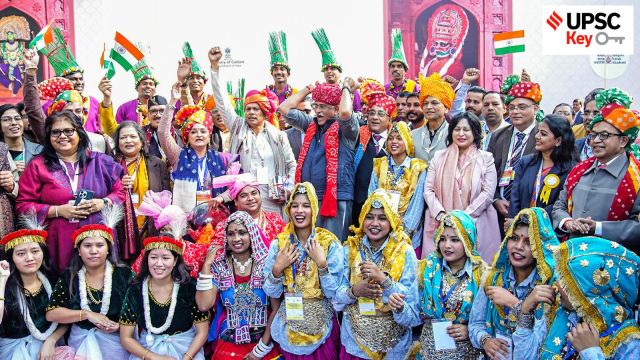 Union Minister of Culture Gajendra Singh Shekhawat in a group photograph during the UNESCO Intergovernmental Committee for the Safeguarding of Intangible Cultural Heritage’s announcement on the inscription of Diwali at Red Fort, in Delhi on Wednesday. Know more in our UPSC Key. (PIB Photo Gallery/ANI Photo)
 Important topics and their relevance in UPSC CSE exam for December 11, 2025. If you missed the December 10, 2025, UPSC CSE exam key from the Indian Express, read it here.
Syllabus:
Preliminary Examination: Current events of national and international importance
Mains Examination: General Studies-II: Bilateral, regional and global groupings and agreements involving India and/or affecting India’s interests.
What’s the ongoing story: From December 15, the US will expand the vetting of social media accounts to all H-1B visa applicants as well as their dependents, the US Embassy spokesperson said on Wednesday.
Key Points to Ponder:
— What is an H-1B visa?
— What are the issues related to the H-1B visa?
— What significant policy changes have occurred in recent years regarding the H-1B visa?
— How does the H-1B visa programme affect diplomatic and trade relations between India and the United States?
— What is the contribution of Indian Americans to US Society and economy?
— What are the various categories of visa provided by the US?
— What are the implications of H-1B visa restrictions on global talent mobility?
Key Takeaways:
— “The Department of State conducts thorough vetting of all visa applicants, including an online presence review of all student and exchange visitor applicants in the F, M, and J non-immigrant classifications.”
— This expanding social media scrutiny of applications comes three months after the US administration led by President Donald Trump increased the fee for new H-1B applicants to about US$ 100,000 (about Rs 88 lakh) — from about $2,000-$5,000, depending on employer size and other costs.
— In June this year, citing “national security and public safety”, the US had said that all applicants for student visas must make their social media accounts public.
— “Effective immediately, all individuals applying for an F, M or J non-immigrant visa are requested to adjust the privacy settings on all of their social media accounts to ‘public’ to facilitate vetting necessary to establish their identity and admissibility to the United States under US law,” the US Embassy had said in New Delhi on June 23.
— The F category visa (F-1) is issued to students who want to pursue academic studies; M category visa (M-1) to those who want to pursue vocational or other non-academic studies; J category visa (J-1) to those who want to teach, study, conduct research, or receive on-the-job training for periods ranging from a few weeks to several years.
— India-born professionals are the biggest beneficiaries of the H-1B visas. Between October 2022 and September 2023, 72 per cent of the nearly 4 lakh visas issued under the H-1B programme went to Indian nationals.
Do You Know:
— The H-1B visa programme allows US employers to hire immigrant workers in specialty occupations that require “a high level of skill” and “at least a bachelor’s degree”, according to the US Department of Labour.
— The program was started in 1990, with the intention of helping “employers who cannot otherwise obtain needed business skills and abilities from the US workforce by authorising the temporary employment of qualified individuals who are not otherwise authorised to work in the United States”.
— The initial validity of the H-1B visa is up to three years. It can be extended once, for another three years, giving a total of up to six years in most cases.
— Currently, there is an annual numerical limit (regular cap) of 65,000 new statuses/ visas under this program each fiscal year, with an extra 20,000 visas available to those with a master’s degree or higher from a US university.
Other Important Articles Covering the same topic:
📍H-1B visa changes: Why Trump aides want to change H-1B visa program
📍What is the contribution of Indian Americans to US society and economy?
Previous year UPSC Prelims Question Covering similar theme:
(1) With reference to the H-1B visa program, consider the following statements:
1. It allows American employers to hire non-immigrant workers in specialty occupations that require a high level of skills.
2. There is no capping in the total number of new H-1B visas.
3. In the fiscal year 2023, Indians accounted for more than half of the total H-1B approvals.
Which of the statements given above is/are correct?
(a) 2 and 3 only
(b) 1 only
(c) 1 and 3 only
(d) 3 only
Previous year UPSC Mains Question Covering similar theme:
Indian diaspora has a decisive role to play in the politics and economy of America and European Countries.’ Comment with examples (UPSC CSE 2020)
Syllabus:
Preliminary Examination: Current events of national and international importance
Mains Examination: General Studies-I: Indian culture will cover the salient aspects of Art Forms, literature and Architecture from ancient to modern times
General Studies-II: Important International institutions, agencies and fora- their structure, mandate.
What’s the ongoing story: India’s nomination for ‘Deepavali, the festival of light’ was Wednesday inscribed on the UNESCO’s Representative List of the Intangible Cultural Heritage of Humanity for 2025. This came a year after West Bengal’s Durga Puja made it to the prestigious list. The decision was taken during a key meeting of UNESCO being hosted at the Red Fort.
Key Points to Ponder:
— What is the importance of UNESCO’s Representative List of the Intangible Cultural Heritage of Humanity?
— What are intangible cultural heritage?
— How is the selection made?
— What is the cultural significance of Deepavali?
— How many UNESCO intangible cultural heritages are there in India?
Key Takeaways:
— As opposed to tangible cultural properties — such as ancient monuments, archaeological sites and other natural sites, UNESCO’s Intangible Cultural Heritage (ICH) lists living traditions, skills and expressions passed down through generations.
— It broadly covers five domains: oral traditions, performing arts, social practices/rituals/festivals, nature/universe knowledge, and traditional craftsmanship, such as India’s Garba dance, Kumbh Mela, or perhaps the other recent global example of French baguette-making. These aren’t objects but practices that strengthen identity and diversity and are considered imperative for humanity.
— UNESCO’s Intangible Cultural Heritage List now features around 700 elements corresponding to 140 countries.
— India currently has 16 elements inscribed on UNESCO’s Representative List of the Intangible Cultural Heritage of Humanity.
— The 20th session of the panel is underway from December 8 to 13 at the Red Fort. For the next year’s cycle, India has sent a nomination dossier for Bihar’s Chhat Puja for consideration of the committee.
— To be included on the list, UNESCO says intangible cultural heritage should be inclusive, representative and community-based. For instance, a couple of years ago, UNESCO voted to include the “artisanal know-how and culture of baguette bread”.
— Reflecting on the addition of France’s staple bread to the list, UNESCO chief Audrey Azoulay said this “celebrates the French way of life: the baguette is a daily ritual, a structuring element of the meal, synonymous with sharing and conviviality”.
— As the world becomes increasingly globalised and conflict-ridden, the need to conserve the social histories of its diverse communities is more urgent than ever, as per UNESCO.
— India’s pitch for Deepavali is also aimed at the large Indian diaspora. The Intergovernmental Committee advances the objectives of the 2003 Convention signed by member countries and ensures their effective implementation across member states. It offers guidance on best practices, recommends safeguarding measures and mobilises resources for the Intangible Cultural Heritage Fund.
Do You Know:
— The United Nations Educational, Scientific and Cultural Organisation (UNESCO) plays a vital role in safeguarding cultural and natural heritage across the globe. Its primary objective is to identify, protect, and preserve sites that hold outstanding value for humanity.
— According to unesco.org, “cultural heritage does not end at monuments and collections of objects. It also includes traditions or living expressions inherited from our ancestors and passed on to our descendants, such as oral traditions, performing arts, social practices, rituals, festive events, knowledge and practices concerning nature and the universe or the knowledge and skills to produce traditional crafts”.
Other Important Articles Covering the same topic:
Previous year UPSC Prelims Question Covering similar theme:
(2) Recently, which one of the following was included in the UNESCO’s World Heritage list? ( UPSC CSE 2009)
(a) Dilwara Temple
(b) Kalka-Shimla Railway
(c) Bhiterkanika Mangrove Area
(d) Visakhapatnam to Araku valley railway line
Syllabus:
Preliminary Examination: Current events of national and international importance.
Mains Examination: General Studies-II: Government policies and interventions for development in various sectors and issues arising out of their design and implementation.
What’s the ongoing story: Australia has become the first country in the world to enforce a minimum age for social media use, requiring platforms such as Instagram, YouTube and Snap to block more than a million accounts of users below the age of 16. The Australian legislation, which has drawn criticism from tech companies but support from parents, is likely to set a template for a broader global push to tighten regulation of young users’ online safety.
Key Points to Ponder:
— What is the reason for this ban?
— How is social media impacting different sections of the society?
— How does it typically impact the children?
— What are the criticisms related to the ban?
— Social media exposes under 16 to cyberbullying, stalking, grooming, and harmful and hateful content. What needs to be done to address this in India?
Key Takeaways:
— According to the new law, called the ‘Online Safety Amendment (Social Media Minimum Age) Act’, age-restricted platforms will be expected to take “reasonable” steps to find existing accounts held by under-16s, and deactivate or remove those accounts, prevent them from opening new accounts, including prohibiting any workarounds that may allow under-16s to bypass the restrictions.
— The Australian approach differs significantly from India’s. Here, the data protection framework states that tech companies offering services to those under 18 years will have to seek consent from parents. India’s framework also prohibits behavioural tracking and targeted advertising to children. It has been notified but is yet to come into effect.
— According to the Australian government, the restrictions aim to protect young people from “pressures and risks” that users can be exposed to while logged in to social media accounts. These come from design features that encourage them to spend more time on screens, while also serving up content that can harm their health and wellbeing.
— The regulation has left Big Tech scrambling, as all of them have publicly opposed the law, while maintaining that they will comply with it. Local reporting suggests that Meta has already started deactivating accounts of users under the age of 16. While the law does not penalise young Australians who try accessing social media after its enforcement, platforms which fail to block them risk fines of up to $33 million.
— To be sure, the Australian government has excluded dating websites, gaming platforms and AI chatbots from the law, even as the latter has recently come under the scanner for allowing children to have “sensual” chats. Apart from tech companies, the Australian Human Rights Commission has also said a blanket ban on social media for under-16s may not be the “right response”, as it could curtail their right to free speech.
— More generally, age restrictions will apply to social media platforms that meet three specific conditions: the sole purpose, or a significant purpose, of the service is to enable online social interaction between two or more end-users; the service allows end-users to link to, or interact with, some or all of the other end-users; and the service allows end-users to post material on the service.
— According to the government, being logged into a social media account increases the likelihood that under-16s will be exposed to pressures and risks that can be hard to deal with, exposing them to cyberbullying, stalking, grooming, and harmful and hateful content.
— While India does not have a law specifically to regulate the use of social media platforms by children, under the Digital Personal Data Protection Act, 2023, tech companies are required to implement a mechanism for collecting “verifiable” parental consent before processing personal data of children, even though it does not prescribe a particular technical measure to collect such consent. As per India’s law, a child has been defined as an individual below the age of 18.
— The law also directs companies to not process personal data of children in cases where it could cause any detrimental effect on the well-being of a child, and not tracking or engaging in behavioural monitoring or targeted advertising directed at children
Do You Know:
— A report by cybersecurity firm McAfee Corp informs that as many as 85 per cent of children in India have been victims of cyberbullying. Given the lasting emotional harm caused by cyberbullying, coupled with the tender age of its victims, the world of social media becomes an exceptionally challenging turf for parents.
— Films such as Logout (2025), Not Okay (2022), and War of Likes (2021), and web series such as Adolescence (2025), Clickbait (2021), and Black Mirror (2011), and documentaries like The Social Dilemma (2020), Childhood 2.0 (2020), and The Great Hack (2019) vividly illustrate how social media reshapes our subjectivities in profound ways.
— Additionally, a recent study by Celia B. Fisher and others, Social media: A double-edged sword for LGBTQ+ youth, explores the double-edged nature of social media with respect to LGBTQ+ youth. It underlines how social media platforms are simultaneously safe and toxic for them.
— On the one hand, these platforms offer opportunities to connect with others who share similar identities or who support them. On the other hand, social media platforms also remain active sites of brazen transphobic and homophobic cyberbullying.
Other Important Articles Covering the same topic:
📍Why social media governance demands balancing free speech with accountability
Previous year UPSC Mains Question Covering similar theme:
Social media is triggering ‘Fear of Missing Out’ amongst the youth, precipitating depression and loneliness. (UPSC CSE 2024)
Syllabus:
Preliminary Examination: Economic and Social Development – Sustainable Development, Poverty, Inclusion, Demographics, Social Sector Initiatives, etc.
Mains Examination: General Studies-I: Role of women and women’s organisation, population and associated issues, poverty and developmental issues, urbanisation, their problems and their remedies.
General Studies-II: Issues relating to poverty and hunger
What’s the ongoing story: India has “virtually eliminated” extreme poverty between 2011-12 and 2023-24, with the poverty rate among Muslims slightly lower (1.5% of their population) than among Hindus (2.3%).
Key Points to Ponder:
— What is extreme poverty?
— How is poverty defined?
— What are the Issues relating to poverty and hunger in India?
— How is poverty calculated in India?
— What are the government schemes for reducing poverty in India?
— What is purchasing power parity (PPP)?
— How is the poverty line defined in India?
— Know about the various committees formed for estimating poverty in India?
Key Takeaways:
— This is what a new paper authored by Columbia University professor and Sixteenth Finance Commission Chairman Arvind Panagariya and Vishal More, founder of the New Delhi-based research and consulting firm Intelink Advisors, published in the Economic & Political Weekly, says.
— As per the paper, in 2022-23 too, the gap between the two communities was the same, with the poverty rate among Muslims (4% of the population) 0.8 percentage point behind Hindus (4.8%).
— Noting that “the country has virtually eliminated extreme poverty”, the paper adds: “The common perception that Muslims experience a higher incidence of poverty than Hindus… requires correction, at least with respect to extreme poverty.”
— The World Bank defines extreme poverty as living on less than $3 per person per day in purchasing power parity (PPP) terms. As per the authors, it is close to the Tendulkar poverty line, the last officially adopted poverty line.
— The paper estimates poverty levels across social, religious, and economic groups, and rural and urban areas, at the state and Union Territory as well as national levels.
— According to the paper, overall poverty has witnessed a “sharp and sustained” decline in the 2011-2024 period. “The national poverty rate fell from 21.9% (of the population) in 2011-12 to 2.3% in 2023-24 – a decline of 19.7 percentage points over 12 years, or 1.64 percentage points per annum.”
— It says that class-wise too, poverty has declined significantly across all major social groups – Scheduled Castes, Scheduled Tribes, Other Backward Classes (OBCs), and Forward Castes (FCs).
— While the rate of poverty among Hindus is estimated at 2.3%, for Muslims it is 1.5%, for Christians 5%, for Buddhists 3.5%, and for Sikhs and Jains 0%.
— “Differences in extreme poverty between Hindus and Muslims have, remarkably, almost disappeared,” the paper says, adding that in rural areas, even fewer Muslims classify as poor compared to Hindus (1.6% vs 2.8%). Incidentally, in urban areas, Muslim poverty rate was 20.8% in 2011-12 compared to 12.5% among Hindus. By 2023-24, this was 1.2% and 1%, respectively.
— Calling for “correction” in the perception that poverty – or at least extreme poverty – among Muslims is higher than Hindus, the paper states: “Accelerated growth over the last two decades has enabled nearly all population groups to attain consumption levels above the extreme-poverty threshold. Concentrations of extreme poverty are now largely confined to tribal populations.”
Do You Know:
— Poverty can be defined as a condition in which an individual or household lacks the financial resources to afford a basic minimum standard of living.
— Economists and policymakers estimate “absolute” poverty as the shortfall in consumption expenditure from a threshold called the “poverty line”.
— The poverty line is a threshold used to classify people as poor or not based on their income or consumption levels. The poverty line represents the minimum income level necessary to meet basic needs, and varies across countries depending on their overall economic conditions.
— India’s last officially recognised poverty line was in 2011-12. It was built on a 2009 formula suggested by a committee led by noted Delhi School economist Suresh Tendulkar. Since then, there has been no update on the method.
— In 2014, a committee led by former RBI Governor C Rangarajan was commissioned to provide a new method, but this recommendation was never officially accepted.
— Since then, thanks to gaps and changes in relevant data collection, India has increasingly used either the Niti Aayog multidimensional poverty index (which is fundamentally different in how it measures poverty) or relied on the World Bank’s poverty line.
Other Important Articles Covering the same topic:
📍ExplainSpeaking: The truth about poverty in India
📍Declining poverty, and the data that shows it
Previous year UPSC Prelims Question Covering similar theme:
(3) In a given year in India, official poverty lines are higher in some States than in others because (UPSC CSE 2019)
(a) poverty rates vary from State to State
(b) price levels vary from State to State
(c) Gross State Product varies from State to State
(d) quality of public distribution varies from State to State
Previous year UPSC mains Question Covering similar theme:
Though there have been several different estimates of poverty in India, all indicate reduction in poverty levels over time. Do you agree? Critically examine with reference to urban and rural poverty indicators (UPSC CSE 2015)
Syllabus:
Preliminary Examination: Current events of national and international importance
Mains Examination: General Studies-II: Issues relating to development and management of Social Sector/Services relating to Health, Education, Human Resources
What’s the ongoing story: Arti Ahuja and Utsav Kheria wrote: Infrastructure has long been the backbone of India’s growth story. Yet the 8-10 per cent growth ambition will stall if we ignore the “soft” infrastructure that frees up the time and talent of half the workforce. Childcare must shift from being seen as a “safety net” to a “springboard” for growth, productivity, and human capital.
Key Points to Ponder:
— How childcare augments maternal employment and women’s productivity?
— What is the status of childcare support in India?
— What is Poshan Tracker?
— What is the National Mission on Early Childhood Care?
— What is the significance of early childhood care?
— How institutional support in childcare can help in increasing women’s productivity?
Key Takeaways:
— The drag on productivity is hiding in plain sight, in homes where millions of mothers scale back or exit work because childcare is unaffordable or inaccessible. Reliable childcare facilities would allow women to work consistently in jobs that match their skills and aspirations.
— Some states show what is possible. The five southern states account for almost three-fourths of women in manufacturing. They have invested in social infrastructure that enables women to work, from childcare support to hostels to free public transport.
— Global evidence reinforces how childcare augments maternal employment and women’s productivity.
— In Vietnam, where gender parity in the workforce was already high, more childcare did not raise participation but improved job quality, as more women moved into formal employment and stayed longer in the workforce.
— In Rio de Janeiro’s urban slums, free childcare for low-income families increased mothers’ working hours almost exactly in line with daycare hours.
— The way forward must be a hybrid model: Brick-and-mortar centres complemented by digital technology that extends early stimulation into the home environment. Enabling full-day childcare services through physical Anganwadi centres and crèches is critical, especially in industrial belts, service hubs, and urban wards with high female employment potential.
— In Tamil Nadu, adding a half-time worker for preschool education doubled instructional time while sustaining nutritional outcomes.
— Anganwadi hours can be extended to convert the centres into full-day facilities in a fairly low-cost way, by increasing the Anganwadi workers’ stipend as done in Telangana.
— Support in the first 1,000 days of a child’s life is equally vital. Nearly 80 per cent of brain development occurs during this period. Infants spend this time primarily at home, where early stimulation through simple exchanges with parents nurtures this neural base for lifelong learning.
— While excessive screen time is inadvisable for children, digital tools for parents can play a constructive role. Bite-sized media and personalised nudges can help turn daily routines into learning moments: Narrating steps while cooking or pointing out colours on a walk.
— In Odisha, a study showed that weekly mothers’ group sessions improved children’s cognitive and language skills almost as much as one-on-one home visits. Peer learning, supported by digital tools, can be cost-effective and impactful.
— To move childcare to the mainstream, and treat it as market-shaping infrastructure, India needs an institutional anchor. A National Mission on Early Childhood Care could unite the ministries of Women and Child Development, Labour, Education, Health, and Industry to align child welfare with childcare initiatives to improve women’s workforce participation.
— In terms of demographics, the time is now. Fertility rates in several states are below replacement. By 2050, one in five Indians will be over 60. Without stronger support for women’s labour and children’s learning, the demographic dividend could turn into a deficit: Fewer children, with poor capabilities, and too few productive workers.
Do You Know:
— The Poshan Tracker, launched in 2021 by the Ministry of Women and Child Development, is among the world’s largest government-funded nutrition monitoring systems. It connects more than 1.4 million Anganwadi Centres, recording service delivery and monitoring the nutritional status of over 88 million women, children and adolescent girls across target geographies.
— Anganwadi workers (AWWs) are part of the Integrated Child Development Services Scheme (ICDS) launched in 1975, and their role relates to nutritional education, supplementation for women and children, and facilitation of the delivery of maternal and child health services. Though strictly not a part of the healthcare system, they work closely with it.
Other Important Articles Covering the same topic:
📍Busting myths and half-truths about Poshan Tracker
Previous year UPSC Prelims Question Covering similar theme:
(4) Which of the following are the objectives of ‘National Nutrition Mission’? (UPSC CSE 2017)
1. To create awareness relating to malnutrition among pregnant women and lactating mothers.
2. To reduce the incidence of anaemia among young children, adolescent girls and women.
3. To promote the consumption of millets, coarse cereals and unpolished rice.
4. To promote the consumption of poultry eggs.
Select the correct answer using the code given below:
(a) 1 and 2 only
(b) 1, 2 and 3 only
(c) 1, 2 and 4 only
(d) 3 and 4 only
Previous year UPSC Mains Question Covering similar theme:
“Besides being a moral imperative of a Welfare State, primary health structure is a necessary precondition for sustainable development.” Analyse. (UPSC CSE 2021)
Syllabus:
Preliminary Examination: Current events of national and international importance
Mains Examination: General Studies-III: Indian Economy and issues relating to planning, mobilisation of resources, growth, development and employment.
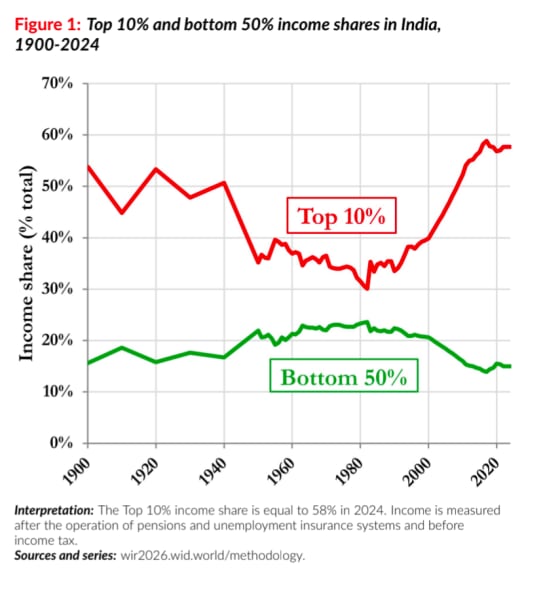
What’s the ongoing story: Income inequality in India remains among the highest in the world, with top 10 per cent of earners capturing 58 per cent of national income, while bottom 50 per cent receive only 15 per cent, according to the latest World Inequality Report 2026, edited by economists Lucas Chancel, Ricardo Gómez-Carrera, Rowaida Moshrif, and Thomas Piketty.
Key Points to Ponder:
— What are the reasons for increasing inequality in India?
— What is the impact of inequality on the social development of the country?
— What are the steps taken by the government to reduce income inequality in the country?
— What is the Gini Coefficient?
— How is inequality measured in India?
Key Takeaways:
— Wealth inequality is even greater in India, with the richest 10 per cent holding around 65 per cent of total wealth and the top 1 per cent holding about 40 per cent, the report released by the World Inequality Lab on Wednesday said.
— As per the earlier World Inequality Report 2022, the top 10 per cent in India held 57 per cent of the total national income while the bottom 50 per cent’s share was 13 per cent in 2021.
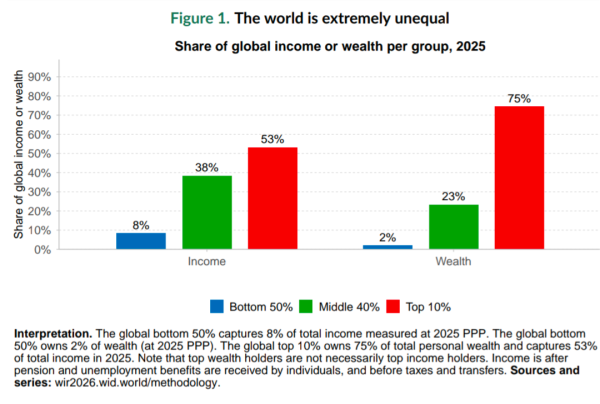
— Globally, wealth has reached historic highs but remains very unevenly distributed, with the top 0.001 per cent, comprising fewer than 60,000 multi-millionaires, owning three times more wealth than the entire bottom half of humanity.
— Their share has grown steadily from almost 4 per cent in 1995 to over 6 per cent today, and comes against the backdrop of the explosion of global inequalities and the weakening of multilateralism, the report said.
— The global top 10 per cent owns three-quarters of all wealth, while the bottom 50 per cent holds just 2 per cent, the report said.
— The top one-in-a-million, collectively hold 3 per cent of global wealth, more than the bottom half of the world’s adult population.
— Providing a geographic breakdown of global income groups in 1980 and 2025, the report said in 1980, the global elite was concentrated in North America & Oceania, Europe. Latin America also had some presence near the top, but China and India were almost entirely confined to the bottom half of the distribution.
— India, the report said, has lost relative ground: in 1980, a larger part of its population was in the middle 40 per cent, but today almost all are in the bottom 50 per cent. Sub-Saharan Africa has also remained in the lower half of the global distribution.
— In gender terms, the pay gap persists across all regions, especially for unpaid labour. Excluding unpaid work, women earn only 61 per cent of what men earn per working hour; and when unpaid labor is included, this figure falls to just 32 per cent.
— he report also highlighted the climate crisis stating that the poorest half of the global population accounts for only 3 per cent of carbon emissions associated with private capital ownership, while the top 10 per cent account for 77 per cent of emissions.
— The wealthiest 1 per cent account for 41 per cent of private capital ownership emissions, almost double the amount of the entire bottom 90 per cent, the report stated.
— Noting that policy can reduce inequality, the report said taxation often fails where it is most needed: at the very top of the distribution with the ultra-rich escaping taxation. Effective income tax rates climb steadily for most of the population but fall sharply for billionaires and centi-millionaires, it said.
— Elites pay proportionally less than most of the households that earn much lower incomes. This regressive pattern deprives states of resources for essential investments in education, healthcare, and climate action,” it said.
Do You Know:
— The Gini Index or Gini coefficient, named after the early 20th century Italian statistician Corrado Gini, has historically been the most commonly used measure of inequality. It measures inequality on a scale from 0 to 1 (or 0% to 100%), with higher values indicating higher inequality.
— The Gini Index, a report by the World Bank, has placed India in the fourth position with a score of 25.5, much lower than countries like China (35.7), the USA (41.8), and the United Kingdom (34.4). It is also more equal than every G7 and G20 country, many of which are considered advanced economies.
— The Gini Index measures the extent to which the distribution of income or consumption among individuals or households within an economy deviates from a perfectly equal distribution. In simpler terms, it provides a clear picture of how evenly income is distributed within a country.
— The index ranges from 0 to 100 — a Gini Index of 0 represents perfect equality, while an index of 100 implies perfect inequality. The higher the Gini Index the more unequal the country.
Other Important Articles Covering the same topic:
UPSC Prelims Practise Question Covering similar theme:
(5) The Gini coefficient is a measure of
(a) Rodent population
(b) Migration rate of Guiness nationals
(c) Income inequality
(d) Ratio of coinage to currency note
Previous year UPSC Mains Question Covering similar theme:
COVID-19 pandemic accelerated class inequalities and poverty in India. Comment. (UPSC CSE 2020)
| ALSO IN NEWS | |
| Key part to be fixed before Dhruvs with Navy, Coast Guard fly again | The Advanced Light Helicopter (ALH) Dhruv fleet of the Indian Coast Guard (ICG) and the Indian Navy will soon receive manufacturing modifications to a key component, senior officials familiar with the developments have told The Indian Express.
These modifications, officials said, will be implemented in batches before the helicopters are delivered to the ICG and the Navy, about six months from now The Dhruv, an indigenously designed and developed ALH, is a twin-engine, multi-role, multi-mission new-generation helicopter in the 5.5 tonne weight class. According to the HAL website, a total of 345 helicopters were produced until June 2024 including 313 for the Indian Armed Forces. The choppers together have clocked over four lakh flying hours. |
| For AI, India can build on the Aadhaar-UPI model | Jayant Sinha writes: India has deployed technology to solve problems at a population scale. We connected hundreds of millions through mobile networks without wiring copper lines. We built Aadhaar and UPI to deliver identity and payments securely to every citizen. These systems were designed in India for India and became the foundation of our digital public infrastructure.
Artificial intelligence now offers a similar opportunity with even higher stakes. AI will change how we learn, work, and make decisions. For India, AI is a leapfrog moment. We already have digital identity, payments, and platforms operating at scale; we can move directly to the intelligence layer, combining our data and green energy to build the world’s most inclusive AI economy. To realise this, three priorities are essential. First, AI systems should be subject to our laws and strategic priorities. The most capable AI systems today are foundation models trained on massive datasets compiled through the interactions of billions of users. Second, we must build out our own green AI infrastructure. Third, every Indian should have a multilingual agent that they control, and that will assist them in this brave new AI world. |
| PRELIMS ANSWER KEY |
| 1. (c) 2. (b) 3. (b) 4. (a) 5. (c) |
Subscribe to our UPSC newsletter. Stay updated with the latest UPSC articles by joining our Telegram channel – IndianExpress UPSC Hub, and follow us on Instagram and X.
🚨 Click Here to read the UPSC Essentials magazine for November 2025. Share your views and suggestions in the comment box or at manas.srivastava@indianexpress.com🚨

Read UPSC Magazine