© IE Online Media Services Pvt Ltd
 26 min read


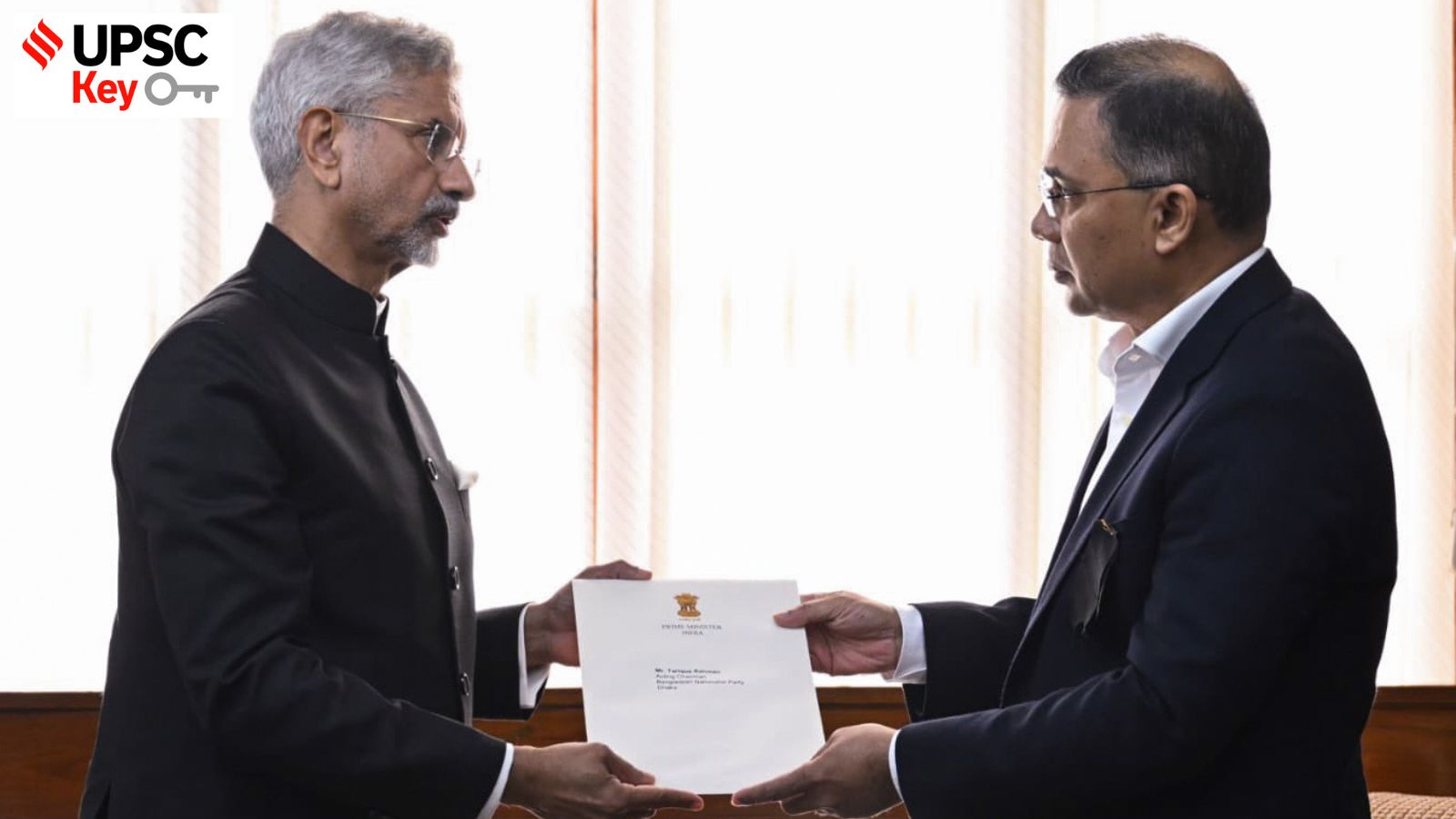 External Affairs Minister S. Jaishankar hands over a personal letter from Prime Minister Narendra Modi to Acting Chairman of Bangladesh Nationalist Party and the son of former Prime Minister of Bangladesh Khaleda Zia, Tarique Rahman, as he conveys condolences of the people and Government of India on her passing, in Dhaka on Wednesday. (@DrSJaishankar/ANI Photo)
 Important topics and their relevance in UPSC CSE exam for December 31, 2025. If you missed the December 30, 2025, UPSC CSE exam key from the Indian Express, read it here.
Syllabus:
Preliminary Examination: Current events of national and international importance
Mains Examination: General Studies-II: India and its neighbourhood- relations, Bilateral, regional and global groupings and agreements involving India and/or affecting India’s interests.
What’s the ongoing story: Bangladesh’s first woman prime minister Khaleda Zia, who played a major role in restoring democracy after a period of tumultuous military rule and dominated the country’s politics for decades, died Tuesday after a prolonged illness. She was 80. External Affairs Minister S Jaishankar will represent India at the funeral of Khaleda Zia in Dhaka on Wednesday.
Key Points to Ponder:
— Read about the history of India-Bangladesh bilateral relations.
— What are the areas of cooperation between India and Bangladesh?
— What are the challenges in India and Bangladesh ties?
— How does the political transition in Bangladesh and its impact on India’s foreign policy underscores the importance of neighbourhood diplomacy?
— What is India’s “neighborhood first” policy?
— Map work: Location of Bangladesh and Indian states sharing boundaries with Bangladesh.
Key Takeaways:
— A three-time prime minister, Zia held the position of chairperson of BNP. Zia’s funeral will be held on Wednesday at Parliament’s South Plaza and the adjoining Manik Mia Avenue, Law Advisor Asif Nazrul said. She will later be laid to rest with full state honours beside the grave of her husband, former president and BNP founder Ziaur Rahman, at Zia Udyan in Shere-Bangla Nagar in Dhaka, Nazrul said after a special meeting of the interim government’s advisory council.
— Jaishankar will represent the government and people of India at the funeral of Khaleda Zia, former prime minister of Bangladesh and chairperson of the Bangladesh Nationalist Party, an official statement said.
Do You Know:
— Khaleda Zia served three terms as Prime Minister — from 1991 to 1996, briefly in 1996, and again from 2001 to 2006. During her first term, her government restored the parliamentary system and expanded access to education, including free primary schooling and free education for girls up to Class 10.
— Her son Tarique Rahman, who is currently the acting chairman of the BNP, returned to Bangladesh last week after 17 years abroad. Her political career was marked by periods of imprisonment, illness and long legal battles, alongside repeated confrontations between the BNP and the ruling Awami League.
— The political turmoil in Bangladesh in 2024 resulted in the ouster of former Prime Minister Sheikh Hasina and the establishment of an interim government led by Nobel laureate Muhammad Yunus. It is considered a significant turning point in Bangladesh’s history and has introduced new dynamics in regional politics. As a neighboring country of India, Bangladesh has always played a crucial role in India’s “neighborhood first” policy.
Other Important Articles Covering the same topic:
📍In history, Khaleda Zia loomed large. So will her shadow over Bangladesh’s future
Previous year UPSC Prelims Question Covering similar theme:
(1) With reference to river Teesta, consider the following statements: (UPSC CSE 2017)
1. The source of river Teesta is the same as that of Brahmaputra but it flows through Sikkim.
2. River Rangeet originates in Sikkim and it is a tributary of river Teesta.
3. River Teesta flows into Bay of Bengal on the border of India and Bangladesh.
Which of the statements given above is/are correct?
(a) 1 and 3 only
(b) 2 only
(c) 2 and 3 only
(d) 1, 2 and 3
Previous year UPSC Mains Question Covering similar theme:
Critically examine the compulsions which prompted India to play a decisive role in the emergence of Bangladesh. (UPSC CSE 2013)
The protests in Shahbag Square in Dhaka in Bangladesh reveal a fundamental split in society between the nationalists and Islamic forces. What is its significance for India? ( UPSC CSE 2013)
Syllabus:
Preliminary Examination: Current events of national and international importance
Mains Examination: General Studies II: Government policies and interventions for development in various sectors and issues arising out of their design and implementation.
What’s the ongoing story: Over a year after the government asked the Union Public Service Commission (UPSC) to withdraw an advertisement for lateral entry to 45 posts, the lateral entry scheme for recruiting experts for government jobs remains in limbo, with the Department of Personnel and Training (DoPT) still in “consultation” with ministries over the scheme.
Key Points to Ponder:
— What is the lateral entry scheme?
— What is the role and function of UPSC?
— How is it different from the role and function of the DoPT?
— What is the issue regarding the reservation in the lateral entry?
— What is ARC’s recommendation on the lateral entry system?
— What are the pros and cons of the lateral entry system?
Key Takeaways:
— The UPSC had on August 17, 2024 advertised 45 lateral entry posts, but just days later, Union Minister of State for Personnel Jitendra Singh on August 20 wrote to the UPSC chairperson asking for the advertisement to be cancelled. This was after the government received backlash, including from BJP’s ally LJP (Ram Vilas) president Chirag Paswan, about the lack of reservations in the lateral entry scheme.
— Asked about the status of the scheme and if lateral entry would be revived in 2026, Singh, at a press conference on Tuesday, chose to refer the question to DoPT Secretary Rachna Shah, saying the secretary would “fill in the gaps”. Shah said about 60 officers had been recruited in three instalments of lateral entry and about 38-40 were still working in various ministries.
— The government had introduced the scheme in 2018 and subsequently hired experts in 2021 and 2023 as well. Under the scheme, domain-specific and technical positions at the level of Joint Secretary, Director and Deputy Secretary were advertised. A total of 63 individuals had been appointed through lateral entry.
Do You Know:
— Lateral entry refers to the practice of recruiting individuals from the private sector for administrative positions within the government, even if they have not been part of the traditional bureaucratic setup.
— Under the lateral entry policy, the government recruits some prominent persons for specific assignments in government, keeping in view their specialized knowledge and expertise in the domain area. Generally, these recruitments are made at the level of joint secretary, director and deputy secretary. The officers at these levels play an important role in policy-making.
— In 2017, NITI Aayog, in its three-year Action Agenda, and the Sectoral Group of Secretaries on Governance in its report submitted in February, recommended the induction of personnel at middle and senior management levels in the central government. These ‘lateral entrants’ would be part of the central secretariat which, till then, had only career bureaucrats from the All India Services/ Central Civil Services. They would be given contracts of three years, extendable to a total term of five years
Other Important Articles Covering the same topic:
📍UPSC Essentials | Expert talk : Is lateral entry a disadvantage for Civil Services?
Previous year UPSC Mains Question Covering similar theme:
“Institutional quality is a crucial driver of economic performance”. In this context suggest reforms in the Civil Service for strengthening democracy. (UPSC CSE 2020)
Syllabus:
Preliminary Examination: Current events of national and international importance.
Mains Examination: General Studies-II, III: Government policies and interventions for development in various sectors and issues arising out of their design and implementation, defence technology.
What’s the ongoing story: Setting its eyes on the civil aviation sector, Hindustan Aeronautics Limited (HAL) completed the inaugural flight of the Dhruv New Generation helicopter on Tuesday.
Key Points to Ponder:
— Read about the Dhruv-NG helicopters.
— What is the significance of procurement of CQB Carbines significant for the Indian Armed Forces?
— Read about the Kalvari-class (P-75) submarines.
— What are the key issues and challenges with India’s defence sector?
— How does defence indigenisation contribute to strategic autonomy?
— What does India’s rising defence expenditure reveal about its strategic priorities?
— What are the recent steps taken by the Ministry of Defence to streamline procurement timelines?
Key Takeaways:
— During an event held to mark the feat, HAL received certification from the Directorate General of Civil Aviation (DGCA) for the “indigenous manufacturing of the Shakti civil engine”, paving the way for the certification of the helicopter before its commercial release.
— Speaking at a news conference following the event, HAL Chairman and Managing Director D K Sunil said the helicopter could carry 14 passengers and offer various services, such as VIP movement, heli-tourism, and medical ambulances.
— Although the helicopter is yet to receive complete certification from the DGCA, Sunil said that HAL had received orders for eight Dhruv-NG helicopters from the state-run Pawan Hans Helicopter Limited. “These will be used to transport men and materials to Bombay High (an oil field run by ONGC off the coast of Maharashtra),” he said.
— Over the next two months, HAL will complete around 150 flights in two Dhruv helicopters to complete certification for the whole aircraft,” Sunil said.
— The Defence Ministry Tuesday signed contracts for the procurement of 4.25 lakh Close Quarter Battle (CQB) Carbines and 48 heavyweight torpedoes worth Rs 4,666 crore.
— The massive order for the forces comes ahead of the Union Budget for the next fiscal. In FY 2025-26, the Defence Ministry has signed capital contracts amounting to Rs 1,82,492 crore.
— The contract for over 4.25 lakh CQB Carbine along with accessories, worth Rs 2,770 crore, for Indian Army and Navy was signed with Bharat Forge Ltd and PLR Systems Pvt Ltd.
— The contract for procurement and integration of 48 heavyweight torpedoes, along with associated equipment for Kalvari-class submarines of the Navy at an approximate cost of Rs 1,896 crore, was signed with WASS Submarine Systems SRL, Italy.
— According to Defence Ministry, the long-due deal signed to procure CQB Carbines will equip soldiers with “world-class lethality, replacing legacy systems with cutting-edge indigenous technology under the ‘Atmanirbhar Bharat’ vision.
— The acquisition and integration of torpedoes along with associated equipment for Kalvari-class Submarines (P-75) of the Navy will enhance combat capability of six submarines, the Ministry said, adding that delivery will start from April 2028 and will be completed by early 2030.
— “As a cornerstone of the modern infantry arsenal, the CQB Carbine provides a critical edge in close combat through its compact design and high rate of fire, ensuring rapid, decisive lethality in confined spaces,” the Ministry said in a statement.
It added that the contract highlights the synergy between the government and the private sector, which will give impetus to the Make-in-India initiative.
Other Important Articles Covering the same topic:
📍How India’s defence spending is aligned with its regional ambition
📍Military hardware worth Rs 79,000 crore gets govt nod
Syllabus:
Preliminary Examination: General Science.
Mains Examination: General Studies-III: Science and Technology- developments and their applications and effects in everyday life.
What’s the ongoing story: J Bharathi Kannan and M S Santhanam writes- “Almost 100 years ago, in June 1925, the young German scientist Werner Heisenberg went to Helgoland, an island off Germany, to recover from his nagging hay fever. While recovering in solitude, he was also thinking about a question that had been bothering him: How to construct a coherent framework to understand the microscopic world of atoms? His research in the serene Helgoland laid the foundations for quantum physics, one of the most successful scientific theories in human history, which also shapes the emerging technologies.”
Key Points to Ponder:
— What is quantum physics?
— What was Satyendra Nath Bose’s contribution to quantum science?
— Read about the National Quantum Mission.
— How has quantum physics influenced modern technologies?
— What emerging technologies are based on quantum principles?
Key Takeaways:
— “Quantum physics is counterintuitive. In the words of American physicist Richard Feynman, “no one understands it”. Yet, surprisingly, it has touched every aspect of our lives. From nuclear power to semiconductors, computers, electronics, lasers, and medical diagnostic tools such as MRI scanners, all have emerged from the principles of quantum physics. Commemorating these achievements, the United Nations had declared 2025 as the Year of Quantum Science and Technology.”
— “The emerging quantum technologies hold promise for precise atomic clocks, navigation systems, quantum computers for solving certain classes of hard problems, high-resolution sensors, and secure messaging and banking transactions. They represent a market worth $1-2 billion today, though back in the 1920s, it was an emerging and poorly understood science.”
— “Heisenberg stood on the shoulders of many others who had laid out the quantum jigsaw pieces, but failed to assemble it. In 1900, Max Planck was attempting to describe the light emerging from hot objects. Having spent many unsuccessful years in this pursuit, “out of sheer desperation” rather than any rational logic, he postulated that light must be radiated in packets or quanta, like bullets coming out of a gun. This unusual idea that none, including Planck, believed in at that time was, however, successful in describing thermal radiation.”
— “In 1905, Albert Einstein picked it up to explain the photoelectric effect. In 1913, Niels Bohr applied it to decode the hydrogen atom. All these were quick-fix solutions without a coherent story. In Helgoland, Heisenberg was trying to weave these pieces together into one cohesive framework.”
— “Throughout the 1920s, many other scientists were working to decode the quantum puzzle. In 1924, French physicist Louis de Broglie proposed in his doctoral thesis that material particles, such as electrons and protons, can behave like waves. This was so radical that his doctoral committee remained unconvinced, but finally yielded when Einstein stated that deBroglie had “lifted a corner of the great veil”. Building on this picture, in 1925, the Austrian physicist Erwin Schrödinger developed a wave equation that now bears his name. This landmark equation made it easier to apply quantum principles to subatomic particles and even the whole universe.”
— “In 1924, Satyendra Nath Bose, then working in Calcutta, wrote to Einstein about his method of counting photons. Einstein recognised the novelty and expanded its scope leading to the prediction of a new state of matter, the Bose–Einstein condensate, which was observed decades later.”
— “C V Raman’s experiments with light in 1929 provided direct evidence of quantum effects in light-matter interactions, earning him the 1930 Nobel Prize. By 1927, as Paul Dirac declared, quantum physics was a “complete theory of dynamics”. There has been no looking back since. Thanks to these developments, semiconductors emerged in the 1950s, lasers in the 1960s, high-density hard disks in the 1990s, and sensing devices in the 2000s. This is a story of how investment in basic sciences returns dividends for over a century. The governments must resist the urge to cut funds for basic research.”
— “One century after the Helgoland breakthrough, quantum principles have also entered popular culture through the mythical Schrödinger cat, which can be alive and dead at the same time. It overthrew the foundational ideas of Newton’s laws and transformed our perception of the universe. So profound was this change that every reigning doctrine — from communism and Buddhism to Vedanta — took positions on what quantum science means for its worldview. In 1925, Heisenberg may not have anticipated this impact on technology and life that continues to unfold to this day.”
Do You Know:
— In order to develop capabilities in quantum-related science and technology, India announced the setting up of the National Quantum Mission in 2023. It focuses on four key domains or verticals, i.e. Quantum Computing, Quantum Communication, Quantum Sensing & Metrology, and Quantum Materials & Devices.
— The Mission has an outlay of Rs 6,003.65 crore, which will be used to fund the scientific and industrial research projects for eight years (2023-2031). It includes the establishment of four thematic hubs (T-Hubs) dedicated to the four domains or verticals. Each vertical will have its own goals and challenges. Before exploring each vertical, let us first understand what is quantum technology.
Other Important Articles Covering the same topic:
📍National Quantum Mission: How does India seek to harness the potential of quantum technology
Syllabus:
Preliminary Examination: Current events of national and international importance
Mains Examination: General Studies-II: Government policies and interventions for development in various sectors and issues arising out of their design and implementation
What’s the ongoing story: N.K. Singh and Nicholas Stern wrote: This year’s defining story could be the requiem of the post-Cold War order. Not through a single collapse but through a thousand cuts. The leadership change in Washington supercharged great-power rivalries. As the ghost of mercantilism displaced multilateralism, India held on to its faith in a multilateral rules-based order and national interest as the compass of independent foreign policy.
Key Points to Ponder:
— What do you understand about multilateral rules-based order?
— What is mercantilism?
— What is the significance of multilateralism? Name some international organisations that are multilateral.
— What are the major FTAs signed by India this year?
— What is de-dollarisation?
— What is India’s youth bulge?
— What are the major challenges facing the Indian economy?
Key Takeaways:
— Tariffs surged from a universal 10 per cent rate to country-specific duties of up to 50 per cent. We responded by pursuing FTAs with vigour, harnessing trade as an engine of growth. Allowing an orderly recalibration of exchange rates could mitigate loss of competitiveness.
— Money, too, became overtly political. Parts of the Global South sought to reduce dependence on the dollar. China’s reduction of US Treasury holdings to its lowest in 17 years was more than symbolic. BRICS advanced de-dollarisation as financial sovereignty acquired centre-stage.
— War cast a long shadow, as Ukraine, Gaza and Sudan displaced over 12 million people. India pursued cautious diplomacy: Prime Minister Narendra Modi crafted diplomacy to say India is “on the side of peace” in Ukraine, engaged with Moscow, called for a Gaza ceasefire, sent humanitarian aid, and espoused a two-state solution, while condemning terrorism in multiple forms and the loss of innocent lives.
— Climate is existential, beyond fiscal, financial and development issues. Insured losses hit $145 billion in 2025 and could exceed $300 billion in the future.
— That was the year we leave behind. A year of contradictions, uncertainty and incoherence. What should guide us into 2026?
— First, we must accept that the era of grand global designs may be over. Coalitions will be ad hoc, agreements partial and temporary. For India, strategic navigation in a fragmented world demands flexibility, adaptability and resilience.
— Second, the axis of global debate is shifting from democracy and development to, equally, demography and development. By 2030, one in six people globally will be aged over 60. These seismic changes necessitate a new global compact.
— Migration is and will be a compelling issue. Demographic shifts given ageing differentials and the promotion of human welfare through productivity will be challenging in preserving the cultural ethos of sovereign nations.
— India’s youth bulge must become a source of strength rather than a liability. This is true both among and within nations. Some states have shown the way through greater appetite for labour mobility and partnerships with ageing economies.
— Third, we should expect a world neither at war nor at peace. An unreformed United Nations, especially its Security Council, is effectively emasculated. The G20 is significant but not representative.
— India must continue its multi-alignment strategy. It should diversify defence acquisitions to enhance deterrence without compromising strategic autonomy.
— Fourth, bond markets will discipline advanced economies with shrinking fiscal space. Deeper cooperation among central bankers, possibly through a broadened Basel forum, could propose a credible, consensus-based path for reducing global debt.
— Fifth, technology will inspire both hope and anxiety. With global AI funding reaching $120 billion in Q3, India must seize this wave by scaling up investment in AI and quantum computing R&D.
— Sixth, India should align climate action with growth, through electrification, accelerating renewables, electric vehicles, and green hydrogen. Leading the International Solar Alliance can help countries of the South, including India, garner large productivity-enhancing investments in select renewable technology and human capital. This will mainstream climate strategy.
— The way forward lies in sustaining macroeconomic stability. We must harness our extraordinary entrepreneurship by freeing land, labour, and capital through Centre-led reforms across states. Leveraging the multiplier effects of global capability centres (GCCs) is key.
Do You Know:
— In international relations, multilateralism is commonly used for any form of cooperation among states. The idea gained traction after WWI and was central to the formation of the League of Nations (1920) and the United Nations (1945).
— Thus, multilateralism constitutes a core element of the Liberal International Order or rules-based international order premised on liberal values like democracy, open market and shared rules. It stands in contrast to the realist tradition, where international order is defined as anarchic.
— The growing integration of the world that followed the end of the Cold War sparked renewed interest in multilateralism. As a result, countries turned to international cooperation through multilateral institutions to address global economic and political issues, such as trade, investment, climate change, conflicts, migration, etc.
Other Important Articles Covering the same topic:
📍Shashi Tharoor writes: Multilateralism isn’t dead
📍Beyond Trending: What is Multilateralism?
Previous year UPSC Prelims Question Covering similar theme:
(2) With reference to the United Nations General Assembly, consider the following statements: (UPSC CSE 2022)
1. The UN General Assembly can grant observer status to non-member States.
2. Inter-governmental organisations can seek observer status in the UN General Assembly.
3. Permanent Observers in the UN General Assembly can maintain missions at the UN headquarters.
Which of the statements given above are correct?
(a) 1 and 2 only
(b) 2 and 3 only
(c) 1 and 3 only
(d) 1, 2 and 3
Previous year UPSC Mains Question Covering similar theme:
Critically examine the role of WHO in providing global health security during the COVID-19 pandemic. (UPSC CSE 2020)
Syllabus:
Preliminary Examination: Current events of national and international importance
Mains Examination: General Studies-III: Conservation, environmental pollution and degradation, environmental impact assessment
What’s the ongoing story: A significant portion of the fine particulate matter that Delhi residents breathe is not emitted directly, but created in the atmosphere itself.
Key Points to Ponder:
— What are the major causes of air pollution?
— What are secondary pollutants?
— What is the impact of Secondary particulate matter on human health?
— What are the major sources of SO2?
— What are the flue gas desulphurisation (FGD) systems?
— How does FGD reduce SO2?
— What is the rationale given by the government to scale back its 2015 mandate requiring coal-based thermal plants to install FGD devices?
Key Takeaways:
— Secondary aerosols now contribute at least one-third of the city’s annual PM2.5 pollution, intensifying exposure during prolonged smog spells and helping explain why air quality can deteriorate sharply even when local sources appear under control.
— Primary pollutants emerge directly from factors such as road dust resuspension, construction activity, open burning, vehicle exhaust and industries. Secondary particulate matter, on the other hand, forms after gases are released into the air.
— These gases, known as precursor pollutants, undergo chemical reactions influenced by humidity, temperature and sunlight. They eventually form microscopic particles that penetrate deep into the lungs.
— Among the most dominant of these pollutants in Delhi is ammonium sulfate, a secondary inorganic aerosol. According to an analysis released earlier this month by the Centre for Research on Energy and Clean Air (CREA), ammonium sulfate alone accounts for nearly one-third of Delhi’s annual PM2.5 load, rising sharply during the post-monsoon winter months when pollution episodes are at their worst.
— The SO₂ gets oxidised in the atmosphere to form sulfate. This sulfate then reacts with ammonia, which is released mainly from agricultural activities, such as fertilizer use, livestock waste, sewage systems, landfills, biomass burning, diesel vehicles equipped with catalytic converters and certain industrial processes.
— The resulting compound becomes suspended in the air as fine particulate matter. It remains airborne for days, travelling long distances and contributing to transboundary pollution.
— India is currently the world’s largest emitter of SO₂, largely due to coal-based power generation. In July 2025, the government exempted nearly 78% of coal-fired thermal power plants from installing flue gas desulphurisation (FGD) systems, weakening SO₂ control at the source.
— For Delhi-NCR, this has direct implications. Secondary aerosols formed from emissions hundreds of kilometres away can combine in the atmosphere and significantly affect the capital’s air.
— Humidity plays a critical role in this process. Moist air, fog and low winter temperatures accelerate chemical reactions, allowing gases to transform into particles within hours. This explains why Delhi’s pollution often worsens during stagnant winter conditions, even without a proportional rise in visible emissions.
— Atmospheric studies from Beijing have shown how concentrations of sulfate, nitrate and ammonium can multiply several-fold during heavy pollution episodes.
— A recent analysis by Centre for Science and Environment, a Delhi-based think tank, found that NOx spiked alongside rising PM2.5 levels during peak traffic hours in Delhi, with NOx displaying a sharper and more immediate surge tied to vehicular emissions.
Do You Know:
— A significant portion of the world’s electricity continues to be generated from coal. In India, coal accounts for more than 70 per cent of electricity generation. Although India has one of the lowest electricity tariffs in the world, its per capita electricity consumption remains low.
— Sulphur, a non-metal in Group 16 of the periodic table, forms acidic oxides, most notably sulphur dioxide (SO₂), which is a major air pollutant emitted mainly from coal-fired power plants. SO₂ contributes to acid smog, acid rain, and secondary aerosols.
— In the US, SO₂ is listed as a criteria pollutant under the Clean Air Act and is regulated by the Environmental Protection Agency (EPA). In India, the Air (Prevention and Control of Pollution) Act, 1981, sets the annual average SO₂ limit of 50 µg/m³ for residential/industrial areas, and 20 µg/m³ for ecologically sensitive zones. The 24-hour average limit is 80 µg/m³ for both.
— Coal contains 0.5–6 per cent sulphur, present as organic sulphur (bound to carbon) and inorganic sulphur (mainly iron pyrites, FeS₂). Notably, inorganic sulphur can be partially removed through washing and pulverising. Besides coal, other significant sources of SO₂ include petroleum refining, copper smelting, and cement production.
Other Important Articles Covering the same topic:
📍Why concerns about SO₂ emissions, a major air pollutant, keep recurring
Previous year UPSC Prelims Question Covering similar theme:
(3) Consider the following statements: (UPSC CSE 2020)
1. Coal ash contains arsenic, lead and mercury.
2. Coal-fired power plants release sulphur dioxide and oxides of nitrogen into the environment.
3. High ash content is observed in Indian coal.
Which of the statements given above is/are correct?
(a) 1 only
(b) 2 and 3 only
(c) 3 only
(d) 1, 2 and 3
| PRELIMS ANSWER KEY |
| 1. (b) 2. (d) 3. (d) |
Subscribe to our UPSC newsletter. Stay updated with the latest UPSC articles by joining our Telegram channel – IndianExpress UPSC Hub, and follow us on Instagram and X.
🚨 Click Here to read the UPSC Essentials magazine for December 2025. Share your views and suggestions in the comment box or at manas.srivastava@indianexpress.com🚨

Read UPSC Magazine